
HACCP Certification plays an important role in helping food businesses manage food safety risks and demonstrate a structured approach to protecting consumers.
Quick Overview
HACCP Certification helps food businesses and individuals understand how to identify, control, and prevent food safety hazards using the internationally recognised Hazard Analysis and Critical Control Point (HACCP) approach.
This guide covers:
✅ What HACCP Certification is and why it is important for food businesses operating in the UK food industry
✅ The difference between HACCP training certificates, regulated HACCP qualifications and third-party business certification
✅ Why HACCP Certification is important for legal compliance, food safety management and customer confidence
✅ Who needs HACCP Certification, including food handlers, supervisors, managers, quality teams and business operators
✅ Different HACCP training levels, including Level 2, Level 3 and Level 4, and how to choose the right course
✅ How HACCP Certification supports hazard control, monitoring procedures, corrective actions and continuous improvement within food businesses
Food businesses carry a responsibility that extends far beyond preparing products customers enjoy. They must prevent food from becoming unsafe through contamination, inadequate temperature control, undeclared allergens, poor hygiene, or failures within production and storage.
Hazard Analysis and Critical Control Point (HACCP) provides a structured method for managing these risks. It is a preventive food safety system that identifies where hazards may occur, establishes effective control measures, and defines the actions employees must take if a process moves outside safe limits.
This is why HACCP Certification has become increasingly relevant for restaurants, cafés, caterers, manufacturers, retailers, and hospitality businesses across the UK. Appropriate training can help employees recognise food safety hazards, support managers responsible for maintaining HACCP-based food safety systems, and provide evidence of ongoing professional development.
However, HACCP terminology is often used imprecisely. An employee’s course completion certificate is not the same as a regulated HACCP qualification. Likewise, neither automatically means that an employer’s premises or its entire food safety management system has been independently certified.
This guide explains what HACCP Certification means, how it relates to UK food law, who may need HACCP training, which course level may be appropriate, and the typical costs associated with different certification routes.
What Is HACCP Certification?
HACCP Certification is a term commonly used to describe training, qualifications, or third-party certification relating to the Hazard Analysis and Critical Control Point (HACCP) system. Understanding what the term means is important because different types of HACCP certification serve different purposes.
HACCP stands for Hazard Analysis and Critical Control Point. It is an internationally recognised approach to identifying, evaluating, and controlling significant food safety hazards.
Rather than relying primarily on testing or inspections after food has been produced, HACCP focuses on preventing hazards throughout the production process. A food business considers what could go wrong during purchasing, delivery, storage, preparation, cooking, cooling, packaging, transport, and service.
The system addresses several categories of food safety hazards.
Biological hazards include harmful bacteria, viruses, parasites, and moulds. Chemical hazards may arise from cleaning products, pesticides, excessive additives, or naturally occurring toxins. Physical hazards include glass, metal, stones, plastic, and other foreign objects. Allergen hazards can occur when allergenic ingredients are omitted from food information or unintentionally transferred between products through cross-contamination.
HACCP helps a food business determine which hazards are significant, where control is essential, and how those controls should be monitored and reviewed.
The Seven HACCP Principles
The Codex HACCP framework is based on seven internationally recognised principles:
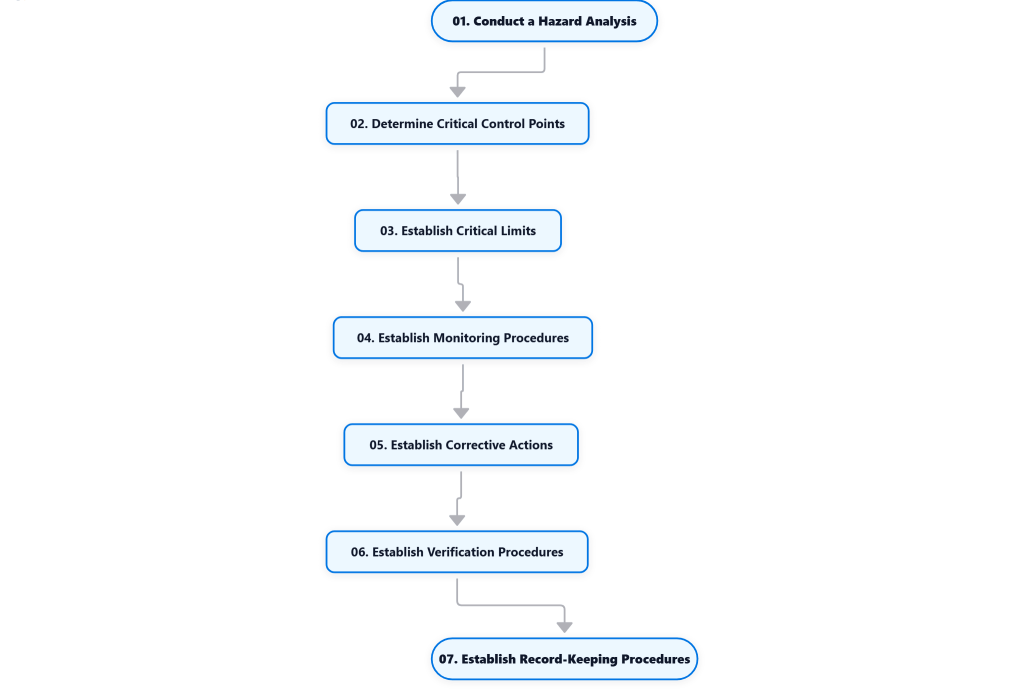
- Conduct a hazard analysis.
- Determine the critical control points.
- Establish validated critical limits.
- Establish procedures for monitoring critical control points.
- Establish corrective actions when control is lost.
- Establish procedures for validating and verifying the system.
- Maintain appropriate documentation and records.
These principles work together as an integrated food safety management system rather than as separate administrative exercises.
A hazard analysis identifies what could make food unsafe and evaluates the likelihood and severity of each hazard. Critical control points are stages where control is essential to prevent, eliminate, or reduce a significant hazard to an acceptable level.
A critical limit defines the boundary between acceptable and unacceptable operation. Monitoring confirms whether the process remains within those limits, while corrective actions specify what must happen if monitoring identifies a loss of control.
Verification then confirms that the HACCP system is operating as intended. Documentation and records provide evidence of decisions, monitoring activities, corrective actions, validation, verification, and ongoing review.
HACCP Principles and HACCP Certification Are Not the Same
A food business can implement HACCP principles without obtaining commercial third-party HACCP Certification for its entire operation.
For many smaller caterers and retailers, the priority is maintaining a suitable HACCP-based food safety management system. In the UK, this may be developed using official resources such as Safer Food, Better Business in England or the equivalent guidance provided by other UK nations. As a result, HACCP certification UK can refer to several different forms of certification depending on the context.
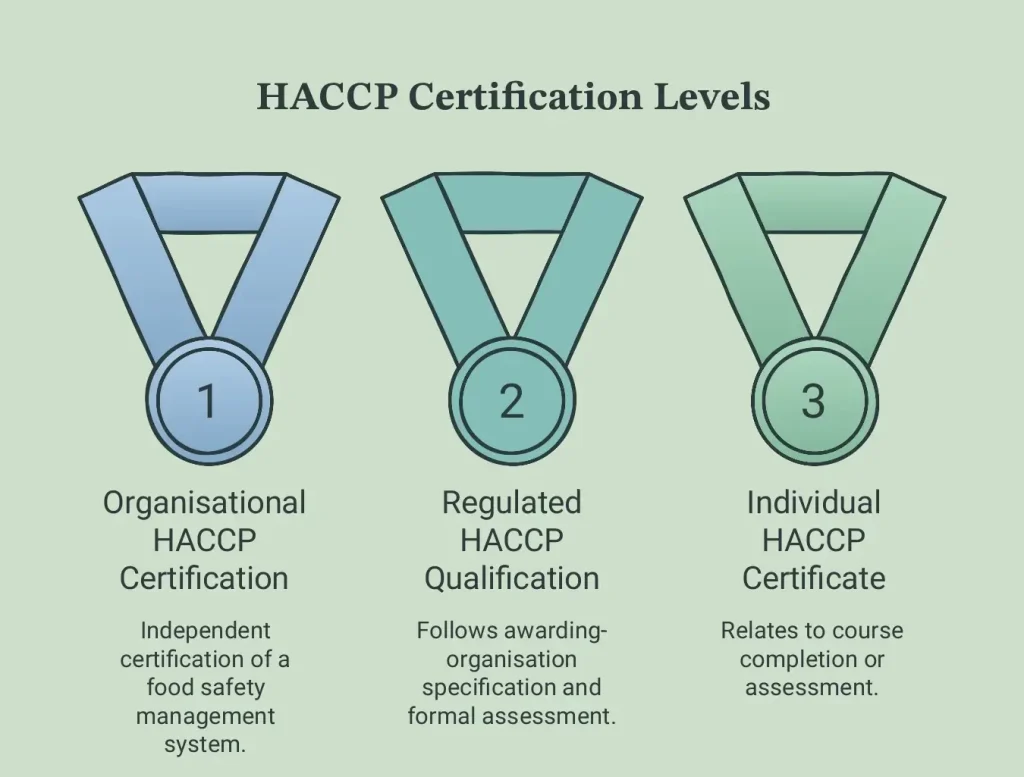
Organisational certification is a separate process. An independent certification body may audit a food safety management system against a recognised scheme or standard. This can include reviewing documentation, inspecting the premises, interviewing employees, identifying non-conformities, and carrying out ongoing surveillance audits.
An individual HACCP certificate usually confirms that a learner has successfully completed a training course or passed its assessment. It does not certify the premises, production processes, or the employer’s food safety management system.
A regulated HACCP qualification is different again. It normally follows a specification developed by an awarding organisation and includes formal assessment alongside external quality assurance.
These distinctions are important whenever a person or business states that it is HACCP certified. Employers, customers, and learners should consider the following questions:
- Who or what has been certified?
- Which course, qualification, certification scheme, or standard was used?
- Was there a formal assessment or an independent external audit?
- Is the certificate current and independently verifiable?
- Does it meet the relevant employer, customer, or regulatory requirement?
A broad statement such as “fully HACCP certified” may create an inaccurate impression if it refers only to one employee completing a short awareness course.
Why Businesses Obtain HACCP Certification
Businesses pursue HACCP Certification and HACCP-related training for a variety of reasons.
Business owners may wish to strengthen their understanding before opening a restaurant, café, or catering company. Managers may need to develop, implement, or review a HACCP-based food safety management system. Manufacturers often require trained HACCP team members, while commercial customers may expect suppliers to hold recognised organisational certification as part of supplier approval processes.
An individual HACCP certificate can provide evidence that an employee has completed structured training. A regulated HACCP qualification may offer stronger formal recognition for specific job roles. Organisational HACCP certification can help businesses demonstrate effective food safety management, strengthen supplier assurance, and support access to more demanding commercial contracts.
Ultimately, certification has the greatest value when it reflects genuine day-to-day food safety practices. No certificate can compensate for an inadequate hazard analysis, incomplete monitoring records, or employees who fail to follow established food safety controls.
Why HACCP Certification Matters in the UK
HACCP Certification is relevant because HACCP is not merely an optional management technique used by large manufacturers. Procedures based on HACCP principles form part of the legal food safety framework that applies to UK food businesses and underpin effective HACCP food hygiene practices.
The depth of a HACCP Certification system and its documentation should be proportionate to the business. A small café preparing a limited menu may use a relatively straightforward system, whereas a manufacturer producing several high-risk foods for national distribution will generally require more detailed technical controls. Appropriate HACCP training helps businesses implement controls that reflect their operations.
UK Food Safety Regulations
HACCP Certification is closely linked to UK food safety legislation. Article 5 of Regulation (EC) No. 852/2004 requires food business operators to put in place, implement, and maintain permanent procedures based on HACCP principles. The system must also be reviewed whenever products, processes, or operational stages change.

Within HACCP UK requirements, domestic legislation supports enforcement across the separate UK jurisdictions. In England, this includes the Food Safety and Hygiene (England) Regulations 2013. Scotland, Wales, and Northern Ireland each have their own associated regulatory and enforcement arrangements.
The HACCP Certification framework operates alongside wider food legislation. The Food Safety Act 1990 remains central to food law in Great Britain, while Northern Ireland has separate primary legislation, including the Food Safety (Northern Ireland) Order 1991.
Businesses should therefore exercise care when reading general HACCP UK guidance. The broad legal requirement to control food safety through HACCP-based procedures applies widely, but detailed legislation, official guidance, and food hygiene rating arrangements differ between the UK nations.
The Role of the Food Standards Agency
HACCP Certification supports the implementation of effective food safety management systems, but businesses should also follow official guidance. The Food Standards Agency (FSA) is responsible for food safety and hygiene in England, Wales, and Northern Ireland, while Food Standards Scotland performs a corresponding role in Scotland.
The FSA explains that a food safety management system is a documented collection of procedures, checks, rules, and records designed to ensure food remains safe. This guidance supports HACCP food hygiene by covering areas such as cleaning, cooking, chilled storage, allergen management, staff training, and temperature monitoring.
Official guidance also supports HACCP Certification by providing practical resources for businesses. Safer Food, Better Business is designed to help many smaller food businesses comply with hygiene requirements, support HACCP training, and demonstrate safe working practices. Scotland provides equivalent resources, including CookSafe and RetailSafe.
Although these official packs provide an excellent starting point for HACCP Certification, businesses should adapt their food safety management system to reflect their actual premises, menu, equipment, and processes. A copied document that does not represent day-to-day operations is unlikely to provide effective food safety controls.
Consumer Expectations
HACCP Certification can support consumer confidence because customers expect businesses to manage food hygiene consistently, even if they are unfamiliar with the technical principles of HACCP.
Food hygiene ratings make part of that performance visible. In England, Wales, and Northern Ireland, the Food Hygiene Rating Scheme generally uses a scale from 0 to 5. A rating of 5 indicates that hygiene standards were very good at the time of inspection, while a rating of 0 indicates that urgent improvement was necessary. Although completing a HACCP course may strengthen staff knowledge, inspection outcomes depend on how food safety is managed in practice.
In Scotland, the Food Hygiene Information Scheme normally records outcomes such as Pass or Improvement Required. HACCP Certification can support documented food safety procedures, but businesses are assessed against their actual compliance with food hygiene requirements.
Customers can search these results before deciding where to eat or purchase food. In Wales and Northern Ireland, businesses are generally required to display their current food hygiene rating, whereas display remains voluntary in England. HACCP Certification may strengthen confidence, but it does not replace good inspection outcomes.
Training, documented procedures, and HACCP Certification can all support confidence in food safety management. However, long-term customer trust ultimately depends on consistent hygiene standards, effective food safety practices, and accurate information rather than the existence of certificates alone.
Industry Requirements
HACCP Certification may also be required to satisfy commercial or contractual expectations that go beyond the general legal minimum.
A large retailer may require manufacturers to hold certification against a recognised food safety scheme. A public-sector catering contract may request evidence of employee HACCP training, documented HACCP procedures, inspection performance, or completion of an appropriate HACCP course.
Hotels, restaurant groups, wholesalers, and other commercial buyers may also conduct supplier assessments. Alongside HACCP Certification, they may evaluate allergen controls, traceability, product specifications, recall procedures, and staff competence before approving a supplier.
Businesses seeking these opportunities should review the exact contractual requirements. A general online course may provide valuable knowledge, but it may not satisfy a tender requiring a regulated qualification or independently audited organisational certification. Businesses comparing providers should also consider factors such as HACCP certification online options, course content, accreditation, and HACCP certification cost, rather than choosing solely on price.
Why You Need HACCP Certification
Why you need HACCP Certification in UK food businesses is often answered too simply. The law does not require every worker to obtain the same certificate, but appropriate HACCP Certification, knowledge, and evidence can support several essential business objectives. Why is HACCP Certification important? It helps businesses implement effective food safety controls, support legal compliance, and demonstrate that employees have received appropriate training for their responsibilities.
Legal Compliance
One of the main reasons for HACCP Certification is to understand and implement legal responsibilities. Who needs HACCP Certification? The answer depends on an individual’s role. Food business operators must maintain procedures based on HACCP principles. Food handlers must receive supervision, instruction, or training appropriate to their work, while those responsible for developing and maintaining HACCP-based procedures require suitable HACCP training.
A well-designed HACCP Certification course can explain how these legal requirements translate into day-to-day practice. Managers can learn how to develop process flow diagrams, identify food safety hazards, establish effective controls, and determine which records should be maintained.
Employees completing HACCP Certification training can better understand why they must follow specific temperature controls, cleaning procedures, separation methods, and allergen controls. Understanding the purpose behind each control can improve consistency and help employees recognise when something has gone wrong.
HACCP Certification training is only one part of legal compliance. A food business must apply what it has learned to its own premises, products, processes, and working practices to meet its legal obligations.
Due Diligence Protection
HACCP Certification can support a business’s food safety management system, but it does not guarantee a legal defence. Section 21 of the Food Safety Act 1990 provides a due diligence defence for certain offences where the person charged proves that all reasonable precautions were taken and all due diligence was exercised to avoid the offence.
An individual HACCP Certification or HACCP certificate does not automatically establish this defence. A court would consider the precautions actually taken and the evidence available to support those actions.
Evidence supporting HACCP Certification may include supplier approval records, cleaning schedules, cooking and chilling records, allergen controls, employee training records, maintenance logs, and corrective action reports.
A documented HACCP system supported by HACCP Certification helps responsible employees understand what should be monitored and why accurate records are essential for effective food safety management.
The outcome of any legal proceedings will always depend on the facts of the case. For that reason, providers should avoid suggesting that HACCP Certification alone guarantees a successful due diligence defence.
Improved FSA Food Hygiene Ratings
HACCP Certification can contribute to stronger food hygiene management, which may support improved Food Hygiene Rating Scheme outcomes.
Under the Food Hygiene Rating Scheme, the inspecting officer considers three key areas:
- How hygienically food is handled.
- The physical condition and cleanliness of the premises.
- How food safety is managed and whether standards are likely to be maintained.
The management element includes documented systems, food safety procedures, and employee training. A suitable HACCP plan supported by HACCP Certification, accurate records, and knowledgeable employees can therefore increase an inspecting officer’s confidence in the business’s ability to maintain food safety standards.
However, HACCP Certification does not guarantee a food hygiene rating of 5. Inspecting officers assess the actual conditions and practices observed during the inspection. A certificate cannot compensate for pest activity, cross-contamination, unsafe food storage, poorly maintained equipment, or inadequate premises.
Where a business receives a lower rating, the inspecting officer will normally explain the improvements required. After addressing those issues, the operator may, subject to the relevant scheme rules, request a re-rating inspection. HACCP Certification can support these improvements when it is applied effectively in day-to-day operations.
Prevention of Foodborne Illness
Why you need HACCP Certification for food safety is best understood through its preventive approach. HACCP Certification helps businesses identify, assess, and control significant food safety hazards before they result in unsafe food or foodborne illness.
Foodborne illness can result from pathogenic microorganisms, toxins, allergens, and other contaminants. Some people, including young children, older adults, pregnant women, and individuals with certain health conditions, may be particularly vulnerable.
As part of HACCP Certification, businesses learn to identify where significant hazards may arise before an incident occurs.

A catering operation may control bacterial survival through validated cooking and reheating temperatures. A manufacturer may manage contamination through supplier approval procedures, validated heat treatment, or metal detection. Allergen controls may include ingredient segregation, validated cleaning procedures, and label verification. HACCP Certification helps businesses understand how these controls should be implemented and monitored.
Monitoring determines whether each control remains effective, while corrective actions define what happens to affected food and how the process is returned to a safe condition. HACCP Certification reinforces the importance of documenting these activities.
This preventive approach supported by HACCP Certification is far more reliable than assuming unsafe food will always look, smell, or taste different.
Access to More Commercial Opportunities
HACCP Certification can help businesses access contracts and supply chains with higher food safety expectations.
A corporate client may ask a catering company to provide employee HACCP Certification records alongside recent food hygiene inspection results. Retailers may require manufacturers to hold certification against recognised food safety standards.
Businesses may also need to demonstrate that employees responsible for supervisory, technical, or quality assurance duties possess appropriate knowledge supported by HACCP Certification.
For individuals, a relevant HACCP qualification or HACCP Certification can strengthen applications for roles such as:
- Catering supervisor
- Kitchen manager
- Quality assurance assistant
- Food production supervisor
- Technical or compliance assistant
- Food safety coordinator
Although HACCP Certification does not guarantee employment or promotion, it can demonstrate that an applicant understands a recognised food safety framework widely used throughout the food industry.
Stronger Business Reputation and Customer Trust
HACCP Certification can strengthen customer confidence when it reflects genuine food safety practices rather than simply serving as a marketing claim.
A documented HACCP system supported by HACCP Certification demonstrates that a business has identified its hazards and established procedures to manage them effectively. Trained employees are also more likely to explain food safety controls confidently during inspections, customer audits, or supplier assessments.
Visible HACCP Certification and employee training records can reassure commercial buyers that the business is investing in staff competence and maintaining appropriate food safety standards.
Marketing claims should always remain accurate. If only selected employees have completed HACCP Certification, the business should not describe its entire operation as independently HACCP certified unless this has been verified through an appropriate third-party certification process.
Accurate statements are usually more credible than broad claims. Explaining that managers have completed advanced HACCP Certification training and that the business operates documented HACCP-based procedures provides clearer and more reliable information.
Reduced Operational Costs
HACCP Certification supports preventive food safety management by helping businesses identify failures before they become more serious and costly.
Temperature monitoring may reveal that refrigeration equipment is no longer maintaining safe conditions. Supplier approval checks may prevent unsuitable ingredients from entering production. Label verification procedures may identify an undeclared allergen before products are distributed. HACCP Certification helps businesses understand how these controls reduce food safety risks.
Taking corrective action early can reduce food waste, product spoilage, discarded stock, customer complaints, rework, and operational disruption. It may also reduce the scale of a product withdrawal or recall. Although HACCP Certification cannot guarantee lower operating costs, preventive food safety management generally supports more consistent and efficient operations than responding only after problems become apparent.
Who Needs HACCP Certification?
Who needs HACCP Certification? The answer depends on a person’s responsibilities and on what is meant by HACCP Certification. Why is HACCP Certification important? It helps businesses demonstrate appropriate food safety knowledge, support legal compliance, and implement effective HACCP-based procedures. Why you need HACCP Certification in UK food businesses also depends on the nature of the role, as the law does not normally require every food employee to hold the same private certificate. Instead, it requires training, supervision, and knowledge appropriate to the work being carried out.
Food Business Operators
HACCP Certification is particularly relevant for food business operators because they are responsible for ensuring that their organisations comply with applicable food law.
This group includes restaurants, cafés, caterers, bakeries, takeaways, food manufacturers, retailers, wholesalers, hospitality businesses, and organisations that provide meals as part of another service. Appropriate HACCP Certification can help operators understand their responsibilities within a HACCP-based food safety management system.
The operator must ensure that an effective food safety management system is implemented and maintained. Obtaining HACCP Certification or appointing a consultant or trained manager does not remove the operator’s legal responsibility for food safety.
Food businesses should also determine whether they need to register with or obtain approval from the relevant local authority before commencing operations. HACCP Certification supports food safety management but does not replace these legal obligations.
Owners and Managers
Owners and managers often require more advanced HACCP Certification because they are responsible for developing, implementing, reviewing, or maintaining the HACCP system.
They should understand how prerequisite hygiene controls support the HACCP plan. HACCP Certification also helps them develop the skills needed to analyse hazards, identify critical control points, establish monitoring procedures, investigate failures, and implement corrective actions.
Managers must ensure that the HACCP plan remains current. Changes to recipes, suppliers, equipment, packaging, or production methods may introduce new hazards or affect existing controls. Regular review is an important part of maintaining effective HACCP Certification practices.
A Level 3 HACCP programme is commonly suitable for supervisors and managers, while senior technical personnel may benefit from Level 4 training or another advanced HACCP Certification route, depending on their responsibilities.
Supervisors and QA/QC Staff
Supervisors benefit from HACCP Certification because they need sufficient knowledge to ensure that employees follow procedures, complete records correctly, and take appropriate action whenever critical limits are not met.
Quality assurance (QA) and quality control (QC) personnel may use HACCP Certification knowledge when carrying out hazard analysis, validation, verification, internal audits, and investigations into non-conformities.
Food manufacturers frequently operate multidisciplinary HACCP teams. Team members may come from production, engineering, procurement, hygiene, microbiology, and technical departments. HACCP Certification helps provide a shared understanding of HACCP principles across these functions.
No single team member is expected to understand every aspect of the operation. Instead, their combined expertise allows the business to evaluate ingredients, equipment, processing conditions, intended consumers, and food safety risks as part of an effective HACCP system supported by HACCP Certification.
Food Handlers and Other Frontline Employees
Food handlers require training that is proportionate to their duties, and HACCP Certification may form part of that learning where appropriate.
Training may cover personal hygiene, contamination prevention, cleaning procedures, temperature control, allergen management, and the specific food safety controls employees are expected to follow. HACCP Certification also helps employees understand when to report illness and how to respond if food safety procedures are not followed.
Not every food handler needs to complete a full hazard analysis. Introductory HACCP food hygiene training or entry-level HACCP Certification may be sufficient where employees follow procedures developed and managed by others.
Employers should still provide workplace-specific instruction because HACCP Certification alone cannot teach the exact critical limits, monitoring records, equipment, or reporting procedures used within every food business.
HACCP Certification and Legal Compliance
Understanding the legal position helps businesses recognise what HACCP Certification does—and does not—demonstrate. This distinction prevents employers from relying on the wrong type of certificate when meeting legal or commercial requirements.
The Food Safety Act 1990
The Food Safety Act 1990 forms a central part of the legal framework governing food safety in Great Britain. Although HACCP Certification supports food safety competence, the Act focuses on whether food is safe and whether businesses have acted responsibly.
The legislation does not simply require businesses to attend training courses. Instead, it considers whether appropriate food safety controls have been implemented and maintained alongside any HACCP Certification obtained by employees.
Section 21 provides a due diligence defence for certain offences, making evidence particularly important. HACCP Certification training records may contribute to that evidence, but they should be supported by effective procedures, monitoring records, corrective actions, and consistent implementation.
Northern Ireland operates under its own legislative framework. Businesses operating there should therefore review current Northern Ireland requirements rather than relying solely on guidance applicable to Great Britain. HACCP Certification should always be considered alongside the relevant legislation.
Food Hygiene Regulations
HACCP Certification is closely linked to Regulation (EC) No. 852/2004, which contains the principal legal requirement for food businesses to maintain permanent procedures based on HACCP principles.
The Regulation also establishes hygiene requirements covering premises, equipment, waste management, water supply, personal hygiene, food handling, and employee training. HACCP Certification helps businesses understand how these requirements fit within a wider food safety management system.
Additional legal requirements may apply depending on the business’s activities, including allergen information, traceability, and product-specific controls. HACCP Certification supports compliance with HACCP principles but does not replace other legal responsibilities.
Is HACCP Legally Required?
Who needs HACCP Certification? Businesses often ask whether it is legally required. HACCP-based procedures are generally required for food businesses covered by food hygiene legislation, but this does not mean every employee must obtain the same private HACCP Certification.
The HACCP system should be proportionate to the size and nature of the business. A small retailer selling mainly packaged foods may require a simpler system than a manufacturer producing ready-to-eat products. HACCP Certification helps businesses apply HACCP principles appropriately without overlooking significant food safety hazards.
Procedures must also remain current and be actively maintained. Developing a HACCP plan once and never reviewing it as the business changes does not meet the objectives of HACCP or diminish the importance of ongoing HACCP Certification and food safety management.
Is HACCP Certification Mandatory or Recommended?
A specific private HACCP Certification or food hygiene certificate is not universally mandatory for every food handler.
The Food Standards Agency states that a person starting a food business does not need to hold a particular food hygiene certificate, provided they can demonstrate appropriate knowledge and training. HACCP Certification can nevertheless provide useful evidence of structured learning and professional development.
Independent third-party HACCP Certification of an entire business is also not legally required for every café, restaurant, retailer, or catering business. However, it may become commercially necessary where customers, contracts, retailers, or certification schemes require it.
HACCP Certification Training Levels
HACCP Certification training providers and awarding organisations commonly use Levels 2, 3, and 4 to describe different depths of HACCP learning. Who needs HACCP Certification? The answer depends on an individual’s responsibilities, while why is HACCP Certification important depends on the level of food safety knowledge required for a particular role.
The level number alone does not prove that a course is regulated. Before enrolling on HACCP Certification, learners should check the awarding organisation, assessment arrangements, qualification status, and intended audience.
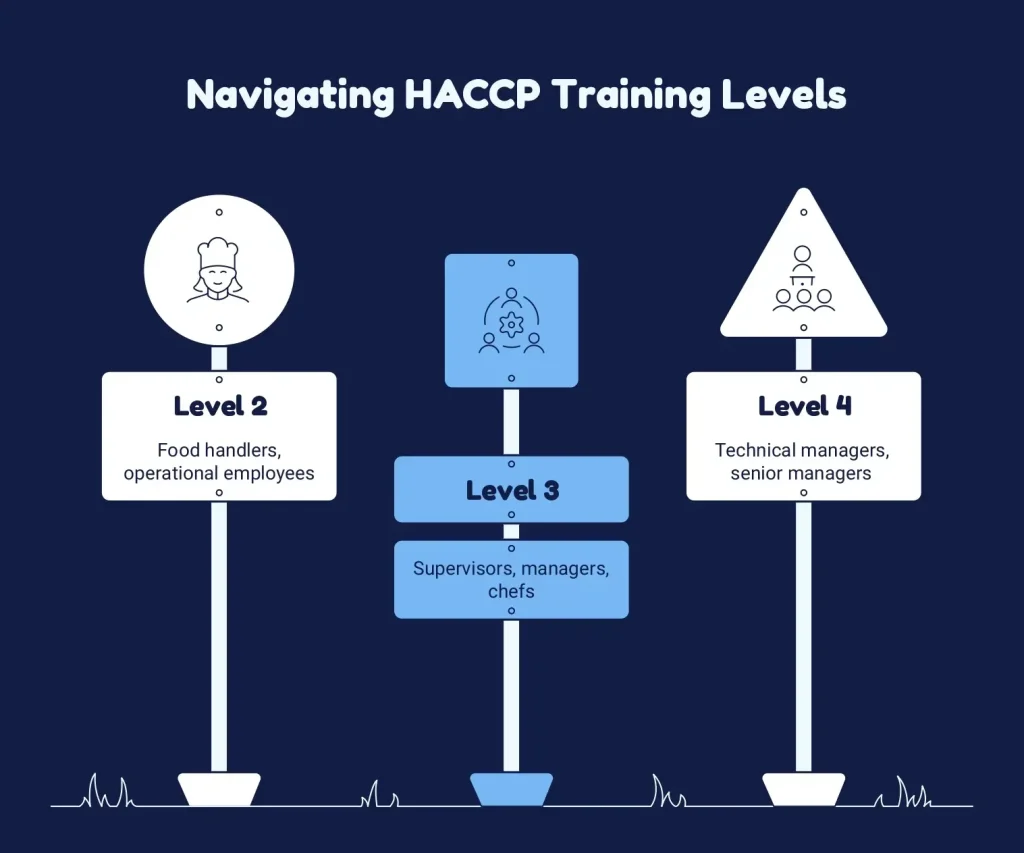
Several recognised UK awarding organisations offer regulated Level 2, Level 3, and Level 4 HACCP Certification qualifications for catering, manufacturing, and food production settings. Learners should always confirm whether the course provides a regulated qualification or a certificate of course completion.
Level 2 HACCP
HACCP Certification at Level 2 generally introduces HACCP principles to employees working within an established food safety management system.
Learners typically study the purpose of HACCP, common categories of food safety hazards, critical control points, monitoring procedures, and corrective actions. HACCP Certification at this level helps employees understand how their day-to-day responsibilities contribute to food safety.
For example, a kitchen employee may need to monitor cooking temperatures, while a production operative may be responsible for following separation procedures or carrying out product inspections. HACCP Certification helps employees understand why these controls are important.
Level 2 HACCP Certification should not be confused with Level 2 Food Safety or Food Hygiene training. Food hygiene courses generally cover broader safe working practices, whereas HACCP training focuses specifically on hazard analysis and preventive food safety controls.
Level 3 HACCP
Level 3 HACCP Certification is commonly intended for owners, supervisors, chefs, managers, and employees responsible for developing, implementing, or maintaining HACCP-based food safety procedures.
Typical learning outcomes include understanding prerequisite programmes, preparing process flow diagrams, conducting hazard analysis, identifying critical control points, establishing critical limits, monitoring procedures, corrective actions, validation, verification, and documentation. HACCP Certification at this level prepares learners for greater responsibility within a food safety management system.
A Level 3 programme is particularly relevant for employees who supervise monitoring activities or contribute to a HACCP team. However, learners should remember that course titles vary. A training bundle advertised simply as “Level 3” does not automatically represent a regulated Level 3 HACCP Certification qualification.
Before enrolling, learners should confirm which awarding organisation issues the certificate and how the assessment is conducted.
Level 4 HACCP
Level 4 HACCP Certification is designed for individuals with advanced food safety responsibilities.
It is often suitable for senior technical managers, HACCP team leaders, food safety consultants, and auditors responsible for developing, implementing, reviewing, and evaluating complex HACCP systems.
Advanced HACCP Certification may include the scientific basis of food safety controls, validation of critical limits, verification planning, internal auditing, system failure investigation, and the management of multidisciplinary HACCP teams.
These programmes generally require stronger prior knowledge and more demanding assessment. Learners with little previous food safety experience may benefit from completing foundation or intermediate HACCP Certification before progressing to Level 4.
Choosing Between Training and a Qualification
Choosing the right HACCP Certification depends on the intended outcome rather than simply selecting the quickest or least expensive course.
A private online HACCP Certification course may be appropriate for knowledge development and continuing professional development. A regulated qualification may be more suitable where an employer, job role, customer, or contract specifies a recognised qualification. Independently audited organisational certification may also be required where customers expect a certified food safety management system.
How to Get HACCP Certified
Why you need HACCP Certification in UK food businesses depends on your role, legal responsibilities, and customer requirements. The following steps can help individuals and businesses select an appropriate and credible HACCP Certification route.
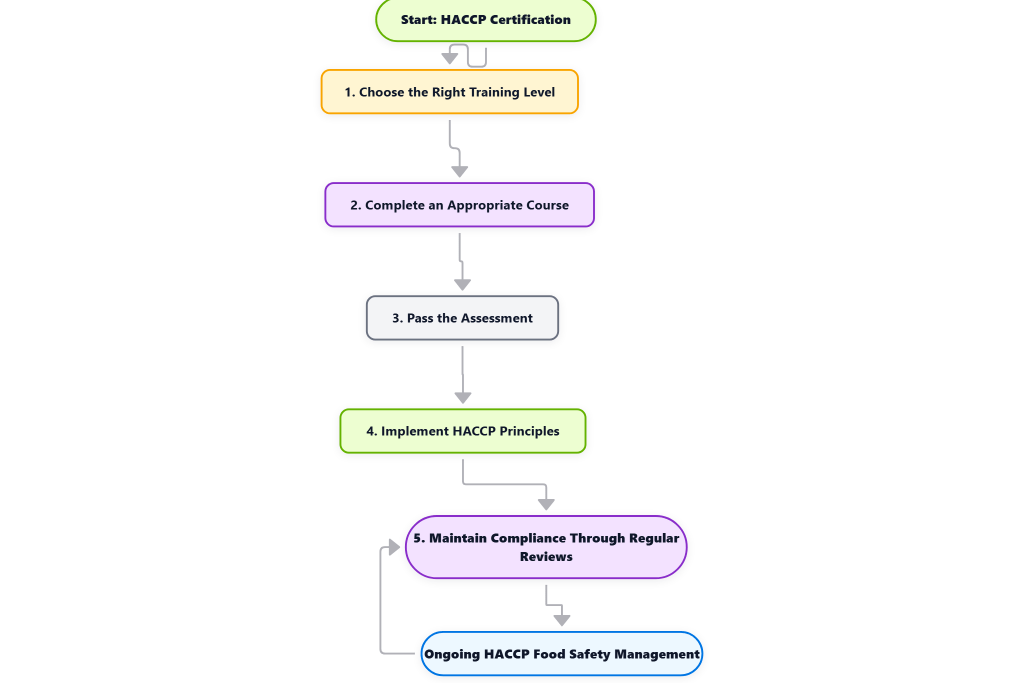
1. Choose the Right HACCP Training Level
Begin by considering the responsibilities of the role.
A food handler following established procedures may require introductory or Level 2 HACCP Certification. A supervisor responsible for monitoring food safety controls and corrective actions may require Level 3, while a senior technical manager responsible for a complex manufacturing HACCP system may benefit from Level 4 or another advanced qualification.
Always review job descriptions, customer requirements, supplier approval criteria, and contractual obligations before choosing HACCP Certification. Do not assume that every HACCP certificate will satisfy the same requirement.
2. Complete an Appropriate or Accredited Course
Before enrolling on HACCP Certification, review the course syllabus, intended audience, duration, assessment methods, and certificate provided.
HACCP Certification online offers flexibility and can be suitable for theory-based learning, awareness training, and continuing professional development. It also allows employees to study around shift patterns and revisit topics when necessary.
However, online HACCP Certification does not replace workplace-specific instruction. Employees must still understand their employer’s products, equipment, monitoring procedures, critical limits, documentation, and corrective actions.
When comparing providers, learners should focus on whether the course meets their objectives rather than assuming that every certificate represents a regulated qualification. Course descriptions should clearly explain whether the programme provides a certificate of completion, a regulated qualification, or continuing professional development.
3. Pass the Assessment
The assessment should be appropriate for the level of HACCP Certification being completed.
A short knowledge assessment may demonstrate that learners understand the seven HACCP principles or can recognise common hazards. However, it is unlikely to demonstrate that someone can independently design, validate, and implement a complex HACCP plan.
Higher-level HACCP Certification qualifications may involve formal examinations or more detailed assessments, while organisational certification normally includes independent on-site audits rather than individual course examinations.
Before paying for HACCP Certification, confirm whether assessment fees, certificate charges, and additional assessment attempts are included.
4. Implement HACCP Principles
Completing HACCP Certification should lead to the effective implementation of HACCP principles within the workplace.
The business should assemble appropriate expertise, describe the product and intended consumer, prepare and verify process flow diagrams, conduct hazard analysis, and establish suitable food safety controls.
Employees should clearly understand what must be monitored, where records are completed, and who should be informed whenever control is lost. HACCP Certification is most valuable when its principles are consistently applied during everyday operations.
Generic HACCP templates should never be copied without adapting them to the business. An inaccurate HACCP plan may create a false sense of security because the documentation appears complete while significant hazards remain uncontrolled.
5. Maintain Compliance Through Regular Reviews
HACCP Certification supports ongoing food safety management, but HACCP itself requires continuous review.
Businesses should review their HACCP system whenever they introduce new ingredients, suppliers, recipes, equipment, packaging, production processes, layouts, or intended consumer groups.
Customer complaints, food safety incidents, product recalls, inspection findings, or repeated monitoring failures may indicate that existing controls are no longer effective. HACCP Certification knowledge should therefore be refreshed whenever responsibilities change or new food safety risks emerge.
A certificate without a formal expiry date does not make knowledge permanent. Current competence depends on continuing professional development, regular review, and the consistent workplace application of HACCP principles.
Frequently Asked Questions
Do I Need to Be HACCP Certified?
Not every food handler must hold one particular commercial HACCP certificate.
Food business operators must maintain HACCP-based procedures, and employees must receive food hygiene instruction, supervision or training appropriate to their activities.
People responsible for developing and maintaining the HACCP system require suitable training in applying the principles.
You may need a particular certificate, qualification or certification standard where your employer, customer, tender or industry scheme requires it.
How Do I Become HACCP Certified?
First, determine which type of certification you need.
For personal training, select a course suitable for your role, complete the learning and pass any assessment. This may lead to a private course-completion certificate or a regulated qualification.
For organisational certification, the food business normally develops and implements the required management system before applying to a suitable certification body. The business may then undergo document review, site audit and corrective action.
The two routes should not be confused. Personally completing a course does not certify the organisation.
What Is a HACCP Audit?
A HACCP audit is a systematic review of whether a food safety system has been designed appropriately, implemented consistently and maintained effectively.
An auditor may examine:
- the scope and composition of the HACCP team;
- product descriptions and process flow diagrams;
- hazard analysis and CCP decisions;
- critical limits and validation evidence;
- monitoring and corrective-action records;
- verification, review and employee knowledge.
Internal audits help the business check its own system. Customer audits assess supplier requirements, while certification audits assess a named standard or scheme.
A local-authority food hygiene inspection is not identical to a commercial HACCP certification audit, although both may consider food safety procedures and records.
How Long Does HACCP Certification Last?
There is no universal duration for every HACCP-related certificate.
A private training certificate may contain no formal expiry date. A regulated qualification generally remains an awarded achievement, although the learner’s knowledge may become outdated.
Employers can require refresher training according to risk, role or internal policy. Organisational certification usually follows a defined cycle involving surveillance, review or renewal audits.
The HACCP system itself must be reviewed whenever significant changes occur. A business should not wait for a certificate to expire before updating an unsafe or outdated plan.
How Much Does HACCP Certification Cost?
The HACCP certification cost depends on the route, level, delivery method and recognition.
Short self-paced online courses can sometimes cost between approximately £15 and £100. At the time of checking, Jobsland’s Advanced HACCP Training listing showed a price of £87, although course prices and promotions can change.
Tutor-led Level 3 programmes and regulated qualifications normally cost more because they may involve teaching, controlled assessment and awarding-organisation fees.
Advanced Level 4 study can cost several hundred pounds or more, depending on the provider and delivery arrangements.
Third-party business certification is priced differently. Costs can include preparation, consultancy, application, initial audit, travel, corrective-action review and continuing surveillance. Certification bodies commonly prepare quotations according to the operation’s size, sites, products, complexity and required standard.
When comparing prices, check whether the following are included:
- assessment or examination;
- certificate format;
- tutor support;
- resits;
- awarding-body registration;
- access duration;
- renewal or audit fees.
The cheapest option may be suitable for general awareness but inadequate where a formal qualification or organisational audit is required.
Why Is HACCP Certification Important?
Why is HACCP certification important? It can provide evidence that a person or organisation has taken defined steps to understand or demonstrate preventive food safety control.
For an employee, training can develop knowledge of hazards, limits, monitoring and corrective action. For a business, formal certification may support commercial assurance and buyer confidence.
Certification does not guarantee that every product is safe. Its value depends on the quality of the course or audit and on how consistently the learning and procedures are applied.
Can I Complete HACCP Certification Online?
Yes, many providers offer online HACCP learning.
Online courses can work well for theoretical knowledge, refresher training and structured professional development. They should include clear learning outcomes, reliable content and assessment proportionate to the certificate.
Some roles may also require practical instruction, workplace observation or a regulated examination. Learners should check employer and industry expectations before relying only on an online certificate.
Is HACCP the Same as Food Hygiene Training?
No, although the subjects are closely connected.
Food hygiene training commonly covers personal hygiene, cleaning, contamination, temperatures, storage and allergens. HACCP focuses on the systematic process of analysing hazards, identifying critical control points and managing them through monitoring and corrective action.
A combined programme may cover both HACCP food hygiene principles. The course title and syllabus should make the depth of each subject clear.
Does a HACCP Certificate Guarantee a Food Hygiene Rating of 5?
No.
The inspector assesses hygienic food handling, the condition of the premises and confidence in food safety management. A course certificate may support training evidence, but the rating reflects the standards found within the business at the time of inspection.
To achieve the strongest rating, the operation must perform well across all assessed areas.
Is a CPD HACCP Course a Regulated Qualification?
Not automatically.
A CPD course can provide valuable professional learning and a certificate of completion. A regulated qualification follows a recognised awarding-organisation framework and should be independently verifiable through the relevant qualification arrangements.
Course providers should describe the distinction accurately. Learners requiring a regulated award should confirm its title, awarding body and qualification status before paying.
Conclusion
HACCP Certification helps individuals and organisations develop and demonstrate the knowledge required to identify, assess, and control food safety hazards systematically. Why is HACCP Certification important? It supports the effective implementation of HACCP principles, strengthens food safety management, and provides evidence that appropriate training has been completed where required.
Why you need HACCP Certification in UK food businesses depends on your role and responsibilities. UK food businesses are legally required to maintain food safety procedures based on HACCP principles. Food handlers must receive appropriate instruction, supervision, or training, while those responsible for developing, implementing, or maintaining the HACCP system need a higher level of HACCP knowledge and competence.
Who needs HACCP Certification? There is no single answer. An individual HACCP certificate, a regulated HACCP qualification, and independent third-party organisational certification each serve different purposes. The most appropriate option depends on the learner’s responsibilities, the employer’s requirements, and any contractual or industry expectations.
HACCP Certification at Level 2 commonly supports employees who follow established food safety procedures. Level 3 is generally more appropriate for supervisors, chefs, owners, and managers responsible for implementing or maintaining HACCP-based systems, while Level 4 is intended for senior technical personnel, auditors, consultants, and HACCP team leaders managing more complex food safety systems.
Online HACCP Certification can provide a flexible route to professional development and may be suitable for theory-based learning and continuing professional development. However, learners should always confirm whether a course provides a certificate of completion, CPD evidence, or a regulated qualification, depending on their objectives.
HACCP Certification can support legal compliance, staff competence, due diligence, food hygiene management, supplier assurance, commercial opportunities, and customer confidence. However, no certificate alone guarantees legal compliance, inspection outcomes, or food safety. Businesses remain responsible for implementing effective HACCP-based procedures, maintaining accurate records, reviewing their systems regularly, and managing the actual hazards associated with their operations.
Ultimately, why you need HACCP Certification for food safety is closely linked to prevention rather than paperwork. Appropriate HACCP training helps people recognise where food may become unsafe, understand how preventive controls should operate, monitor those controls effectively, and take corrective action before unsafe food reaches consumers.
The real value of HACCP Certification lies not simply in obtaining a certificate, but in building a stronger food safety culture through informed decision-making, effective HACCP procedures, continuous improvement, and a sustained commitment to protecting consumers.