Becoming a Teaching Assistant (TA) in the UK offers a deeply rewarding career path for individuals passionate about supporting children’s education and development. This role is fundamental to the effective functioning of schools, providing crucial support to teachers and directly impacting student learning experiences, especially as new Special Educational Needs and Disability (SEND) reforms are expected to place early intervention, often delivered by TAs, at their core in early 2026 [1].
Key Takeaways
A Teaching Assistant directly supports teachers and students in the classroom, aiding learning and development.
Essential skills include strong communication, patience, empathy, organisational abilities, and adaptability.
Formal qualifications like Level 2 and Level 3 Certificates in Supporting Teaching and Learning are highly valued in the UK.
Career progression can lead to roles such as Higher Level Teaching Assistant (HLTA), SEN specialist, or even a pathway to becoming a qualified teacher.
The job outlook for Teaching Assistants in the UK remains positive, particularly with anticipated SEND reforms and a consistent need for classroom support.
Practical steps to get started involve gaining experience, choosing the right qualification, and building a strong application.
Anticipated pay increases, with unions calling for a minimum £15 hourly rate or a 10% increase, whichever is greater, for 2026-27, highlight growing recognition for the role [1].
New guidance on medical care responsibilities for support staff is expected, clarifying the scope of TA duties in this area [1].
AI tools are emerging to support TAs with administrative tasks and lesson planning, freeing up time for direct student interaction [3, 4].
What is a Teaching Assistant, and What Do They Do?
A Teaching Assistant (TA), sometimes known as a Classroom Assistant or Learning Support Assistant, is a vital member of the school team who supports pupils, teachers, and the curriculum to foster an effective learning environment. Their primary function is to enhance student learning experiences, both academically and socially, under the guidance of a qualified teacher.
The role of a Teaching Assistant is incredibly varied, making each day unique and dynamic. Generally, a TA assists with classroom activities, helps individual students or small groups, and supports pupils with special educational needs (SEN). For instance, a TA might spend the morning helping a small group of Year 3 students grasp multiplication tables, then transition to supporting a child with dyslexia during a literacy lesson, and in the afternoon, assist the teacher in setting up an art project. This direct involvement makes TAs integral to student progress and well-being.
Core Responsibilities of a Teaching Assistant
Teaching Assistants perform a wide array of duties designed to complement the work of the main class teacher. These responsibilities can vary significantly depending on the age group, the specific needs of the pupils, and the school’s structure.
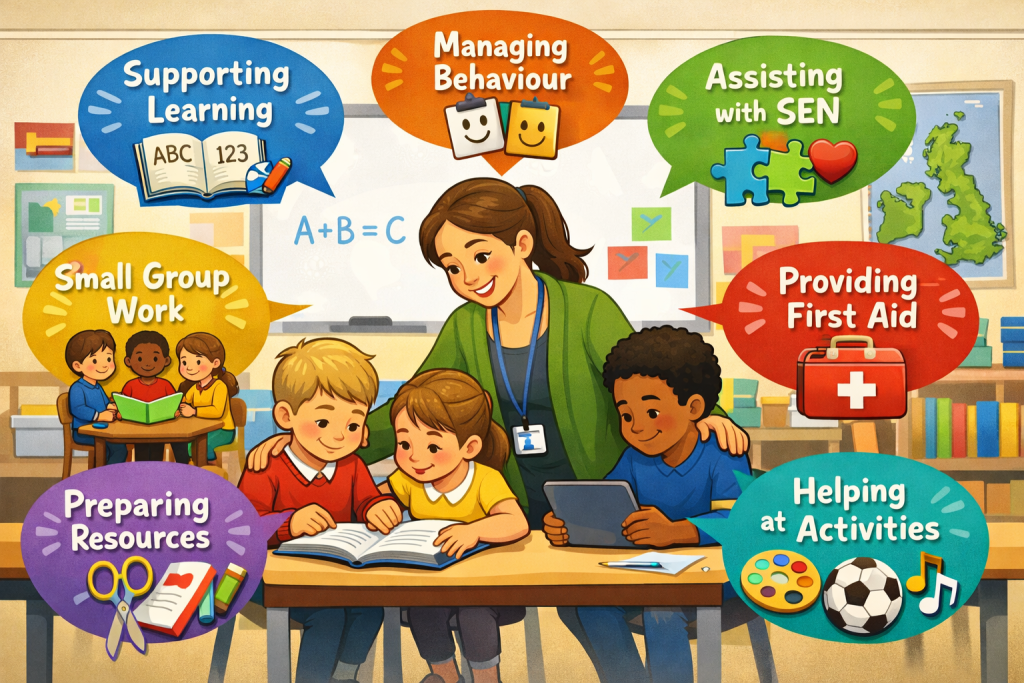
Supporting Student Learning: This is often the core of the role, involving helping students understand lessons, clarify instructions, and complete tasks. TAs may work with students one-on-one, in small groups, or support the entire class.
Assisting with Special Educational Needs (SEN): A significant part of many TA roles involves providing tailored support to students with diverse learning needs, disabilities, or behavioural challenges, often following an individual education plan (IEP). This includes helping students with communication difficulties, mobility, or specific learning differences like dyslexia or ADHD. The expected SEND reforms in early 2026 are set to put early intervention, often provided by TAs, at the forefront [1].
Managing Classroom Behaviour: TAs help to maintain a positive and productive learning environment by assisting teachers with behaviour management strategies, encouraging good conduct, and addressing minor disruptions.
Preparing Learning Resources: This can involve creating display boards, photocopying worksheets, laminating materials, and organising the classroom to ensure a stimulating and orderly space.
Supervision Duties: TAs often supervise students during playtime, lunch breaks, and on school trips, ensuring their safety and encouraging positive social interactions.
Administrative Tasks: While less frequent, TAs may assist with some administrative duties like recording attendance, filing, or communicating with parents under the teacher’s direction. The rise of AI-powered tools may increasingly take on these administrative burdens, potentially freeing up TAs to focus more on direct student interaction [3, 4].
Supporting the Teacher: This includes listening to students read, running small intervention groups, or providing feedback to the teacher on student progress.
What the Role is NOT
It’s important to clarify that a Teaching Assistant is not a substitute for a qualified teacher. While they provide invaluable support and may lead small group activities, the ultimate responsibility for planning lessons, assessing overall progress, and managing the classroom rests with the class teacher. TAs work under the teacher’s direction, executing plans rather than creating the core curriculum. Schools are also awaiting non-statutory guidance clarifying support staff responsibilities regarding medical care, which was delayed from autumn 2025 [1]. This guidance will help ensure TAs understand the precise scope of their involvement in student medical needs.
Choosing a career as a Teaching Assistant is ideal for those who are patient, enjoy working with children, and want to make a tangible difference in young lives. If you thrive in a dynamic environment and enjoy a supporting role, this could be the perfect fit.
What Skills are Required to be a Successful Teaching Assistant?
A successful Teaching Assistant needs a blend of soft skills, practical abilities, and a genuine passion for supporting children’s development. These skills enable them to effectively assist teachers, engage with students, and manage the varied demands of a busy classroom environment. Strong interpersonal skills and resilience are particularly important for navigating the diverse needs within a school.
Essential Soft Skills
These are the personal attributes that underpin effective performance as a Teaching Assistant.
Excellent Communication Skills: TAs need to communicate clearly and patiently with children, adapting their language to suit different age groups and learning styles. They also need to communicate effectively with teachers, parents, and other school staff. This includes active listening, explaining tasks simply, and providing constructive feedback.
Patience and Empathy: Working with children, especially those facing challenges, requires immense patience. Understanding and sharing the feelings of students (empathy) helps TAs build rapport and provide appropriate emotional support. A calm demeanour is crucial when dealing with challenging behaviour or frustrating learning moments.
Adaptability and Flexibility: Every day in a school can bring unexpected situations. TAs must be able to adapt quickly to changing plans, new student needs, or different classroom activities. One moment they might be helping with a maths problem, the next they could be mediating a playground dispute.
Organisation and Time Management: With multiple responsibilities and often several students to support, TAs need to be well-organised. This means managing their time effectively, preparing resources efficiently, and keeping track of student progress notes.
Teamwork: TAs are part of a larger school team. Collaborating effectively with teachers, other TAs, and school leaders is essential for a cohesive and supportive educational environment. This involves sharing observations, contributing to student assessments, and working towards common goals.
Initiative and Proactiveness: While working under the direction of a teacher, taking initiative to anticipate needs, tidy resources, or engage a quiet student shows a commitment to the role and benefits the classroom.
Resilience: The school environment can be demanding. TAs often encounter challenging behaviours, emotional situations, or stressful periods. Resilience helps them to manage these pressures, learn from experiences, and maintain a positive attitude.
Practical and Foundational Skills
Beyond soft skills, certain practical abilities and foundational knowledge are highly beneficial.
Literacy and Numeracy Skills: A good grasp of basic English and Maths is essential to support students across the curriculum, from reading comprehension to basic arithmetic. New Hampshire’s HB 1828, though US-based, highlights a broader educational trend towards reviewing educator preparation for effective literacy instruction [2].
Basic IT Skills: Familiarity with computers, tablets, and interactive whiteboards is increasingly important for helping students with digital learning tools and for administrative tasks.
Understanding of Child Development: Knowledge of how children typically learn and develop at different ages helps TAs to better support their educational and emotional needs.
Knowledge of School Policies: Awareness of safeguarding, behaviour management, and health and safety policies ensures TAs operate responsibly and contribute to a safe school environment.
First Aid (Desirable): While not always mandatory, having a basic first aid qualification is a significant asset, particularly in primary school settings, and can be a requirement for specific roles.
If you possess a genuine desire to help children learn and grow, many of these skills can be developed and refined through training and experience. For example, an individual might start with strong communication skills from a previous customer service role (like a Sales Assistant) and then learn specific behaviour management techniques through a Level 2 or 3 Teaching Assistant qualification.
Qualifications and Training Pathways in the UK
To become a Teaching Assistant in the UK, while some schools may employ individuals based solely on experience and enthusiasm, formal qualifications significantly boost your employability and provide a strong foundation. These qualifications demonstrate a commitment to the profession and equip you with the essential knowledge and skills required to excel.
Entry-Level Qualifications
For those new to the field, these qualifications are an excellent starting point.
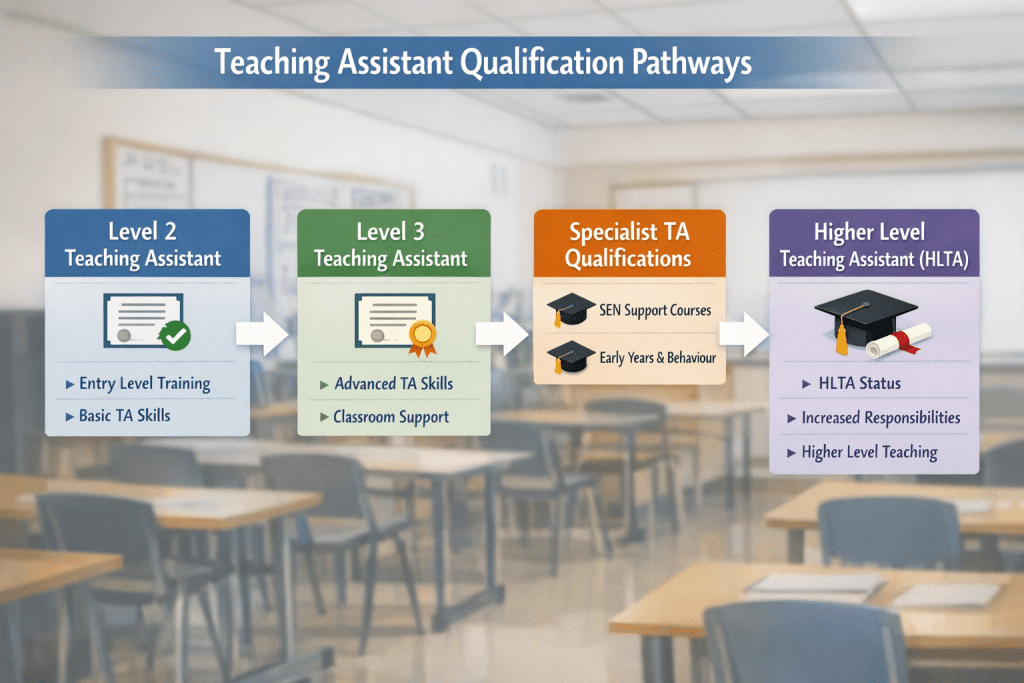
Level 2 Certificate in Supporting Teaching and Learning in Schools:
Focus: This is a foundational qualification suitable for aspiring TAs or those new to the role. It covers core knowledge such as safeguarding, communication with children, and understanding classroom organisation.
Content: Typically includes units on schools as organisations, roles and responsibilities of a TA, child development, and basic safeguarding.
Duration: Can usually be completed in 6-9 months part-time through colleges or online providers.
Entry Requirements: Often no formal academic requirements, but a good standard of English and Maths is helpful. Work experience (paid or voluntary) in a school setting is often recommended or required for some practical elements.
Level 3 Certificate in Supporting Teaching and Learning in Schools (or Diploma):
Focus: This is a more comprehensive qualification, often preferred by schools for permanent or more responsible TA positions. It delves deeper into supporting pupils, curriculum activities, and professional practice.
Content: Builds upon Level 2, covering topics like behaviour management strategies, supporting literacy and numeracy development, promoting positive relationships, and working with children with SEN.
Duration: Typically takes 9-12 months part-time to complete, though a Diploma can take longer (up to 18 months).
Entry Requirements: Often requires a Level 2 qualification or relevant experience. Good GCSEs in English and Maths are beneficial. A work placement in a school is usually a mandatory component.
Progression and Specialisation
Once you have experience and entry-level qualifications, you can consider more advanced training.
Higher Level Teaching Assistant (HLTA) Status:
Focus: This is a nationally recognised standard that allows experienced TAs to take on more responsibility, including planning, preparing, and delivering learning activities for whole classes when the teacher is absent.
Assessment: Achieved through a rigorous assessment process, demonstrating competence against 33 professional standards. It doesn’t involve a specific qualification course, but rather an assessment of existing skills and experience, often with a portfolio submission and an assessment visit to your workplace.
Eligibility: Typically requires a Level 3 qualification and significant experience as a Teaching Assistant. You also need to have achieved GCSE English and Maths at Grade C/4 or above (or equivalent).
Benefits: HLTAs earn a higher salary and have greater career opportunities, often acting as line managers for other TAs or leading specific school initiatives.
Special Educational Needs (SEN) Training:
Focus: Many TAs choose to specialise in supporting students with SEN. This can involve short courses, workshops, or more in-depth Level 3 or 4 qualifications focusing on specific conditions like autism, dyslexia, or profound and multiple learning difficulties.
Importance: With new SEND reforms expected to be enacted in early 2026, emphasising early intervention [1], specialised SEN training will likely become even more valuable for TAs.
Apprenticeships
Teaching Assistant apprenticeships offer a practical, earn-while-you-learn pathway.
Level 3 Teaching Assistant Apprenticeship:
Structure: Combines on-the-job training in a school with off-the-job learning towards a Level 3 qualification.
Benefits: Gain practical experience, earn a salary, and achieve a recognised qualification simultaneously.
Eligibility: Typically for new entrants to the role or existing TAs wanting to upskill.
Work Experience
Regardless of formal qualifications, practical experience in a school setting is invaluable.
Voluntary Work: Offering your time as a volunteer in a local school is a fantastic way to gain insight into the role, build connections, and demonstrate your commitment. It can often be a stepping stone to paid employment.
Classroom Placements: Many Level 2 and 3 courses require a practical placement, ensuring you gain hands-on experience as part of your training.
Choosing the right pathway depends on your current experience, career goals, and available time. If you’re completely new to education, starting with voluntary work or a Level 2 qualification is a sensible first step. If you already have some experience, aiming for Level 3 or HLTA status can accelerate your career. For those considering a career change from roles like an Admin Assistant, your transferable organisational and communication skills will be a great advantage.
Career Opportunities and Job Outlook for Teaching Assistants
The career path for a Teaching Assistant in the UK is dynamic, offering a range of opportunities for professional growth and specialisation. The job outlook remains consistently positive, driven by a continuous need for classroom support, particularly with evolving educational policies and an increasing focus on inclusive education.
Diverse Career Opportunities
A role as a Teaching Assistant can open doors to various specialisations and progressions within the education sector.
Higher Level Teaching Assistant (HLTA): This is a natural progression for experienced TAs. HLTAs take on more responsibilities, including planning and delivering lessons, leading intervention groups, and supporting other TAs. This role offers enhanced pay and professional autonomy.
Special Educational Needs (SEN) Assistant/Coordinator: Many TAs choose to specialise in supporting students with particular special educational needs. This might involve working exclusively with students on the autism spectrum, with specific learning difficulties, or with physical disabilities. With anticipated SEND reforms in early 2026 prioritising early intervention [1], expertise in this area is becoming even more crucial.
Pastoral Support Worker: Some TAs move into roles focused on student well-being, offering emotional and behavioural support, liaising with families, and connecting students with external support services.
Cover Supervisor: In secondary schools, TAs or HLTAs might train to become Cover Supervisors, responsible for managing a classroom and ensuring students complete pre-set work during a teacher’s short-term absence.
Curriculum-Specific Support: TAs can specialise in supporting specific subject areas, such as literacy, numeracy, or even science, often leading small group booster sessions. This aligns with literacy instruction trends for 2026, which are moving towards “both/and” approaches, integrating explicit instruction with authentic reading experiences [6].
Progression to Qualified Teacher Status (QTS): For many, being a Teaching Assistant is a stepping stone to becoming a fully qualified teacher. The experience gained is invaluable for teacher training applications, providing a practical understanding of classroom dynamics and student needs. Some universities offer specific pathways for experienced TAs to gain QTS.
Other School-Based Roles: The experience and understanding of school operations gained as a TA can also be valuable for roles such as Admin Assistant, Centre Assistant, or even school office management.
Job Outlook and Trends in 2026
The demand for Teaching Assistants in the UK is expected to remain strong in 2026 and beyond.
Consistent Demand: Schools across all phases (nursery, primary, secondary, and special schools) consistently require dedicated support staff to meet the diverse needs of their student populations.
Impact of SEND Reforms: The Schools White Paper, expected in early 2026, will outline long-awaited SEND reforms. These reforms place a significant emphasis on early intervention, which TAs are uniquely positioned to deliver [1]. This focus will likely increase the demand for skilled TAs, particularly those with SEN expertise.
Focus on Small Group and Individual Support: Educational best practices increasingly highlight the benefits of targeted small group work and one-on-one support for student progress, areas where TAs excel.
Recruitment and Retention Challenges: While much focus is on teacher recruitment, the broader education sector also faces challenges in attracting and retaining support staff. This means qualified and experienced TAs are highly valued. The Department for Education instructing schools to plan for support staff pay rises over the next three years, including the re-establishment of the School Support Staff Negotiating Body (SSSNB), signals a commitment to addressing these challenges [1].
Pay and Conditions: UK unions submitted a 2026-27 pay claim in December 2025, calling for a £3,000 or 10% increase (whichever is greater) and a minimum hourly rate of £15 [1]. This marks an important period for TA pay, reflecting growing recognition of their vital contribution.
Technological Integration: The emergence of AI-powered administrative support tools for faculty and teaching assistants could streamline routine tasks, potentially allowing TAs to dedicate more time to direct student engagement and less to paperwork [3, 4]. While barriers to educator AI adoption still exist [5], the potential for enhanced efficiency is significant.
In summary, a career as a Teaching Assistant offers stability, meaningful work, and clear pathways for advancement within the UK education system. For those passionate about education, it presents a vital and evolving role that directly shapes the future of young learners.
Practical Steps to Get Started as a Teaching Assistant
Embarking on a career as a Teaching Assistant is an achievable goal with a clear action plan. Whether you’re a recent school leaver, a parent looking to re-enter the workforce, or considering a career change, these practical steps will guide you towards securing your first Teaching Assistant role in the UK.
Step 1: Gain Relevant Experience (Voluntary or Paid)
Experience is often the most critical factor for securing a TA position.
Volunteer in a School: Contact local primary schools, secondary schools, or special educational needs schools and express your interest in volunteering. Even a few hours a week helping in a classroom, library, or with after-school clubs can provide invaluable insight and references.
Work with Children in Other Settings: Experience from youth clubs, holiday camps, nurseries, sports coaching, or even caring for your own children can demonstrate transferable skills.
Check DBS Requirements: Any role involving working with children will require an enhanced Disclosure and Barring Service (DBS) check. Schools will guide you through this process, but it’s good to be aware of it upfront.
Decision Rule: If you have limited or no prior experience in a formal education setting, prioritise volunteering. It provides a low-pressure way to confirm your interest and build a foundation.
Step 2: Choose and Obtain the Right Qualification
While experience is crucial, formal qualifications are increasingly preferred by schools.
Research Qualification Levels: Decide whether to start with a Level 2 Certificate or directly pursue a Level 3 Certificate/Diploma in Supporting Teaching and Learning in Schools. Level 3 is generally more comprehensive and leads to more opportunities.
Find a Provider: Look for local colleges, adult education centres, or reputable online learning providers. Ensure the qualification is nationally recognised (e.g., by CACHE, NCFE).
Consider an Apprenticeship: If available in your area, a Teaching Assistant apprenticeship allows you to gain a qualification and experience simultaneously while earning a wage.
Funding: Investigate funding options. Some courses may be free or subsided for certain age groups or income levels.
Common Mistake: Rushing into an expensive qualification without first gaining some voluntary experience. A trial period as a volunteer can help you confirm that the role is right for you before committing to a course.
Step 3: Craft a Strong CV and Cover Letter
Your application documents are your first impression on potential employers.
Highlight Relevant Skills: Emphasise transferable skills from any previous roles or life experiences, such as communication, organisation, patience, and teamwork. Use the skills listed in this guide as a checklist.
Detail Your Experience: Clearly describe your experiences with children, whether voluntary or paid, explaining your responsibilities and the impact you made. For example, “Assisted Year 2 teacher with small group literacy interventions, resulting in measurable progress for 3 students.”
Tailor for Each Application: Customise your CV and cover letter for each school, referencing their specific values, ethos, or any particular areas of focus (e.g., “I am particularly drawn to your school’s commitment to inclusive education, which aligns with my passion for supporting children with diverse learning needs.”).
Proofread Meticulously: Errors in spelling or grammar can detract from your professional image. Get someone else to review your application.
Step 4: Prepare for Interviews
Interviews for Teaching Assistant roles often involve a combination of questions and practical tasks.
Research the School: Understand their values, curriculum, and any recent news. This shows genuine interest.
Anticipate Questions: Prepare answers for common questions about safeguarding, behaviour management, working with SEN, teamwork, and why you want to be a TA.
Be Ready for Practical Tasks: You might be asked to read a story to a small group of children, lead a short activity, or demonstrate how you would support a child with a specific learning challenge.
Show Your Enthusiasm and Personality: Schools are looking for TAs who are genuinely passionate about working with children and can build positive relationships.
Ask Thoughtful Questions: Prepare a few questions to ask at the end of the interview about the role, the team, or professional development opportunities.
Step 5: Continuing Professional Development (CPD)
Once you’ve secured a role, continuous learning is key to a fulfilling career.
Embrace Training Opportunities: Take advantage of any in-house training on offer, especially for safeguarding, first aid, or specific SEN interventions.
Consider HLTA Status: As you gain experience, aim for Higher Level Teaching Assistant (HLTA) status to take on more responsibility and increase your earning potential.
Stay Informed: Keep up-to-date with educational developments, such as the upcoming SEND reforms in 2026 [1] and shifts in literacy instruction [6].
By following these steps, you can build a strong foundation for a rewarding career as a Teaching Assistant in the UK, making a real difference in the lives of children.
Frequently Asked Questions about Being a Teaching Assistant
This section addresses common questions from UK job seekers and working professionals interested in the Teaching Assistant role, offering concise and direct answers.
What is the average salary for a Teaching Assistant in the UK in 2026?
The average salary for a Teaching Assistant in the UK in 2026 varies by location, experience, and specific responsibilities, but unions are pushing for a minimum hourly rate of £15 or a 10% pay increase for 2026-27 [1]. Entry-level roles might start around £12,000-£15,000 per year, while experienced TAs, especially HLTAs, can earn £20,000-£25,000 or more annually (pro-rata for term-time only roles).
Do I need a degree to become a Teaching Assistant?
No, you do not typically need a university degree to become a Teaching Assistant. Formal qualifications like a Level 2 or Level 3 Certificate in Supporting Teaching and Learning in Schools are generally preferred by employers, alongside relevant experience. However, a degree can be beneficial for career progression, particularly if you aim to become a qualified teacher.
Can I become a Teaching Assistant without any experience?
It is challenging but possible to become a Teaching Assistant without direct experience, especially if you have transferable skills from other roles involving children (e.g., youth work, childcare, voluntary work). Many people start by volunteering in schools to gain the necessary experience before applying for paid positions.
What are the working hours for a Teaching Assistant?
Teaching Assistants typically work during school hours, usually term-time only. This can range from 25-35 hours per week, often with additional time for staff meetings or training. The exact hours depend on the school and the specific contract.
What is the difference between a Teaching Assistant and a Higher Level Teaching Assistant (HLTA)?
A Teaching Assistant (TA) supports the class teacher and students, while a Higher Level Teaching Assistant (HLTA) has additional responsibilities, including planning, preparing, and delivering learning activities for whole classes during a teacher’s absence. HLTAs also take on more specialised support roles and often earn a higher salary.
Is being a Teaching Assistant a good career choice for parents?
Yes, being a Teaching Assistant can be an excellent career choice for parents due to the term-time only working pattern, which often aligns well with school holidays. This can offer a good work-life balance for those with school-aged children.
How does AI impact the Teaching Assistant role in 2026?
AI-powered tools are increasingly being deployed to help Teaching Assistants with routine administrative tasks, lesson planning, and resource generation, potentially freeing up more time for direct student engagement [3, 4]. While AI adoption barriers still exist for educators [5], the technology aims to support, not replace, human TAs.
What are the latest developments for Teaching Assistants in 2026?
In 2026, key developments include expected pay increases with unions seeking a minimum £15 hourly rate or a 10% raise, and the long-awaited SEND reforms which will place early intervention (often delivered by TAs) at their core [1]. New guidance on support staff responsibilities regarding medical care is also anticipated [1].
Can a Teaching Assistant become a qualified teacher?
Yes, being a Teaching Assistant can be a fantastic pathway to becoming a qualified teacher. The practical classroom experience and understanding of child development gained are highly valuable for teacher training applications and for success in the profession. Many universities offer routes into teaching for experienced TAs.
Are there opportunities for Teaching Assistants to specialise?
Absolutely. Many Teaching Assistants choose to specialise in areas such as Special Educational Needs (SEN), literacy support, numeracy support, or pastoral care. This specialisation can lead to more focused roles and enhanced professional development opportunities within the school environment.
Conclusion
Becoming a Teaching Assistant in the UK offers a deeply fulfilling and impactful career, particularly in 2026 with ongoing developments in educational policy and technology. The role is more than just helping out; it’s about being a foundational pillar in children’s learning journeys, directly contributing to their academic progress, emotional well-being, and social development. From supporting individual pupils with special educational needs to assisting with whole-class activities, TAs are indispensable to the effective functioning of UK schools.
With new SEND reforms on the horizon prioritising early intervention and a strong push for improved pay and conditions, the value of the Teaching Assistant role is increasingly recognised. For those with a genuine passion for working with children, a blend of patience, empathy, and strong communication skills, this career path offers stability and diverse opportunities for growth.
Whether starting with voluntary experience, pursuing formal qualifications like a Level 3 Certificate, or aspiring to HLTA status, there are clear pathways to enter and advance within this vital profession. As technology, like AI, begins to streamline administrative tasks, TAs are poised to dedicate even more time to what matters most: directly nurturing the next generation. If you’re ready to make a tangible difference in the lives of young learners, the world of a Teaching Assistant awaits your compassion and dedication.
Actionable Next Steps:
Gain Experience: Start by volunteering in a local school to gain firsthand experience and confirm your passion for the role.
Research Qualifications: Explore Level 2 or Level 3 Certificates in Supporting Teaching and Learning and enrol with a reputable provider.
Network: Connect with TAs and teachers in local schools to understand the role better and uncover potential opportunities.
Prepare Your Application: Craft a compelling CV and cover letter that highlights your skills and experience.
Stay Informed: Keep up-to-date with educational news and policy changes, especially regarding SEND reforms and pay claims for 2026 [1].