Functional Skills are fundamental English and mathematics qualifications designed to equip individuals with the practical abilities needed for daily life, further learning, and the modern workplace. These skills are equivalent to a GCSE and are crucial for UK job seekers and professionals aiming to enhance their career prospects, navigate everyday challenges, and unlock new opportunities in 2026 and beyond. Recent policy changes now allow adult apprentices (aged 19+) more flexibility regarding mandatory completion, though 16-18 year olds still require them [1].
Key Takeaways
Definition: Functional Skills are practical, applied English and mathematics qualifications, equivalent to GCSEs, essential for life, learning, and work [1].
Purpose: They build real-world competencies like managing finances, writing clear emails, and problem-solving [1].
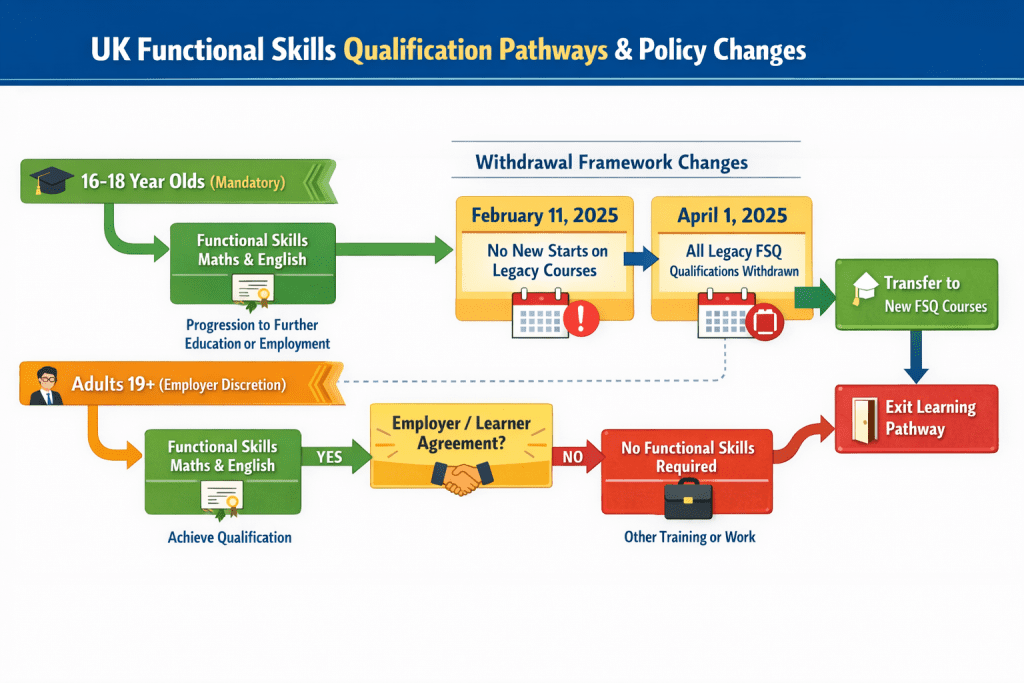
Adult Apprentices (19+): Since February 2025, employers can decide if Functional Skills are mandatory for adult apprentices, a significant policy shift [1].
Younger Apprentices (16-18): These apprentices must still complete Functional Skills English and Maths as a programme requirement, without exemption [1].
Withdrawal Framework: A new framework, effective February 11, 2025, allows learners facing difficulties to request withdrawal from Functional Skills under specific conditions, requiring employer agreement [1].
April 1, 2025 Deadline: Learners enrolled before February 11, 2025, needed to complete a withdrawal agreement review by this date, or they’d need to attempt the exam before requesting withdrawal [1].
Career Impact: These qualifications open doors to diverse career paths and improve employability across various sectors in the UK.
Accessibility: Training is widely available through colleges, training providers, and online platforms.
What Exactly Are Functional Skills in 2026?
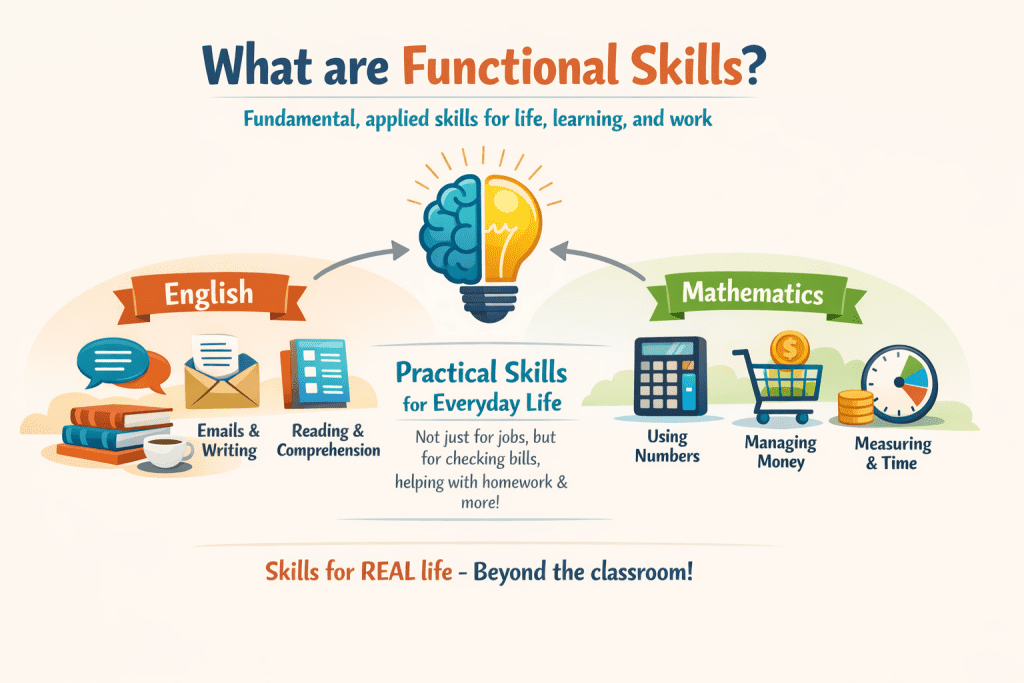
Functional Skills are nationally recognised qualifications in English and mathematics, acting as the bedrock of essential practical competencies for UK adults and young people alike. They are designed to ensure individuals possess the fundamental, applied skills required to thrive in everyday life, succeed in further education, and excel in the workplace [1]. These qualifications are set at different levels, often aiming for Level 2, which is widely considered equivalent to a GCSE grade 4 (C under the old grading system).
Historically, Functional Skills have been a mandatory component for many apprenticeship programmes, ensuring a baseline of core competencies. For example, imagine Sarah, who worked in retail for years but always felt held back by her confidence in maths. When she decided to pursue an apprenticeship in administration, her Functional Skills Level 2 Maths qualification not only boosted her number crunching for invoicing but also gave her the confidence to tackle budgeting for her department. It’s about more than just passing an exam; it’s about gaining practical abilities like checking bills, calculating change, or confidently writing a professional email [1].
Choosing to pursue Functional Skills is particularly beneficial if you want to:
Improve your employability: Many employers consider these skills a prerequisite for entry-level and even supervisory roles.
Access further education: They often serve as entry requirements for college courses or higher apprenticeships.
Enhance daily living: From managing household budgets to understanding contracts, these skills empower you in personal contexts [1].
What Skills are Required and Developed Through Functional Skills?
Functional Skills courses specifically target and develop practical, real-world abilities in both English and mathematics, making them directly applicable to personal and professional scenarios. The emphasis is on how these core subjects are used in daily tasks rather than purely theoretical knowledge.
For Functional Skills English, you’ll develop proficiency in:
Reading: Understanding information from various texts, including forms, emails, and reports. This includes identifying main points, comparing information, and making inferences.
Writing: Communicating clearly and accurately in different formats, such as emails, letters, and short reports. This involves correct grammar, punctuation, spelling, and structuring arguments or information effectively.
Speaking, Listening, and Communication: Engaging in discussions, presenting information, and responding appropriately in various situations. This is vital for teamwork and client interactions, much like what a project manager might need daily.
For Functional Skills Mathematics, the focus is on:
Number: Working with whole numbers, fractions, decimals, and percentages, including calculations without a calculator. This applies to budgeting, invoicing, and understanding financial data.
Measures, Shape, and Space: Understanding and using common measures (length, weight, capacity, time, temperature), calculating perimeter, area, and volume, and interpreting information from diagrams and charts. This could be useful for roles like an installations engineer needing to measure spaces.
Handling Data: Interpreting and comparing data from tables, charts, and graphs, as well as collecting, presenting, and analysing data to draw conclusions. This skill is critical for data-driven roles such as a digital analyst or an FPA analyst.
These are not merely academic skills; they’re about being able to “check bills, work out change, write emails, and help with children’s homework” [1]. Consider Mark, a production operative who enrolled in Functional Skills Maths. He initially struggled with understanding shift patterns and calculating output. After completing the course, he found himself confidently interpreting production reports and even suggesting more efficient ways to track inventory, demonstrating a tangible return on his learning.
UK Qualifications and Training Pathways for Functional Skills
In the UK, Functional Skills qualifications are widely accessible and offered through various training providers, colleges, and adult education centres. The qualifications are available from Entry Level 1 up to Level 2, with Level 2 being the most commonly sought after due to its GCSE equivalency.
Qualification Levels
Entry Level (1, 2, 3): For those developing foundational literacy and numeracy.
Level 1: Roughly equivalent to a GCSE grade 1-3 (D-G under the old system).
Level 2: Equivalent to a GCSE grade 4-9 (A*-C under the old system). This is often the required level for apprenticeships and many college courses.
Training Pathways
Colleges of Further Education: Many local colleges offer Functional Skills courses, often free for eligible adult learners (especially if you haven’t achieved a Level 2 qualification previously). They provide structured learning environments with dedicated tutors.
Private Training Providers: Organisations like Lifetime Training offer focused Functional Skills programmes, often integrated into apprenticeships. These can be flexible, with online and blended learning options [1].
Apprenticeships: For apprentices aged 16-18, completing Functional Skills English and Maths (Level 2) is a mandatory requirement of their programme [1]. For adult apprentices (19+), while historically mandatory, employers now have the discretion to decide if these qualifications are a programme requirement. This flexibility, effective since February 2025, means you might not have to complete them if your employer doesn’t deem them essential for your specific apprenticeship, though they can still be a mandatory exit requirement for certain programmes [1].
Online Learning Platforms: Numerous online providers offer flexible study options, allowing learners to prepare for exams at their own pace. This is ideal for working professionals seeking to upskill.
Key Policy Changes and Deadlines (2025-2026)
Adult Apprenticeship Flexibility: As of February 11, 2025, businesses employing adult apprentices (aged 19+) can decide whether Functional Skills Maths and English are a mandatory part of their apprenticeship programmes [1]. This is a significant shift, meaning it’s crucial to discuss this with your employer or training provider if you’re an adult apprentice.
Withdrawal Framework: A new process came into effect on February 11, 2025, allowing learners experiencing difficulties with Functional Skills exams to request a withdrawal. This requires meeting specific criteria and, importantly, the employer’s support [1].
April 1, 2025 Deadline: For learners who enrolled before February 11, 2025, there was a critical deadline. If they had not completed the Functional Skills Withdrawal Agreement Review by April 1, 2025, they were required to attempt the actual exam before they could request a withdrawal [1]. Learners enrolled after February 11, 2025, also need to meet withdrawal criteria, but the specific pre-exam attempt requirement for prior enrollees does not apply to them. Both the learner and employer must mutually agree to any withdrawal [1].
Important Consideration: Even with the new flexibility for adult apprentices, some programmes still have Functional Skills completion as a mandatory exit requirement, meaning withdrawal might not be an option for all qualifications [1]. Always confirm the specific requirements of your apprenticeship or course.
Career Opportunities and Job Outlook with Functional Skills in 2026
Attaining Functional Skills qualifications significantly broadens career opportunities and improves job outlook for individuals across various sectors in the UK for 2026. These core competencies are foundational and highly valued by employers, acting as a gateway to both entry-level positions and career progression.
Think of Sarah again. After gaining her Functional Skills, she not only secured her administrative apprenticeship but also impressed her manager with her improved communication and organisation. This led to her being considered for a compliance officer role, a step up that required strong report writing and data interpretation skills.
Enhanced Employability Across Sectors
Functional Skills are not confined to a single industry; they are universally applicable and boost employability in:
Administration and Office Support: Roles like administrative assistant, receptionist, or data entry clerk require strong English skills for writing emails, reports, and managing correspondence, alongside maths for invoicing and record-keeping.
Retail and Customer Service: Positions as sales assistants or customer service representatives benefit from clear communication (English) and handling transactions, calculating discounts, and managing stock (Maths).
Healthcare and Social Care: Care assistants and support workers need to accurately record information, communicate effectively with patients and colleagues, and often manage basic calculations for medication or scheduling. A care assistant role, for instance, requires diligent record-keeping.
Construction and Trades: Electricians, plumbers, and production operatives use maths for measurements, calculating materials, and interpreting technical diagrams. English is crucial for understanding safety instructions and communicating with clients.
Logistics and Warehousing: Roles like FLT drivers, warehouse operatives, or production supervisors often involve interpreting schedules, managing inventory, and basic calculations. For instance, an FLT driver needs to accurately track goods.
Apprenticeships: While rules for adult apprentices have changed, Functional Skills remain critical for 16-18 year olds entering apprenticeships and can still be a strong advantage or even a requirement for older learners [1].
Pathways to Further Education and Career Progression
Beyond initial employment, Functional Skills serve as stepping stones:
College Courses: Many vocational courses and access programmes require a Level 2 Functional Skills qualification in English and/or Maths for entry.
Higher Apprenticeships: These often demand a solid foundation in core skills, and Functional Skills can provide that.
Promotion Opportunities: Demonstrating proficiency in these areas can make you a stronger candidate for supervisory or management roles, such as a team leader or even a general manager.
In 2026, the job market continues to value practical skills highly. Employers increasingly look for candidates who can demonstrate their abilities directly, not just theoretical knowledge. Functional Skills prove you can apply your English and maths effectively in real-world scenarios, making you a more versatile and attractive candidate.
Practical Steps to Get Started with Functional Skills
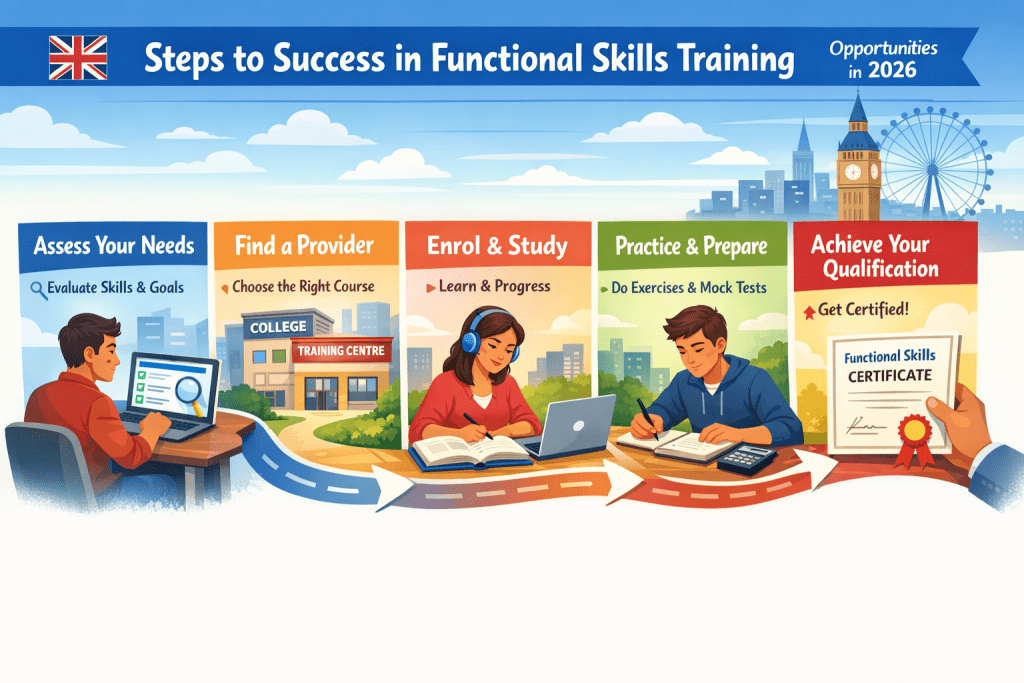
Embarking on your Functional Skills journey in 2026 is a straightforward process, offering flexibility to suit various lifestyles and learning preferences. The key is to assess your current level, choose the right learning pathway, and commit to consistent study.
Assess Your Current Level:
Self-Assessment: Many training providers and online platforms offer free diagnostic assessments. These tests help identify your strengths and weaknesses in English and Maths, guiding you towards the appropriate starting level (Entry Level 1-3, Level 1, or Level 2).
Diagnostic Tests: Formal diagnostic tests are often the first step when enrolling with a college or training provider. They ensure you are placed on the correct course.
Choose Your Learning Pathway:
Local Colleges: Ideal for structured, in-person learning with direct tutor support. Check eligibility for free courses, especially if you don’t already have a GCSE A*-C/9-4 in the subject.
Private Training Providers: Often integrate Functional Skills into apprenticeship programmes. They can offer flexible learning, including online and blended options [1]. If you’re an adult apprentice, discuss with your employer if they still require this qualification, given the recent policy changes [1].
Online Learning: Offers immense flexibility. Platforms provide resources, practice tests, and often online tutor support. This is great for those balancing work or family commitments.
Enrol and Study:
Enrolment: Once you’ve chosen a provider and had your level assessed, enrol in the appropriate course. Ensure you understand the course structure, duration, and exam details.
Study Materials: Utilise textbooks, online resources, practice papers, and revision guides. Focus on the practical application of skills, as this is what Functional Skills exams test.
Time Management: Dedicate regular time to study. Even short, consistent sessions can be more effective than cramming.
Practice and Prepare for Exams:
Past Papers: Regularly work through past exam papers to familiarise yourself with the format, question types, and time constraints. This is crucial for building confidence.
Focus on Weaknesses: Dedicate extra time to areas identified in your initial assessment or through practice where you struggle.
Seek Support: Don’t hesitate to ask your tutor for help or join study groups. Effective communication, a skill honed through Functional Skills English, will serve you well here.
Real-World Application: Actively look for opportunities to use your English and Maths skills in everyday life – checking bills, writing formal emails, budgeting, calculating recipes. This reinforces learning.
Sit the Exam:
Functional Skills exams are typically short, practical, and administered under controlled conditions.
For Maths, both non-calculator and calculator papers are common.
For English, there are separate papers for Reading, Writing, and Speaking, Listening & Communication.
Anecdote: Liam, a young professional aiming for a digital media executive role, realised his CV needed a boost. He had left school without a strong maths qualification. He took an online Functional Skills Maths Level 2 course, dedicating an hour each evening after work. The practical focus helped him see how percentages related to analytics and budgeting for campaigns. He passed his exam, updated his CV, and felt much more confident discussing figures in his job interviews. His Functional Skills certificate helped him secure his current role and propelled his career forward.
Frequently Asked Questions about Functional Skills
What is the difference between Functional Skills and GCSEs?
Functional Skills are practical, applied qualifications focused on real-world use of English and Maths for daily life, learning, and work [1]. GCSEs are broader, more academic qualifications often covering a wider curriculum and theoretical concepts. While Level 2 Functional Skills are often considered equivalent to a GCSE grade 4 (C), they have a different learning approach and assessment style.
Are Functional Skills accepted by universities?
Some universities and higher education institutions accept Functional Skills Level 2 as an alternative to GCSE English and Maths for entry onto certain courses. However, it’s crucial to check the specific entry requirements for each university and course you are interested in, as many still prefer or require GCSEs.
How long does it take to complete Functional Skills?
The time it takes varies depending on your starting level, prior knowledge, and the intensity of the course. Some learners can complete a Functional Skills qualification in a few weeks with intensive study, while others may take several months part-time. Most providers offer flexible programmes.
Can I study Functional Skills online?
Yes, many accredited providers offer Functional Skills courses fully online, providing flexibility for learners to study at their own pace and from any location. These programmes often include online resources, tutor support, and remote or local exam sittings.
Do I have to pay for Functional Skills courses?
For eligible adult learners in the UK (typically those aged 19+ who do not already have a GCSE A*-C/9-4 in the subject), Functional Skills courses are often government-funded and therefore free. For apprentices aged 16-18, the cost is covered as part of their apprenticeship programme. It’s always best to check with your chosen provider for specific funding eligibility.
What happens if I fail my Functional Skills exam?
If you don’t pass your Functional Skills exam on the first attempt, you can usually resit it. Many providers offer additional support and re-takes, though there might be a waiting period or a fee for subsequent attempts. The recent withdrawal framework also provides options for those facing significant difficulties, requiring employer agreement [1].
Are Functional Skills recognised by employers?
Yes, Functional Skills are nationally recognised qualifications and are highly valued by UK employers. They demonstrate that an individual possesses essential practical English and Maths abilities, which are critical for effective communication, problem-solving, and general workplace competency across nearly all sectors.
Is Functional Skills Level 2 equivalent to GCSE?
Yes, Functional Skills Level 2 is widely recognised as being equivalent to a GCSE grade 4 (formerly a C grade) in English and Mathematics. This equivalency makes it a strong alternative for those who didn’t achieve these grades in GCSEs or need a practical qualification.
Conclusion
Functional Skills are far more than just qualifications; they are fundamental tools that empower individuals to navigate the complexities of modern life and the demands of the UK workplace in 2026. Whether you’re a young apprentice building a career foundation, an adult professional seeking advancement, or someone aiming to boost personal confidence, these practical English and Maths skills are indispensable.
The recent policy changes regarding adult apprenticeships highlight a shift towards more employer-led decisions, yet the intrinsic value of these skills remains constant [1]. By understanding what Functional Skills entail, recognising the pathways to gaining them, and appreciating their profound impact on career prospects, you can take proactive steps towards a brighter, more confident future. Start by assessing your current abilities, exploring the numerous flexible training options available, and committing to enhancing these vital competencies. Your journey to unlocking new opportunities begins now.