
Can you reheat microwave rice? Yes, you can reheat microwave rice, provided it has been handled and stored safely after it was first cooked. The most important steps are to cool leftover rice quickly, refrigerate it promptly, consume it within 24 hours, and reheat it only once until it is steaming hot throughout.
Quick Overview
This guide explains how can you reheat microwave rice safely and why proper handling is essential to reduce food safety risks. Rice is a high-risk leftover food, so the main concern is not reheating itself, but how the rice is cooled, stored, and handled before reheating.
Whether you are reheating microwave rice at home or using leftover rice from a pouch, this guide covers:
✅ How to safely cool and store cooked rice before reheating
✅ Why rice should only be reheated once for safety and quality
✅ The safest methods for reheating rice (microwave, steaming, stovetop, reheating in a bowl)
✅ When rice should be thrown away instead of reheated
✅ How to handle different types of rice, including microwave rice pouches, takeaway rice, fried rice, and chicken and rice dishes
The risk does not come from reheating rice itself. Instead, it comes from allowing cooked rice to remain at room temperature for too long. Uncooked rice can contain spores of Bacillus cereus, a bacterium associated with food poisoning. These spores may survive the cooking process. If cooked rice is then left warm or at room temperature, the bacteria can multiply and produce toxins.
Reheating may kill some bacteria, but it may not remove toxins that have already formed. This is why safe cooling and storage are just as important as the reheating method.
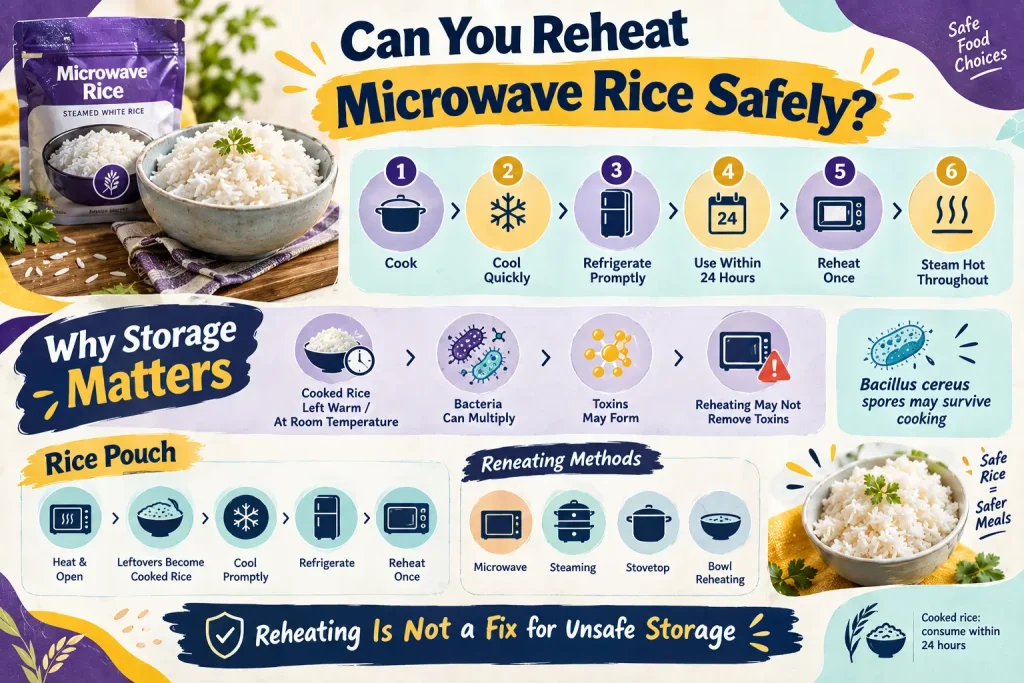
The same principle applies whether you originally cooked the rice from dry grains or used a microwave rice pouch. Once a rice pouch has been heated and opened, any leftovers should be treated as cooked rice.
This means you should not leave the remaining rice sitting in the pouch on the worktop for several hours and then assume reheating will make it safe. Instead, cool it promptly, refrigerate it, and reheat it once within the recommended storage period.
This guide explains how to reheat microwave rice safely, whether you can reheat it the next day, what to do with leftover rice pouches, and why rice should never be reheated more than once.
Can You Reheat Microwave Rice?
You can reheat microwave rice if all of the following are true:
- It was properly cooked or heated the first time.
- It was cooled quickly after the original meal.
- It was placed in the fridge promptly.
- It has been kept refrigerated.
- It has not already been reheated.
- It is still within 24 hours of the initial cooking or heating.
- You reheat it until it is steaming hot throughout.
If you cannot confirm these points, the safest option is to throw the rice away.
Microwave rice is often sold in sealed, shelf-stable pouches. Before the pouch is opened, it should be stored according to the manufacturer’s instructions. Some pouches can be heated directly in the microwave, while others may require a small tear in the packaging or transferring the rice to a bowl.
Always follow the instructions printed on the packet for the initial heating.
Once the pouch has been opened and heated, however, the rice is no longer an unopened shelf-stable product. Any unused portion becomes leftover cooked rice and needs to be cooled and refrigerated safely.
Can You Reheat Microwave Rice That Has Already Been Cooked?
Yes, you can reheat microwave rice that has already been cooked or heated, but you should only do so once.
For example, suppose you heat a full rice pouch for dinner but only eat half of it. The remaining half can be reheated the next day if you:
- Remove it from the hot pouch or serving dish.
- Cool it quickly.
- Refrigerate it as soon as possible, ideally within one hour.
- Keep it covered in the fridge.
- Reheat it within 24 hours.
- Make sure it is steaming hot throughout before eating.
Can You Reheat Microwave Rice Pouches?
Can you reheat microwave rice pouches? Yes, microwave rice pouches can usually be heated according to the packet instructions. However, heating an unopened or newly opened pouch for the first time is different from reheating leftovers from a pouch that has already been cooked.
There are three common situations:
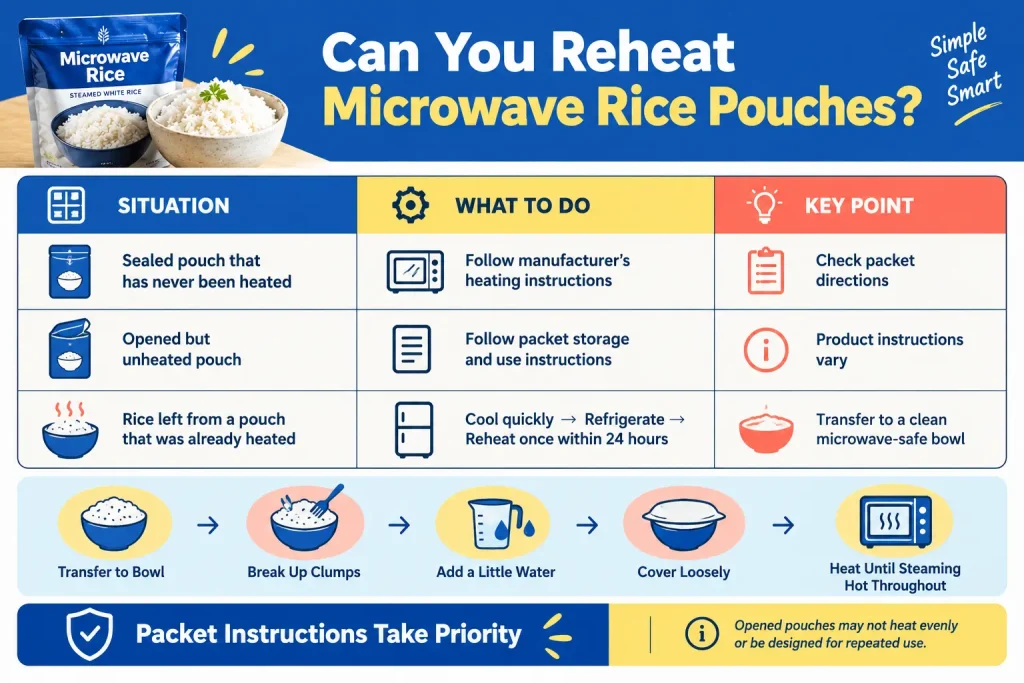
Do not automatically place a previously opened pouch back in the microwave. The packaging may not be designed for repeated use, and an opened pouch may not heat evenly.
Instead, transfer the leftover rice to a clean, microwave-safe bowl. Break up any clumps, add a small amount of water, cover it loosely and heat it until steaming hot throughout.
Packet instructions should always take priority because microwave rice products vary. Some manufacturers may advise consuming the pouch immediately after heating or recommend against storing leftovers. In that case, follow the label instructions and do not save the rice.
If you are wondering, can you reheat microwave rice after cooking, the answer depends on how the rice was cooled and stored after the initial heating. Leftover rice should be refrigerated promptly and reheated only once.
Why Can Rice Cause Food Poisoning?
When people ask, can you reheat microwave rice, they are often concerned about food poisoning. Rice may seem dry and harmless, but it requires careful handling because of a bacterium called Bacillus cereus.
Uncooked rice may contain bacterial spores. Spores are resilient survival structures that can withstand conditions that would kill ordinary bacteria, including some cooking processes.
After rice has been cooked, the spores may still be present. If the rice is kept hot until serving and eaten promptly, this is unlikely to cause a problem. However, if it is left standing at room temperature, the spores may develop into bacteria.
The bacteria can then multiply and produce toxins that may cause food poisoning.
Possible symptoms include:
- Feeling sick
- Vomiting
- Diarrhoea
- Stomach cramps
The important point is that reheating is not a reset button. Heating rice later may not destroy toxins that were produced while it was sitting at an unsafe temperature.
Therefore, the question is not simply, “Can you reheat microwave rice?” You should also ask, “Can you reheat microwave rice after cooking if it has been stored safely?” The answer depends on whether it was cooled quickly and refrigerated promptly.
Rice that was cooled quickly and refrigerated is very different from rice left in a warm pan, takeaway container or open pouch for several hours.
Why Can’t You Reheat Microwave Rice Carelessly?
Many people ask, can you reheat microwave rice safely? The answer is yes, but only if the rice has been handled, cooled and stored correctly after cooking.
You may have heard people say that you cannot reheat rice. That statement is not completely accurate. Rice can be reheated safely, but it must be handled properly to reduce the risk of food poisoning.

The main reasons for caution are:
Spores May Survive Cooking
Cooking rice does not necessarily remove all Bacillus cereus spores. These spores can survive the cooking process, which is why cooked rice still requires careful temperature control after it has been prepared.
Bacteria Can Grow During Slow Cooling
A large container of hot rice can take a long time to cool. During that period, parts of the rice may remain within a temperature range that allows bacteria to grow and multiply.
Rice May Be Left Out for Too Long
People often leave rice in a pan, rice cooker, takeaway container or microwave pouch after eating. The longer cooked rice remains at room temperature, the greater the opportunity for bacteria to multiply.
Reheating May Not Remove Existing Toxins
Although thorough reheating helps kill many bacteria, it cannot always make badly stored rice safe. Some toxins produced before reheating may remain even after the rice has been heated again.
This is why the question is not only, can you reheat microwave rice again, but also whether the rice was cooled and refrigerated promptly after its original cooking or heating.
Microwaves Can Create Cold Spots
Microwave ovens do not always heat food evenly. A bowl may feel hot around the edges while the centre remains cool. Breaking up the rice, stirring it during heating and ensuring it is steaming hot throughout can help reduce this risk.
If you are wondering, can you reheat microwave rice more than once, food safety guidance generally advises against it. Each cycle of cooling, storing and reheating increases the opportunity for bacteria to grow if the rice is not handled correctly. For this reason, leftover rice should normally be reheated only once.
You should therefore avoid judging safety based solely on how the rice looks or smells. Food containing harmful bacteria or toxins may appear completely normal. When considering can you reheat microwave rice, safe storage and handling are just as important as the reheating process itself.
How to Reheat It Safely
If you are wondering, can you reheat microwave rice safely, the answer depends on how the rice was cooled, stored and reheated after the original meal. The safest process starts as soon as you finish eating. Do not wait until the next day to think about food safety. The way the rice is cooled and refrigerated determines whether it is suitable for reheating later.
Cool It Fast
Cool leftover microwave rice as quickly as possible, ideally within one hour.
Do not leave it in a warm microwave, saucepan, rice cooker or sealed hot pouch. These environments can retain heat and slow the cooling process.
To cool rice more quickly:
- Transfer it from the pouch or cooking container.
- Place it in a clean, shallow container.
- Divide a large amount into smaller portions.
- Spread it out rather than leaving it in a deep pile.
- Keep it away from raw foods and dirty surfaces.
Refrigerate it promptly once it has cooled sufficiently.
Smaller portions lose heat faster than one large, compact mass. This is also useful because you can later reheat only the portion you intend to eat.
Do not leave rice out all evening because you are waiting for it to become completely cold. The aim is to cool it quickly and get it into the fridge, not to let it sit at room temperature for hours.
If the rice has already been left out for an uncertain amount of time, throwing it away is safer than trying to make it safe through reheating.
Eat It Quickly
Many people ask, can you reheat microwave rice next day? In most cases, yes, provided the rice was cooled quickly, refrigerated promptly and stored correctly.
Refrigerated cooked rice should be eaten within 24 hours.
This is stricter than the general rule people may follow for some other leftovers. Rice requires particular caution because of the food-safety risks associated with Bacillus cereus.
Therefore:
- Rice cooked or heated on Monday evening should generally be eaten by Tuesday evening.
- Rice should not normally be saved until Wednesday.
- If you cannot eat it within 24 hours, consider freezing it promptly after cooling, where appropriate.
- Follow the storage instructions on the microwave rice packet if they are stricter.
Label the container if you are likely to forget when it was prepared. A simple date and time can prevent uncertainty.
You should also keep your fridge cold enough to store food safely. Avoid repeatedly taking the rice out, leaving it on the worktop and returning it to the fridge.
Get It Piping Hot
The rice must be steaming hot throughout before it is eaten. It should not simply be warm.
“Piping hot” or “steaming hot throughout” means the heat has reached every part of the portion, including the centre. There should be no cold patches.
When using a microwave:
- Break up compacted rice.
- Add a small amount of water.
- Cover the bowl loosely.
- Heat it in stages.
- Stir it thoroughly.
- Continue heating until steam rises throughout.
- Allow any manufacturer-recommended standing time.
- Check the middle before serving.
Heating time depends on the portion size, microwave power, rice type and starting temperature. A small portion may reheat quickly, while a deep bowl takes longer.
Do not rely on a fixed universal heating time. Check the actual food.
If you use a food thermometer in a professional kitchen, follow your organisation’s food-safety procedures. At home, visible steam throughout, thorough stirring and checking the centre are practical signs that the rice has been reheated properly.
Can You Reheat Microwave Rice Pouches?
Many consumers ask, can you reheat microwave rice pouches after they have already been heated. The answer is yes, but only if the leftover rice has been cooled quickly, refrigerated promptly and reheated once within the recommended storage period.
For best results, transfer leftover rice from the pouch into a clean, microwave-safe container before reheating. This helps ensure more even heating and reduces the risk of cold spots.
Always follow any storage and reheating instructions provided by the manufacturer, as products may vary.
Never Reheat Twice
You should only reheat rice once.
This means rice should follow the following sequence:
Original cooking or heating → rapid cooling → refrigeration → one thorough reheating → eat immediately
It should not follow this sequence:
Original cooking → cooling → reheating → cooling again → second reheating
Repeatedly changing the temperature gives bacteria more opportunities to multiply. It also becomes difficult to track how long the rice has spent outside refrigeration.
When considering can you reheat microwave rice, food-safety guidance consistently recommends reheating only the portion you expect to eat. If you reheat a bowl of rice and cannot finish it, do not cool the remainder and save it for another day.
Discard the leftovers instead.
Best Microwave Reheating Method
If you are asking, can you reheat microwave rice safely in a microwave, the answer is yes, provided the rice has been cooled, stored and reheated correctly.
A microwave is one of the quickest ways to reheat rice, but it must be used properly. Uneven heating is the main concern. Dense clumps may stay cool in the middle even when the surface of the rice feels very hot.
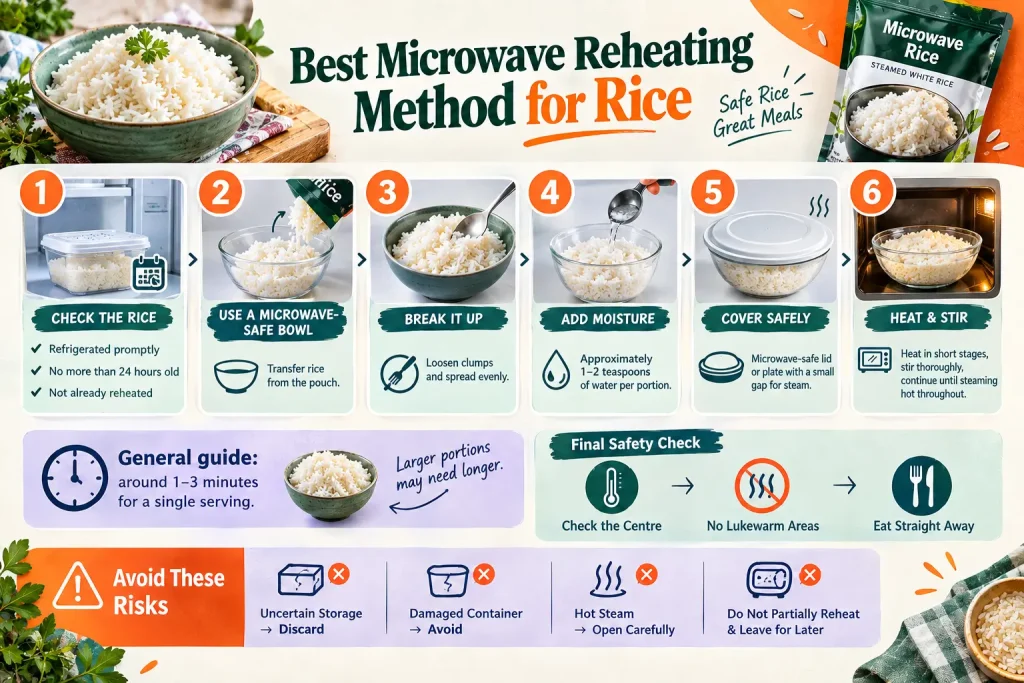
The following method helps improve both safety and texture.
Step 1: Check the Rice First
Before reheating, confirm that:
- It was refrigerated promptly.
- It is no more than 24 hours old.
- It has not already been reheated.
- The fridge remained cold.
- The container was covered.
- There are no signs that it was left out for too long.
Do not taste rice to decide whether it is safe. If you are unsure about how it was stored, discard it.
Many people ask, can you reheat microwave rice after 2 days? As a general food-safety precaution, rice is best eaten within 24 hours of cooking or initial heating. If it has been stored for longer than this, it is safer to discard it rather than risk food poisoning.
Step 2: Use a Microwave-Safe Container
Transfer the rice to a clean microwave-safe bowl or dish.
Do not use a random plastic takeaway container unless it is clearly labelled microwave-safe. Some containers can warp or release substances when heated.
Avoid reheating leftovers in a damaged or previously opened rice pouch unless the manufacturer specifically states that it is suitable for reuse.
Step 3: Break It Up
Cold rice often sticks together. Dense clumps make even reheating difficult because microwave energy may not reach the centre properly.
Use a fork or spoon to loosen the grains before heating. Separate large lumps and spread the rice into an even layer.
If the rice has been frozen, follow a safe defrosting and reheating method. Make sure it is heated thoroughly before eating.
Breaking up the rice also improves the texture. Instead of having a dry outer layer and a cold compact centre, the rice heats more evenly.
Step 4: Add Moisture
Refrigerated rice can become dry because the starch firms up as it cools. Adding a small amount of moisture helps create steam and soften the grains.
Add approximately one or two teaspoons of water per portion. There is no need to soak the rice, as too much water may make it soggy.
You can also use a suitable stock if it complements the meal, but plain water is usually the simplest option.
Distribute the water evenly over the rice rather than pouring it into one area. Once covered and heated, the moisture turns to steam and helps warm the rice more consistently.
Step 5: Cover It
Cover the bowl with a microwave-safe lid or microwave-safe plate. Leave a small gap for steam to escape unless the container instructions state otherwise.
Covering the rice:
- Retains steam.
- Helps prevent drying out.
- Encourages more even heating.
- Reduces splattering.
- Improves the finished texture.
Do not completely seal an unsuitable container, as pressure may build up. Avoid using ordinary cling film unless it is labelled microwave-safe and used according to the manufacturer’s instructions.
Be careful when removing the cover. Escaping steam can be extremely hot. Open the lid away from your face and hands.
Step 6: Heat and Stir
Heat the rice in short stages rather than setting a long cooking time and walking away.
A practical method is:
- Heat for approximately one minute.
- Remove the bowl carefully.
- Stir thoroughly from the outside towards the centre.
- Break up any remaining clumps.
- Return it to the microwave.
- Continue heating in shorter intervals.
- Stir again if needed.
- Stop only when the rice is steaming hot throughout.
The exact heating time depends on the microwave, portion size, rice variety and starting temperature. A single serving may need around one to three minutes, but this is only a general guide. Larger portions will require additional heating and more stirring.
After heating, allow the rice to stand briefly if the packet or microwave instructions recommend it. Standing time allows heat to distribute more evenly throughout the food.
Check the centre before eating. If part of the rice is only lukewarm, stir it and continue heating immediately as part of the same reheating process.
Do not partially warm the rice, leave it for later and then continue reheating. Complete the reheating process in one session and eat the rice straight away.
When considering can you reheat microwave rice, proper storage, thorough reheating and prompt consumption are all essential for food safety.
A Quick Microwave Reheating Checklist
| Step | What to do | Why it matters |
| Check storage | Confirm it was chilled promptly and is under 24 hours old | Poor storage cannot be fixed by reheating |
| Portion it | Reheat only what you will eat | Prevents a second cooling and reheating cycle |
| Transfer it | Use a clean microwave-safe bowl | Supports safe, even heating |
| Break it up | Separate compacted grains | Reduces cold spots |
| Add water | Add a small amount of moisture | Produces steam and prevents dryness |
| Cover it | Use a suitable loose cover | Holds steam and improves even heating |
| Heat in stages | Pause and stir | Moves colder rice towards hotter areas |
| Check it | Ensure it is steaming hot throughout | Warm rice is not enough |
| Eat immediately | Serve as soon as reheated | Avoids another unsafe holding period |
| Discard leftovers | Do not reheat them again | Rice should only be reheated once |
Can You Reheat Microwave Rice the Next Day?
Can you reheat microwave rice the next day? Yes, you can reheat microwave rice the next day if it was cooled quickly, placed in the fridge promptly and has remained refrigerated.
However, “the next day” must still fall within the recommended 24-hour storage period.
For example, if you cooked or heated the rice at 1 pm on Monday, eating it at 10 am on Tuesday would remain within 24 hours. Waiting until Tuesday evening may exceed that recommendation.
Time matters more than the change in calendar date.
Before reheating next-day rice, check that:
- It was not left out overnight.
- It was refrigerated soon after the meal.
- It has not already been reheated.
- It was stored in a clean, covered container.
- It remains within 24 hours of the original cooking or heating.
If the rice sat on the kitchen counter overnight, do not eat it. Placing badly stored rice in the fridge the following morning does not reverse bacterial growth or remove any toxins that may have formed.
If you are asking, can you reheat microwave rice that’s already been cooked, the answer is yes, provided it has been cooled, refrigerated and stored safely before reheating.
Can You Reheat Microwave Rice After Two Days?
Many people wonder, can you reheat microwave rice after two days? As a general food-safety precaution, cooked rice should be consumed within 24 hours of cooking or heating when refrigerated.
After 48 hours, it falls outside that recommended period.
This applies even if:
- The rice looks normal.
- It smells fine.
- It has remained covered.
- You intend to heat it for longer.
- You want to avoid wasting food.
Appearance and smell cannot reliably indicate whether harmful bacteria or toxins are present.
To reduce food waste, cook only the amount you need, divide larger pouches where the manufacturer’s instructions permit, or freeze suitable portions promptly rather than leaving them in the fridge for two days.
Can You Reheat Microwave Rice Twice?
No. You should not reheat microwave rice twice.
If rice has already been cooked, cooled and reheated, it should be eaten immediately. Any remaining portion should be discarded.
The reason is not that a second microwave cycle automatically makes rice unsafe. The concern is the repeated movement between hot, warm and cold temperatures. Each stage creates another opportunity for bacteria to multiply, particularly if cooling is slow or the rice spends time outside the fridge.
It is also easy to lose track of:
- When the rice was first cooked.
- How long it was left out.
- How quickly it cooled.
- Whether it became fully hot during each reheating.
- How long it remained warm after serving.
When considering can you reheat microwave rice that’s already been cooked, the safest approach is to reheat only the portion you intend to eat.
Avoid the problem by reheating a single serving rather than the entire container. This reduces waste and helps minimise food-safety risks associated with repeated cooling and reheating.
Can You Reheat Microwave Rice Again After It Goes Cold?
Many people ask, can you reheat microwave rice again after it has gone cold. If “again” means the rice was reheated, served and then allowed to cool down, it should not be heated a second time.
It has already been reheated once.
If the rice is still in the middle of its first reheating cycle and you discover cold patches immediately, you can stir it and continue heating until it is steaming hot throughout. This is still considered part of one continuous reheating process.
However, you should not:
- Reheat the rice.
- Leave it on the table for an hour.
- Put it back in the microwave.
- Heat it again.
Once reheated, serve and eat the rice promptly.
Can You Reheat Microwave Rice More Than Once?
No. Microwave rice should not be reheated more than once.
The clearest way to manage leftovers is to separate portions before reheating. Keep the remaining rice refrigerated and untouched until needed, provided it remains within the recommended storage period and has not previously been reheated.
For example, if you have two servings of safely refrigerated rice, remove one portion using a clean spoon and reheat it. Leave the second cold portion covered in the fridge. You may reheat that second portion later, provided it remains within the safe storage period, because it has not yet been reheated.
The first serving, however, should not be reheated again.
When people ask, why can’t you reheat microwave rice more than once, the concern is not the microwave itself. The issue is that repeated cycles of cooling, storage and reheating create more opportunities for bacteria to multiply if the rice is not handled correctly.
Can You Eat Leftover Microwave Rice Cold?
Cooked rice may be eaten cold if it was cooked properly, cooled quickly and refrigerated safely. It should still be consumed within 24 hours of cooking or initial heating.
Cold rice can be used in dishes such as rice salads, but safe preparation remains essential. Keep it refrigerated until needed and do not leave it sitting on a buffet table, desk or packed lunch for an extended period.
If you prefer cold rice, you do not need to warm it first. In fact, eating it cold avoids an additional temperature cycle. However, the original cooling and storage must still have been carried out safely.
When considering can you reheat microwave rice, remember that proper storage is just as important as the reheating process itself.
Do not eat cold rice that was left out overnight or stored under uncertain conditions.
Can You Freeze Leftover Microwave Rice?
You can freeze cooked rice, but it must be cooled quickly and frozen promptly while it is still safe to eat.
Freezing can be useful if you will not consume the rice within 24 hours. Divide it into smaller portions so that it freezes and later reheats more evenly.
Use a clean, freezer-safe container or bag. Label it with the date and portion size. When you are ready to use it, follow safe defrosting practices and reheat it until steaming hot throughout.
Many people ask, can you reheat microwave rice in the microwave after freezing. Yes, provided the rice has been defrosted safely where required and reheated thoroughly until piping hot throughout.
Remember:
- Freezing does not make unsafe rice safe again.
- Freeze rice while it is still within the safe storage period.
- Defrost it safely.
- Reheat it only once.
- Do not refreeze rice after reheating.
Always check the original microwave rice packaging because manufacturers may provide product-specific freezing, storage or reheating instructions.
Common Mistakes When Reheating Microwave Rice
When asking can you reheat microwave rice safely, avoiding the following common mistakes is just as important as using the correct reheating method.
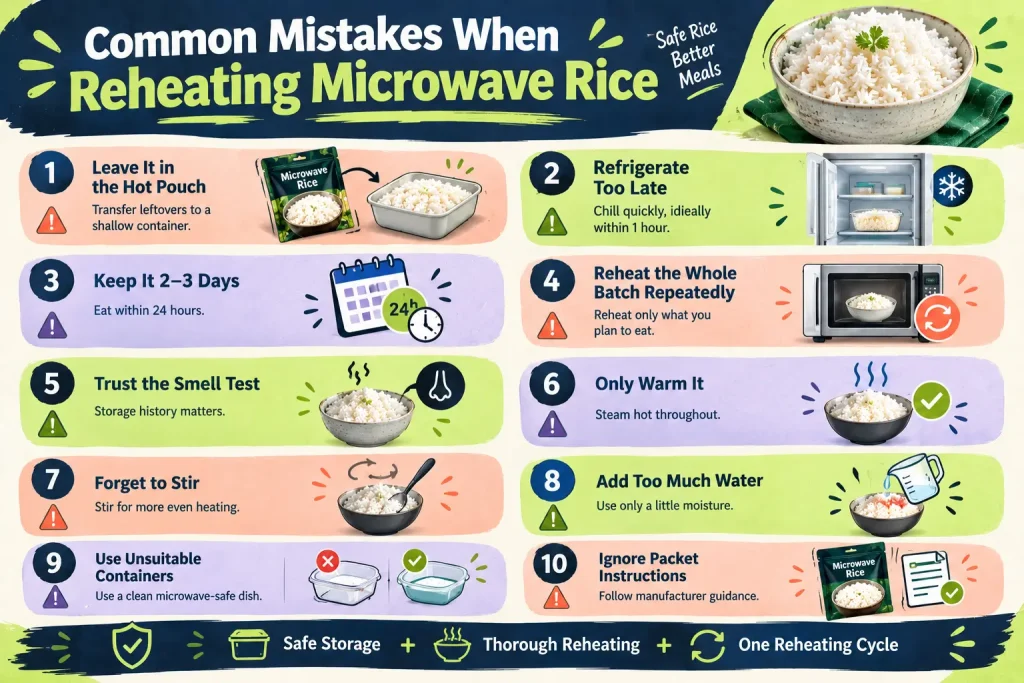
Leaving It Inside the Hot Pouch
A recently heated pouch can retain warmth and slow cooling. Transfer genuine leftovers to a shallow container instead.
Waiting Several Hours Before Refrigerating
Rice should be chilled quickly, ideally within one hour. Do not leave it out until bedtime after an early dinner.
Keeping It in the Fridge for Two or Three Days
Cooked rice should be eaten within 24 hours, not treated like an ordinary leftover that may last longer.
Heating the Whole Batch Repeatedly
Reheat only the amount you plan to eat. Do not warm the same rice over and over.
Trusting the Smell Test
Unsafe rice may look and smell normal. Storage history is more important.
Warming Rather Than Reheating
The rice must be steaming hot throughout. Lukewarm rice may contain cold spots.
Forgetting to Stir
Microwaves can heat unevenly. Stirring helps distribute heat throughout the portion.
Adding Too Much Water
A little water improves texture, but too much can make the rice wet and uneven.
Using Unsuitable Containers
Transfer the rice to a clean, microwave-safe dish rather than heating it in damaged packaging or non-microwave-safe plastic.
Ignoring the Manufacturer’s Instructions
Packet guidance may include specific heating, standing, storage and disposal instructions. Always follow them.
How to Store Leftover Microwave Rice Safely
If you want to know can you reheat microwave rice safely the next day, proper storage is the most important step.
Safe storage can be summarised in five steps:
- Remove it from the heat: Do not leave leftover rice in a warm cooker, pan or pouch.
- Divide it: Put large amounts into smaller, shallow portions.
- Cool it quickly: Aim to refrigerate it as soon as possible, ideally within one hour.
- Cover it: Use a clean, food-safe container with a lid.
- Use it within 24 hours: Reheat once or eat it cold, then discard anything left.
Keep cooked rice away from raw meat, poultry and unwashed produce. Use clean spoons and containers to avoid cross-contamination.
Do not add freshly heated rice to an older container of cold rice. This can warm the stored portion and make it difficult to know which batch was prepared when.
Microwave Rice Safety at Work
For people wondering can you reheat microwave rice at work, the same food-safety principles apply, but shared kitchens can introduce additional risks.
Fridges may be overcrowded or too warm. People may leave food on desks. Shared microwaves may not heat evenly. Containers and utensils may not always be clean.
For a safer work lunch:
- Bring rice in a clean, sealed container.
- Put it in the fridge as soon as you arrive.
- Do not leave it in a warm bag all morning.
- Use a clean microwave-safe bowl.
- Break it up and add a little water.
- Cover it loosely.
- Stir during reheating.
- Check that it is steaming hot throughout.
- Eat it immediately.
- Do not take reheated leftovers home again.
If you cannot rely on suitable refrigeration at work, choose an alternative lunch or use properly chilled storage.
People working in hospitality, healthcare, education or food businesses should follow their organisation’s food-safety procedures rather than relying solely on general home advice.
Microwave Rice Safety for Students
Students often ask can you reheat microwave rice in shared accommodation. The answer depends on how safely it has been stored. (food.gov.uk)
Microwave rice is convenient for students living in halls or shared accommodation. Limited fridge space and irregular meal times can make safe storage more challenging, so planning ahead is important.
Label your container so housemates do not move or eat it. Check that the shared fridge is working properly and avoid storing rice in the fridge door, where temperatures can fluctuate more.
Do not leave leftover rice in your bedroom after a late meal and plan to refrigerate it the following morning. By then, it may have spent too long at room temperature.
If you are unsure whether the rice was stored safely, throw it away. Replacing one serving of rice is better than risking food poisoning.
Learning basic food hygiene can help students and workers make safer decisions not only with rice but also with meat, seafood, dairy products and other leftovers.
Final Thoughts
So, can you reheat microwave rice safely? Yes, but only when the rice has been handled correctly from the moment the original meal ends.
Cool leftovers quickly, ideally within one hour. Transfer them from the hot pouch or cooking container into a clean, shallow container. Refrigerate the rice promptly and consume it within 24 hours.
When reheating, use a microwave-safe bowl. Break up compacted grains, add a small amount of water, cover the bowl and heat in stages. Stir thoroughly to eliminate cold spots and continue heating until the rice is steaming hot throughout.
Most importantly, never reheat rice more than once. Reheat only the amount you intend to eat and discard anything left after that meal.
The rule is straightforward: cool it quickly, eat it promptly, heat it thoroughly and never reheat it twice. Following these steps allows you to enjoy convenient microwave rice while keeping food-poisoning risks as low as possible.