

Can you reheat salmon nicely? Yes—you can reheat salmon safely, provided it has been cooked properly, cooled quickly, stored in the fridge, and reheated only once. This aligns with standard food safety guidance on handling cooked fish and refrigerated leftovers. The salmon should be steaming hot throughout before you eat it to ensure it is safe to consume.
Quick Overview
This guide looks at how can you reheat salmon safely and why correct storage and handling matter more than the reheating itself. Salmon is a delicate, perishable food, so the key risk comes from how it is cooled, stored, and kept before it is reheated.
Whether you are reheating leftover homemade salmon or restaurant takeaway fish, this guide explains:
✅ How to properly cool and store salmon before reheating
✅ Why salmon should only be reheated once for safety and best quality
✅ The safest reheating methods (oven, air fryer, skillet, stovetop, microwave)
✅ When salmon should not be reheated and should be discarded instead
✅ How different salmon dishes behave, including fillets, patties, fishcakes, pasta, rice dishes, en croûte, and Wellington
The main challenge is maintaining texture. Salmon contains delicate flesh and natural oils, so excessive heat can quickly turn a tender fillet dry, firm, and less palatable. The best reheating methods therefore use moderate temperatures, gentle heat, and a little added moisture to help preserve its natural softness.
From a food safety and culinary best-practice perspective, the oven is generally the most reliable all-around option because it reheats salmon gradually and evenly. An air fryer works well for salmon fishcakes, patties, and pastry-covered dishes, as it helps retain crispness while reheating efficiently. A skillet can restore lightly crisp edges and enhance flavour, while the microwave is the quickest option, but should be used carefully to avoid uneven heating or overcooking.
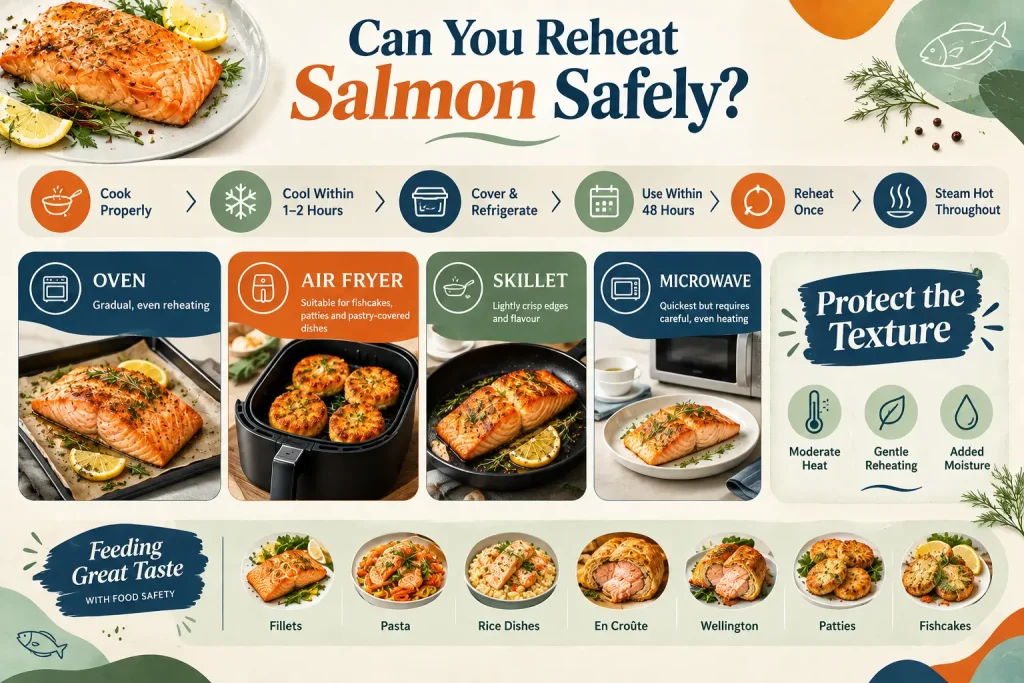
Food safety remains essential regardless of the method. Leftover cooked salmon should be cooled and refrigerated within one to two hours of cooking. It should be kept covered, stored at a safe chilled temperature, used within 48 hours, and reheated only once to minimise any risk of bacterial growth.
This guide covers practical methods for reheating salmon in the oven, air fryer, skillet, and microwave, as well as approaches for dishes such as salmon pasta, salmon and rice, salmon en croûte, salmon Wellington, patties, and fishcakes.
Can You Reheat Salmon Safely?
Can you reheat salmon? Yes, cooked salmon can be safely reheated when proper food safety and storage practices have been followed. Based on established food hygiene principles, reheating is only recommended if the salmon:
- Was fully cooked the first time
- Was cooled promptly after the meal
- Was placed in the fridge within one to two hours of cooking
- Has remained properly refrigerated
- Is no more than 48 hours old
- Has not already been reheated
- Will be reheated until steaming hot throughout
If you cannot confirm how the salmon was stored or handled, it is safer to discard it. Food safety guidance consistently prioritises time and temperature control over smell or appearance alone.
Do not rely solely on smell or appearance. Spoiled fish may develop a sour or ammonia-like smell, a slimy texture, or discolouration, but the absence of these signs does not guarantee it is safe to eat. From a food hygiene perspective, the time–temperature history is the most reliable indicator of safety.
Salmon left out at room temperature for several hours should not be refrigerated and reheated later, even if it appears normal.
How to Store Cooked Salmon Before Reheating
Safe reheating begins with correct storage. If salmon is left warm for too long or allowed to dry out, reheating cannot fully restore its quality or safety.
After the original meal:
- Allow excess steam to escape briefly
- Remove the salmon from any hot tray, pan, or serving dish
- Place it in a clean, shallow airtight container
- Cover it properly once cooled slightly
- Refrigerate within one to two hours
- Consume within 48 hours for best safety and quality
For larger portions, divide the salmon into smaller pieces before refrigerating. This helps it cool faster and more evenly, which is important for reducing bacterial growth risk.
Store sauces separately where possible. Delicate salmon fillets reheat more successfully when moisture levels can be controlled. Cream, butter, or tomato-based sauces may also require different reheating times and can affect texture if mixed too early.
Avoid repeatedly taking salmon in and out of the fridge. Only remove the portion you plan to eat and keep the rest properly chilled.
Can you reheat salmon and rice? Yes, but only if both have been cooled and stored correctly. Rice in particular requires careful handling due to the risk of bacterial growth if left at room temperature for too long.
For safe reheating:
- Ensure both salmon and rice were refrigerated within one to two hours
- Store rice in shallow containers to cool quickly
- Reheat both thoroughly until steaming hot throughout
- Do not reheat more than once
If either the salmon or rice has been left out for an extended period, it is safer to discard the meal.
How Long Can Cooked Salmon Stay in the Fridge?
UK food safety guidance generally recommends eating refrigerated leftovers within 48 hours or freezing them for later use. This is the key principle behind can you reheat salmon, as safe reheating depends entirely on how long the salmon has been stored and at what temperature.
For example, salmon cooked on Monday evening should typically be eaten or frozen by Wednesday evening. Leaving it until Thursday would take it beyond the recommended safe storage window.
The exact calendar date is less important than the time of cooking. If the salmon was cooked at 8 pm, the 48-hour countdown begins from that moment. This is important when considering can you reheat salmon pasta or any other leftover dish containing fish, as the same timing rules apply regardless of how the salmon is served.
The salmon must also have been refrigerated promptly. The 48-hour guideline does not make food safe if it was left at room temperature for several hours before being stored.
Keep your fridge at a temperature between 0°C and 5°C. If you are unsure, use a fridge thermometer. Avoid overfilling the fridge so that cold air can circulate properly, as this supports safer storage when considering can you reheat salmon later.
Can You Reheat Salmon the Next Day?
Yes, can you reheat salmon the next day when it has been cooled and refrigerated within one to two hours of cooking. In most cases, next-day salmon is still well within the 48-hour safe storage window, making it suitable for reheating or eating cold.
When thinking about can you reheat salmon pasta, the same rule applies: both the salmon and the pasta must have been properly chilled and stored. Combined dishes can spoil faster if left at room temperature, so proper cooling is essential.
Before reheating, check that:
- The container has remained properly refrigerated
- The salmon has not already been reheated
- It was not left out overnight
- You are only reheating the portion you plan to eat
- There are no obvious signs of spoilage
You can also eat properly stored salmon cold the next day. Cold salmon is often used in salads, sandwiches, wraps, and grain bowls. This is a safe alternative when considering can you reheat salmon in the microwave, especially if you want to avoid drying out the fish through reheating.
Can You Reheat Salmon Twice?
No, can you reheat salmon twice is not recommended from a food safety perspective.
A safe handling sequence is:
Original cooking → rapid cooling → refrigeration → one thorough reheating → immediate consumption
Avoid:
Original cooking → cooling → reheating → cooling again → second reheating
Repeated heating and cooling increases the risk of bacterial growth and makes it harder to track how long the food has been in and out of refrigeration. This applies equally when considering can you reheat salmon in the microwave, as microwaving does not remove the risk associated with multiple reheating cycles.

Only reheat the portion you intend to eat. If you accidentally reheat too much, it is safer to discard the remainder rather than refrigerate and reheat it again later.
You may stir, turn, or check the salmon during a single continuous reheating process. This does not count as reheating twice. The concern arises when food is fully cooled and then reheated again as part of a new cycle, especially in dishes like can you reheat salmon pasta, where mixed ingredients can complicate storage and safety.
Preparing Salmon for Reheating
Before choosing a method, it is important to prepare the salmon correctly, as this directly affects safety and quality when considering can you reheat salmon.
Take the portion from the fridge shortly before reheating. Do not leave it on the worktop for an extended period in an attempt to bring it fully to room temperature, as this increases food safety risks.
Remove any unsuitable packaging and place the salmon in an ovenproof, air fryer-safe, or microwave-safe container depending on your chosen method. Proper handling at this stage is important when assessing can you reheat salmon en croute, as pastry-based dishes require even more careful temperature control.
Check for bones, especially if you plan to flake the salmon into pasta, rice, or a sauce. Cooked salmon bones can be difficult to detect once the fish has been broken up, which is particularly relevant when thinking about can you reheat salmon wellington, where the fish is often enclosed and less visible.
To help retain moisture during reheating, you may add a small amount of:
- A teaspoon of water
- A squeeze of lemon juice
- A small drizzle of olive oil
- A small knob of butter
- A spoonful of sauce
- A light splash of stock
Only a small amount is needed. The aim is to gently maintain moisture, not to boil or soak the fish. This principle applies whether you are considering can you reheat salmon en croute or a simple fillet.
The Oven Method (Best Overall)
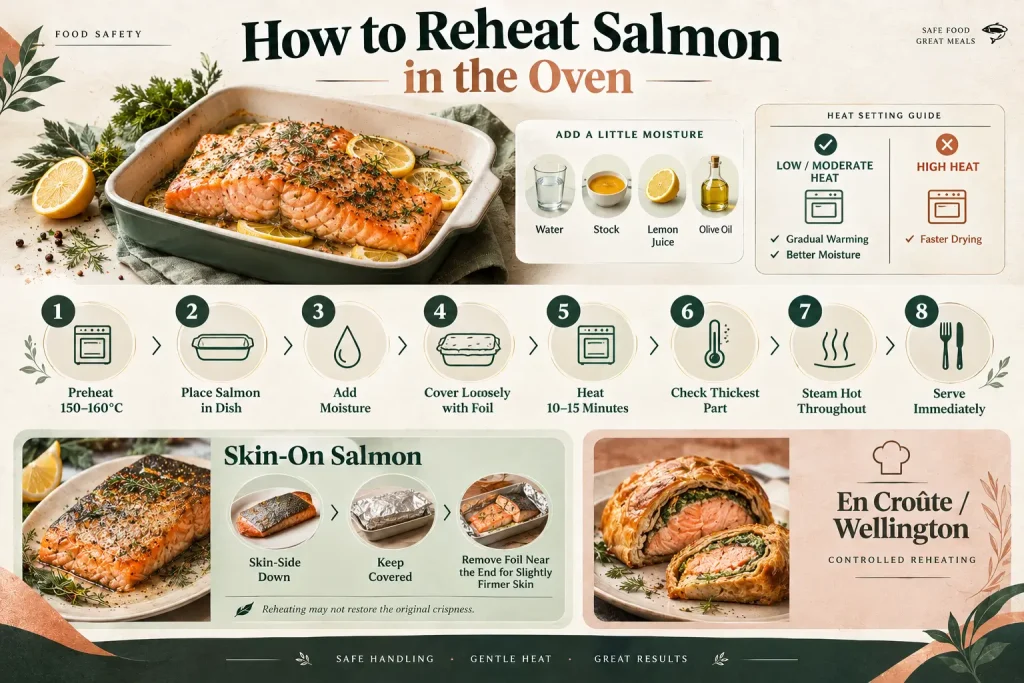
The oven is widely regarded as the best method for reheating salmon, particularly fillets, steaks, and larger portions. From a food safety and culinary perspective, can you reheat salmon is best answered using gentle, even heat rather than rapid high-temperature methods.
The oven provides slow, consistent heating, which helps preserve texture and reduces the risk of drying out. This is especially important when considering can you reheat salmon wellington, as pastry dishes require controlled reheating to avoid overcooking the fish while keeping the pastry from becoming soggy.
The main disadvantage is time. However, the improved texture and more even internal temperature generally make it the preferred method.
How to reheat salmon in the oven
- Preheat the oven to approximately 150°C to 160°C, depending on your appliance
- Place the salmon in a small ovenproof dish
- Add a teaspoon of water, stock, lemon juice, or olive oil
- Cover the dish loosely with foil
- Place in the oven
- Heat for approximately 10 to 15 minutes
- Check the thickest part
- Continue heating if necessary until steaming hot throughout
- Serve immediately
The exact timing will depend on thickness, portion size, whether it is chilled or room temperature, and whether it is part of a dish like can you reheat salmon en croute, which may require slightly adjusted timing due to pastry insulation.
Thin fillets may heat in under 10 minutes, while larger portions or wrapped dishes such as can you reheat salmon wellington may take significantly longer.
Why low heat works better
High heat causes salmon proteins to contract quickly, forcing moisture out of the flesh. This is one of the main reasons people find reheated salmon dry or flaky.
Using moderate heat allows the centre to warm gradually before the exterior overcooks. This is a key principle in food safety and quality when evaluating can you reheat salmon, especially in structured dishes like can you reheat salmon en croute.
Covering the dish loosely helps trap steam and retain moisture. You may remove the foil during the final few minutes if you prefer a slightly firmer surface, but this should be done carefully to avoid drying out the fish.
Reheating salmon with skin in the oven
Place the salmon skin-side down in the dish. Keep it covered for most of the reheating time to protect the flesh.
If you want the skin slightly crisp, you can remove the foil towards the end and increase the heat briefly. However, it is important to monitor closely, as the fish is already cooked and can dry out quickly.
It is worth noting that reheating will not usually restore the original crispness of freshly cooked skin. In dishes like can you reheat salmon wellington, texture is more dependent on the pastry than the skin itself, so results will vary.
For crispier results, alternative methods such as a skillet or air fryer may be more effective, but the oven remains the most balanced option for safely answering can you reheat salmon en croute and similar dishes.
The Air Fryer Method (Quickest and Easiest)
An air fryer is one of the quickest ways to reheat salmon and is often a practical option when considering can you reheat salmon safely and efficiently. It reheats food faster than a conventional oven and can help restore a lightly roasted exterior.
This method is particularly effective for items like salmon patties, fishcakes, and breadcrumb-coated portions. When considering can you reheat salmon patties, the air fryer is often preferred because it helps maintain crispness while ensuring the centre heats through properly.
However, the strong circulating air can dry out an uncovered fillet. For this reason, it is best to use a moderate temperature rather than the highest setting, especially when thinking about can you reheat salmon pasta in the microwave as an alternative method for more delicate or saucy dishes.
How to reheat salmon in an air fryer
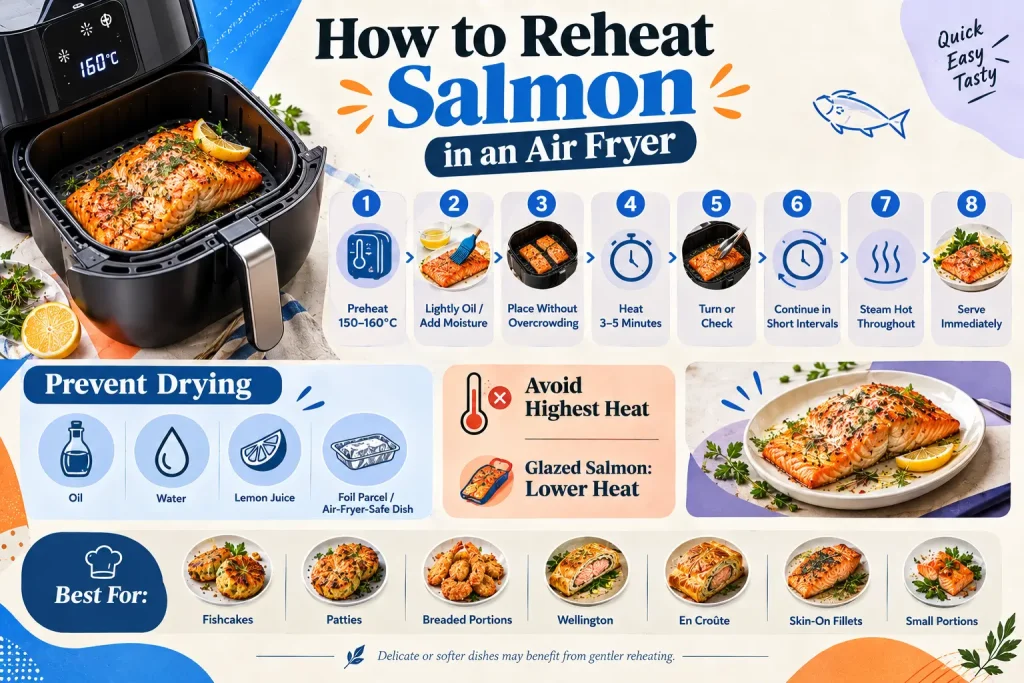
- Preheat the air fryer to approximately 150°C to 160°C if your model requires preheating
- Lightly brush the salmon with oil or add a small amount of moisture
- Place it in the basket without overcrowding
- Heat for 3 to 5 minutes
- Turn or check the salmon
- Continue in short intervals until steaming hot throughout
- Serve immediately
Thicker fillets may require longer than five minutes. From a food safety perspective, it is important to check the centre temperature rather than relying only on surface appearance when evaluating can you reheat salmon patties or fillet portions.
Preventing air-fried salmon from drying out
To maintain moisture, lightly oil the salmon or add a few drops of water or lemon juice before reheating. You may also use a small foil parcel or an air-fryer-safe dish if the fish is already dry.
Avoid tightly wrapping the food in a way that blocks airflow or conflicts with the manufacturer’s instructions. This is especially important when comparing methods such as can you reheat salmon pasta in the microwave, where moisture retention is handled differently.
For glazed salmon, lower heat is recommended to prevent sugars in the glaze from burning. If the coating is sticky, use a suitable liner or dish to keep the basket clean.
When the air fryer works best
Based on practical cooking performance and texture retention, the air fryer is most suitable for:
- Salmon fishcakes
- Salmon patties
- Breaded salmon portions
- Salmon Wellington portions
- Salmon en croûte
- Skin-on fillets
- Small individual portions
When considering can you reheat salmon patties, this method is generally one of the best options for maintaining both texture and internal heat.
For delicate poached salmon fillets or softer dishes, an oven or gentle stovetop method may provide better moisture control and more even results than attempting can you reheat salmon pasta in the microwave, which can sometimes dry out or unevenly heat fish if not carefully managed.
The Skillet Method (Best for Edges)
A skillet is ideal when you want to gently warm salmon while restoring lightly browned edges or crisp skin. It is a reliable method when assessing can you reheat salmon in a way that balances flavour, texture, and moisture.
This method works best for firm fillets and salmon steaks. It is less suitable for very flaky fish, which may break apart during handling.
How to reheat salmon in a skillet
- Place a non-stick or well-seasoned skillet over low to medium-low heat
- Add a small amount of oil or butter
- Place the salmon in the pan, skin-side down where applicable
- Add a teaspoon of water beside the fish
- Cover the skillet with a lid
- Heat gently for 2 to 4 minutes
- Turn carefully if needed
- Continue until the centre is steaming hot
- Serve immediately
This combination of direct heat and trapped steam allows the fish to heat evenly while preserving moisture. It also helps prevent overcooking when considering can you reheat salmon patties, which may dry out more quickly than whole fillets.
How to keep the salmon intact
Use a wide spatula and avoid turning the fish repeatedly, as cooked salmon flakes easily after refrigeration. This is especially important when preparing dishes related to can you reheat salmon pasta in the microwave, where flaked salmon is often mixed into sauces or pasta.
If the portion has no skin, placing it on baking parchment or using a high-quality non-stick surface can help prevent sticking and breaking.
Do not press the salmon down while cooking, as this forces out moisture and damages the texture. Maintaining structure is particularly important when considering can you reheat salmon patties, where the goal is to preserve shape as well as flavour.
On the Stovetop (Fast & Crispy)
The stovetop is a practical and reliable method when considering can you reheat salmon that has already been flaked or incorporated into another dish. Unlike reheating a whole fillet in a skillet, this approach is better suited to smaller pieces mixed with sauces, vegetables, pasta, or rice.
This method is particularly useful when thinking about can you reheat salmon the next day, as leftover portions are often already broken up and stored in mixed dishes.
Reheating flaked salmon on the stovetop
- Warm the accompanying sauce or other ingredients first
- Reduce the heat to low
- Add the cooked salmon near the end of cooking
- Fold it through gently
- Cover the pan briefly
- Continue heating until the salmon and the entire dish are steaming hot
- Serve immediately
Adding the salmon at the end prevents it from being exposed to direct heat for too long, which helps preserve texture and reduces the risk of drying out. This is especially important when considering can you reheat salmon the next day, as stored fish can become more delicate after refrigeration.
For crisp flaked edges, use a lightly oiled pan and spread the salmon in a single layer. Allow it to heat briefly before turning gently. This works well for breakfast hash, fried potatoes, and certain rice-based dishes.
Reheating salmon in sauce
A sauce helps protect salmon from drying out during reheating. Tomato, cream, coconut, and butter-based sauces all help transfer heat evenly through the fish, which supports safe handling when asking can you reheat salmon in mixed dishes.
Heat the sauce first, then add the cooked salmon. Avoid boiling it vigorously for an extended period, as this can cause the fish to become tough and break apart.
Stir gently and ensure that both the sauce and salmon are steaming hot throughout before serving.
The Microwave Method (Quickest, but Use Caution)
Yes, can you reheat salmon in the microwave. It is the fastest reheating method, but also the most likely to produce uneven results such as dry edges, a cold centre, or a strong fish aroma if not handled carefully.
The microwave is best suited for small portions, salmon already mixed into sauce, or situations where speed is more important than texture quality.
This method is also commonly used when considering can you reheat salmon the next day, particularly for leftovers such as pasta dishes or meal-prepped containers.
How to reheat salmon in the microwave
- Place the salmon in a microwave-safe dish
- Add a teaspoon of water, lemon juice, sauce, or stock
- Cover loosely with a microwave-safe lid or plate
- Use a medium or reduced power setting where possible
- Heat for approximately 30 seconds
- Check and turn or rearrange the salmon
- Continue in 20–30 second intervals
- Stop when steaming hot throughout
- Allow recommended standing time
- Serve immediately
Avoid microwaving thick fillets at full power for several minutes continuously, as this can result in uneven heating. The outside may overcook while the centre remains underheated, which is an important safety consideration when evaluating can you reheat salmon the next day.
Can you reheat salmon pasta in the microwave?
Yes, can you reheat salmon the next day is often most commonly asked in relation to pasta dishes, and salmon pasta can be safely reheated in the microwave if it has been cooled promptly and stored in the fridge for no more than 48 hours.
Transfer it to a microwave-safe bowl and add a splash of water, milk, or suitable sauce. Cover loosely and heat in short intervals.
Stir thoroughly between heating cycles, as pasta dishes tend to heat unevenly. Ensure the salmon, pasta, and sauce are all steaming hot throughout before serving.
Cream-based sauces may separate slightly during reheating. Using lower power settings and gentle stirring can help maintain a smoother texture and improve overall results.
Managing the smell
Covering the salmon helps contain splashes and may reduce odour during reheating. Adding a small amount of lemon juice can also help freshen the flavour slightly.
Clean the microwave promptly after use. A bowl of water with lemon heated briefly can help loosen residue, but regular cleaning is still required for hygiene purposes.
In shared or workplace kitchens, it is important to be considerate when considering can you reheat salmon the next day, as even properly reheated fish can produce a strong lingering smell.
Why You Should Avoid the Microwave
The microwave is not automatically unsafe. Properly stored salmon can be safely reheated in it until steaming hot throughout, which is an important baseline when considering can you reheat salmon from a food safety perspective.
However, the reasons to avoid it are mainly related to quality, texture, and control rather than safety.
It heats unevenly
Microwaves can create hot and cold spots. The thin edges may become dry while the thicker centre remains cool. Turning, rearranging, and allowing standing time can reduce this issue, but compared with other methods, the oven generally reheats salmon more evenly when assessing can you reheat salmon fishcakes or fillets.

It can dry the salmon quickly
Salmon is already fully cooked, so applying high microwave power forces moisture out of the flesh. This can result in a dry or rubbery texture. Short intervals and reduced power are essential for maintaining quality when considering can you reheat salmon fishcakes or delicate portions.
It can strengthen the smell
Microwave heating releases steam and oils rapidly, which can intensify the fish smell. This may be particularly noticeable in shared environments such as offices, classrooms, or accommodation. This is a practical consideration when deciding can you reheat salmon in a workplace setting.
It damages crisp textures
Salmon skin, breadcrumbs, and pastry tend to soften in the microwave. For this reason, ovens or air fryers are generally better for maintaining texture, especially when evaluating can you reheat salmon fishcakes, which rely on a crisp exterior.
It encourages rushed reheating
People often use the microwave for quick reheating and may consume food before it is evenly heated. From a food safety standpoint, leftovers should always be steaming hot throughout to ensure safe consumption when asking can you reheat salmon fishcakes or similar dishes.
If the microwave is your only option, it should be used carefully rather than avoided entirely. Cover the dish, use medium power, heat in stages, and always check the centre temperature.
Can You Reheat Salmon and Rice?
Yes, can you reheat salmon with rice is possible, but rice introduces an additional food safety consideration.
Cooked salmon leftovers should generally be refrigerated within one to two hours and consumed within 48 hours. Cooked rice should be cooled more quickly—ideally within one hour—and eaten within 24 hours when refrigerated, according to standard food hygiene guidance.
Therefore, a combined salmon and rice meal should follow the stricter rice safety rule:
- Cool quickly, ideally within one hour
- Refrigerate promptly
- Consume within 24 hours
- Reheat only once
- Ensure the entire dish is steaming hot
Best way to reheat salmon and rice
Where practical, separate the salmon from the rice. Reheat the rice with a small splash of water, covering and stirring to eliminate cold spots. Warm the salmon gently using the oven, skillet, or microwave.
If separation is not possible, place the meal in a microwave-safe dish, add a splash of water to the rice, and cover loosely. Heat in intervals and stir the rice carefully while avoiding breaking up the salmon.
Always check both the centre of the rice and the thickest part of the fish to ensure even heating when considering can you reheat salmon fishcakes or mixed dishes.
Do not reheat salmon and rice that has been left at room temperature for several hours or stored beyond safe time limits.
Can You Reheat Salmon Pasta?
Yes, can you reheat salmon pasta when it has been cooled promptly, refrigerated, and kept for no more than 48 hours.
Creamy salmon pasta
Heat gently in a saucepan over low heat. Add a small splash of milk, cream, or water and stir gently. Heat gradually until steaming hot, avoiding boiling, which can cause the sauce to split and the salmon to become tough.
Tomato-based salmon pasta
Tomato sauces generally tolerate reheating well. Add a small splash of water if the sauce has thickened. Stir gently to keep salmon pieces intact.
Oven-baked salmon pasta
Cover with foil and reheat in a moderate oven. Remove the foil near the end to lightly brown the top. Always check the centre, as deeper pasta dishes take longer to heat evenly.
Microwave salmon pasta
Use a microwave-safe container, cover loosely, and heat in short intervals. Stir between each interval and ensure the entire dish is steaming hot throughout.
Can You Reheat Salmon en Croûte?
Yes, can you reheat salmon fishcakes and similar baked fish dishes differs from salmon en croûte, which requires careful reheating to preserve pastry texture.
The oven is the best method:
- Preheat to 160°C to 180°C
- Place on a baking tray
- Cover loosely with foil initially
- Heat until the centre is hot
- Remove foil near the end to crisp pastry
- Ensure filling is steaming hot throughout
- Serve immediately
Large whole portions take longer than slices. Cutting into portions before reheating improves even heating and food safety control.
Avoid microwaving salmon en croûte, as it can soften pastry and lead to uneven heating of the fish.
Can You Reheat Salmon Wellington?
Salmon Wellington is similar to en croûte and is best reheated using the oven or air fryer.
Oven method:
- Place on a baking tray
- Cover loosely with foil
- Reheat at a moderate temperature
- Remove foil near the end for crisping
- Heat until steaming hot throughout
Air fryer method:
Use a moderate temperature and monitor closely, as pastry can brown quickly before the centre is fully heated.
Large whole Wellingtons should ideally be portioned before reheating for more even results and improved safety control when considering can you reheat salmon fishcakes or pastry-based dishes.
Do not reheat Salmon Wellington more than once. Both pastry and filling should have been refrigerated promptly after cooking.
Can You Reheat Salmon Patties?
Yes, can you reheat salmon patties safely, and they generally reheat very well because their flatter shape allows heat to reach the centre more quickly and evenly compared with thicker fillets.
The air fryer, oven, skillet, and microwave are all suitable methods, depending on the texture you want to preserve.
Air fryer
Heat the patties at a moderate temperature for approximately 3 to 6 minutes, turning halfway if necessary. This method is often preferred when considering can you reheat salmon twice, as it helps maintain structure during a single reheating cycle.
Oven
Place the patties on a baking tray and heat at approximately 170°C until hot throughout. Turn once for a more even exterior and consistent internal temperature.
Skillet
Add a small amount of oil to a pan and heat the patties over medium-low heat. Turn carefully and continue until the centre is steaming hot. This method is useful for maintaining crisp edges.
Microwave
Place patties on a microwave-safe plate, cover loosely, and heat in short intervals. The coating will be softer compared with other methods, which is important to consider when evaluating can you reheat salmon in the oven versus faster reheating methods.
Do not rely only on a crisp exterior to judge doneness. Always check the centre for proper reheating from a food safety perspective.
Can You Reheat Salmon Fishcakes?
Yes, can you reheat salmon fishcakes safely, and they often retain their texture better than plain salmon fillets due to their coating and structure.
The oven or air fryer is usually the best option because both methods help restore a crisp exterior while ensuring the centre is properly heated.
Oven method
- Preheat the oven to approximately 180°C.
- Place fishcakes on a baking tray.
- Heat for 10 to 15 minutes, depending on size.
- Turn halfway if necessary.
- Ensure the centre is steaming hot.
Air fryer method
- Preheat to 160°C to 180°C if required.
- Arrange fishcakes in a single layer.
- Heat for approximately 5 to 8 minutes.
- Turn halfway through cooking.
- Check the centre before serving.
Large or dense fishcakes may require additional time. From a food safety perspective, avoid excessively high heat, as this can burn the exterior while leaving the centre underheated—especially relevant when considering can you reheat salmon twice and maintaining safe reheating discipline.
Mistakes to Avoid When Reheating Salmon
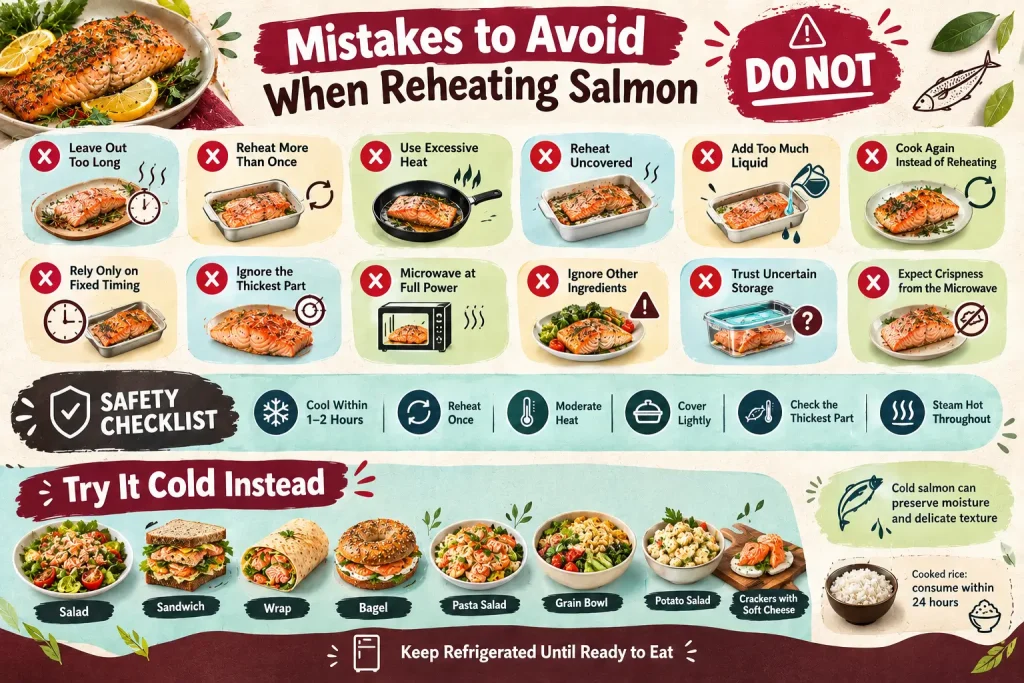
Leaving it out for too long
Cooked salmon should be cooled and refrigerated within one to two hours. Leaving it out for extended periods increases bacterial risk and is unsafe from a food hygiene standpoint.
Reheating it more than once
You should not reheat salmon twice. The correct principle is can you reheat salmon twice → no. Only reheat once, and reheat only the portion you intend to eat. Reheating repeatedly increases bacterial growth risk and reduces quality.
Using excessively high heat
High heat dries out salmon before the centre warms properly. Moderate temperatures ensure safer and more even reheating, whether using an oven or air fryer, including can you reheat salmon in the oven methods.
Reheating it uncovered
A light cover helps retain steam and moisture. This is especially important in ovens and microwaves for even heat distribution.
Adding too much liquid
A small amount of moisture helps, but excessive liquid can damage texture and dilute flavour.
Cooking it again instead of reheating it
The salmon is already cooked. The goal is safe reheating to steaming hot, not a second cooking process.
Relying on fixed timing alone
Cooking times vary depending on portion size, appliance type, and starting temperature. Always check the actual food rather than relying solely on timing.
Forgetting the thickest part
The surface may feel hot while the centre remains underheated. Always check the thickest section for safe reheating, especially in fishcakes and baked dishes.
Microwaving at full power
Full power can overcook the edges while leaving the centre cold. Use reduced power and short intervals whenever possible.
Ignoring accompanying ingredients
Rice, sauces, pasta, and pastry all have different safety and reheating requirements. The entire dish must be properly heated, not just the salmon.
Reheating from uncertain storage conditions
If you are unsure how long the salmon was left out or how it was stored, it is safer to discard it rather than risk foodborne illness.
Expecting every dish to remain crisp
Microwaves soften coatings, pastry, and skin. For crisp textures, ovens, air fryers, or skillets are generally better choices when evaluating can you reheat salmon in the oven methods versus faster alternatives.
Try It Cold
Cooked salmon does not always need reheating. Properly cooked, promptly cooled, and refrigerated salmon can be eaten cold within the recommended storage period, which is an important consideration when asking can you reheat salmon or whether it is necessary at all.
Cold salmon may actually taste better than poorly reheated fish because it retains its moisture and delicate texture.
It works well in:
- Leafy salads
- Pasta salads
- Sandwiches
- Wraps
- Bagels
- Grain bowls
- Potato salads
- Cold noodle dishes
- Couscous
- Crackers with soft cheese
Flake the salmon gently and combine it with ingredients such as cucumber, lemon, herbs, capers, yoghurt, mustard, or mayonnaise.
Keep cold salmon refrigerated until you are ready to eat it. Do not leave it in a warm packed lunch or on a buffet table for an extended period, as this increases food safety risks when considering can you reheat salmon later or consume it cold.
When preparing a cold salmon and rice bowl, remember that refrigerated cooked rice should be consumed within 24 hours. Even when not reheating, food safety rules still apply alongside can you reheat salmon guidance.
Pro-Tip: Skip Reheating Altogether!
The easiest way to avoid dry reheated salmon is to plan a cold meal from the beginning, especially when thinking about can you reheat salmon and whether reheating is even necessary. (food.gov.uk)
Instead of trying to reproduce the exact texture of a freshly cooked fillet, turn leftovers into something different.
Make a salmon salad
Flake the fish over lettuce, tomatoes, cucumber and vegetables. Add a lemon and herb dressing.
Prepare a salmon sandwich
Mix cold salmon with a little yoghurt or mayonnaise, mustard, black pepper and lemon juice.
Create a breakfast bagel
Serve cold salmon with cream cheese, cucumber and fresh herbs. This works best with salmon that was originally cooked or smoked and stored according to its packaging and food-safety requirements.
Add it to a cold pasta salad
Combine cooked pasta, salmon, vegetables and a light dressing. Make sure all ingredients have been cooled and refrigerated safely.
Use it in a wrap
Add cold salmon, salad leaves and a yoghurt-based dressing to a tortilla.
Make a grain bowl
Serve salmon with chilled grains, vegetables and a suitable dressing. If using cooked rice, follow the 24-hour rice rule.
Skipping reheating can save time, reduce food waste, avoid workplace microwave odours, and preserve texture. However, all cold storage must still follow safe handling rules when considering can you reheat salmon in other contexts.
Choosing the Best Reheating Method
| Salmon dish | Best method | Why |
| Plain salmon fillet | Oven | Slow, even, moisture-friendly |
| Skin-on salmon | Skillet or air fryer | Helps restore crispness |
| Salmon steak | Oven or skillet | Controlled heating |
| Flaked salmon in sauce | Stovetop | Sauce protects fish |
| Salmon pasta | Stovetop or microwave | Easy moisture control |
| Salmon and rice | Microwave (preferably separated) | Allows even checking |
| Salmon en croûte | Oven | Best pastry texture |
| Salmon Wellington | Oven or air fryer | Even heat + crisp pastry |
| Salmon patties | Air fryer or skillet | Restores browned edges |
| Salmon fishcakes | Oven or air fryer | Keeps coating crisp |
| Delicate poached salmon | Oven or cold | Prevents overcooking |
| Office lunch | Microwave or cold | Practical, cold avoids odour |
This table supports practical decision-making when evaluating can you reheat salmon across different meal types.
Frequently Asked Questions
Can you reheat salmon in the oven?
Yes. The oven is generally the best method. Use a moderate temperature, add a little moisture, and cover loosely until the salmon is steaming hot, in line with safe reheating practices for can you reheat salmon.
Can you reheat salmon in the microwave?
Yes. Use a microwave-safe dish, cover loosely, use reduced power where possible, and heat in short intervals. Always check the thickest part for cold spots when considering can you reheat salmon safely.
Can you reheat salmon the next day?
Yes, provided it was refrigerated within one to two hours and kept cold. This is a key safety principle behind can you reheat salmon guidance.
Can you reheat salmon twice?
No. Cooked salmon should only be reheated once. Reheating twice increases food safety risks and reduces quality, so can you reheat salmon should always be interpreted as a single-reheat rule.
Can you reheat salmon and rice?
Yes, but follow the stricter rice rule. Cool within one hour, refrigerate promptly, and eat within 24 hours. Reheat once until steaming hot throughout.
Can you reheat salmon pasta?
Yes. Reheat on the stovetop, in the oven, or microwave. Add a little liquid and stir gently until steaming hot throughout.
Can you reheat salmon en croûte?
Yes. Use the oven and cover loosely at first, removing the cover near the end to crisp pastry.
Can you reheat salmon Wellington?
Yes. Oven or air fryer works best. Use moderate heat to warm the filling before the pastry overcooks.
Can you reheat salmon patties?
Yes. Air fry, bake, or pan-fry until steaming hot in the centre while maintaining crisp texture.
Can you reheat salmon fishcakes?
Yes. Oven and air fryer are usually best for maintaining a crisp coating while ensuring even heating.
Is it better to eat leftover salmon cold?
It can be. Properly stored cold salmon often retains more moisture and texture than reheated salmon and is a safe alternative within storage guidelines.
Final Thoughts
You can reheat salmon safely when it has been fully cooked, cooled promptly, and refrigerated within one to two hours. Eat it within 48 hours and reheat it only once until steaming hot throughout, which is the core principle behind can you reheat salmon food safety guidance.
The oven is the best overall method for fillets due to even heating. Air fryers work well for patties, fishcakes, and pastry-based dishes. Skillets are ideal for restoring crisp edges, while the stovetop is best for flaked salmon in sauces or pasta.
The microwave is suitable when time is limited, but it requires careful control using lower power and short intervals to avoid uneven heating and dryness.
Extra caution is needed with combined dishes. Salmon and rice must follow the stricter rice safety rule and be consumed within 24 hours. Salmon pasta, en croûte, and Wellington should always be heated thoroughly to the centre.
Most importantly, never attempt to reheat salmon that has been left out for too long, stored beyond safe limits, or already reheated once. If the storage history is uncertain, it is safer to discard it.
Handled correctly, leftover salmon can become a safe and enjoyable second meal—whether gently reheated in the oven, crisped in an air fryer, or served cold in a fresh salad, all within safe can you reheat salmon practices.