
A HACCP Plan helps food businesses prevent food safety failures before they lead to customer complaints, contamination incidents or outbreaks. Rather than reacting after something has gone wrong, a well-designed HACCP Plan identifies potential hazards, determines where control is essential and provides clear instructions for employees on what they must monitor, record and correct.
Quick Overview
This guide explains what is the HACCP plan, the five preliminary tasks, the seven HACCP principles, practical HACCP plan examples, HACCP plan templates and the importance of regular HACCP plan review to keep food safety procedures accurate and effective.
This guide covers:
✅ What a HACCP Plan means and how it supports effective food safety management
✅ Why HACCP principles are important for controlling food safety risks
✅ The five preliminary tasks and seven HACCP principles explained with practical examples
✅ How hazards, Critical Control Points (CCPs), critical limits and monitoring procedures work together
✅ HACCP documentation, verification, corrective actions and record-keeping requirements
✅ HACCP templates, workplace applications, training considerations and UK food safety practices
HACCP principles are used across a wide range of food businesses, including restaurants, cafés, takeaways, care home kitchens, food manufacturers, retailers, bakeries, caterers and other organisations involved in preparing, handling or selling food. The level of detail required will depend on the nature and complexity of the operation. For example, a small sandwich shop may require a straightforward HACCP-based food safety system, while a factory producing chilled ready-to-eat products may need multiple detailed HACCP plans supported by scientific evidence, validation and documented verification procedures.
Creating a HACCP Plan is not simply a matter of downloading a template and adding a business name. An effective plan must be developed around the real activities of the business, including its ingredients, suppliers, equipment, premises layout, food preparation methods, customer groups and day-to-day working practices.
A properly implemented HACCP Plan demonstrates a proactive commitment to food safety by helping businesses identify risks, establish effective controls and maintain consistent standards. It also supports compliance with food safety requirements and provides employees with a structured approach to handling hazards throughout food preparation and service.
This guide explains the five preliminary tasks, the seven HACCP principles, a practical HACCP Plan example, a usable template and the ongoing review processes required to ensure the system remains accurate, effective and up to date.
What is the HACCP plan?
A HACCP Plan is a documented food safety management system that identifies significant hazards and establishes controls to prevent, eliminate or reduce those hazards to an acceptable level.
The HACCP plan meaning can be understood by breaking down the term HACCP, which stands for Hazard Analysis and Critical Control Point. It is a preventive approach used by food businesses to identify where food safety risks may occur and how those risks can be effectively controlled before food reaches the consumer.
A hazard is anything that has the potential to make food unsafe. Hazards are generally classified as microbiological, chemical or physical. Allergens are included within chemical hazards in some official classifications; however, many food businesses assess allergen risks separately because of their significant impact on food safety and consumer health.
Hazard analysis is the process of identifying which hazards could reasonably occur, assessing the severity of their consequences and determining whether existing control measures are sufficient.
A Critical Control Point (CCP) is a stage in a food process where control is essential to prevent, eliminate or reduce a food safety hazard to an acceptable level. If control is lost at this stage, the food may become unsafe.
A HACCP Plan documents the control measures, critical limits, monitoring procedures, corrective actions, verification activities and records required to manage identified food safety hazards effectively.
Unlike reactive approaches, HACCP is preventive. For example, testing a cooked chicken dish after preparation may identify a problem occasionally, but it does not provide continuous control over the process. A HACCP system examines the complete food journey, including supplier approval, refrigerated storage, preparation practices, cooking temperatures, hot holding, cooling procedures and reheating controls. This allows risks to be managed before food is served to customers.
A HACCP Plan is usually part of a wider food safety management system. This wider system includes essential controls such as cleaning and disinfection, handwashing, pest management, allergen communication, waste disposal, equipment maintenance, temperature monitoring and staff training.
These supporting controls are commonly known as prerequisite programmes (PRPs) or good hygiene practices. They provide the foundation for an effective HACCP system. A business cannot rely on a detailed HACCP document to compensate for poor hygiene standards, unsafe working practices or inadequate refrigeration.
An effective HACCP Plan must reflect what actually happens in the workplace. A document copied from another restaurant or food business may fail to consider differences in ingredients, suppliers, portion sizes, equipment, customer groups or food preparation methods. Generic HACCP templates can provide a useful starting point, but they must be adapted, implemented and verified for the specific operation.
HACCP Plan Requirements
The main HACCP Plan requirements are based on seven internationally recognised principles:
- Conduct a hazard analysis and identify food safety hazards.
- Determine the Critical Control Points (CCPs).
- Establish critical limits for each CCP.
- Establish monitoring procedures.
- Establish corrective actions when controls fail.
- Establish verification procedures to confirm the system works effectively.
- Maintain appropriate documentation and records.
Before applying these principles, a food business must establish effective basic hygiene controls. These commonly include:
- supplier approval and food sourcing controls;
- receiving and checking deliveries;
- cleaning and disinfection procedures;
- personal hygiene requirements;
- staff sickness reporting;
- temperature control;
- allergen management;
- pest control;
- waste management;
- equipment maintenance;
- calibration of monitoring equipment;
- traceability systems; and
- staff training.
The business must also clearly define the scope of the HACCP Plan. The scope explains which products, processes, areas and activities are covered. A clearly defined scope helps prevent important stages from being overlooked.
For example, a restaurant HACCP Plan may cover food handling activities from delivery through storage, preparation, cooking and service. However, if the business also provides chilled takeaway meals, off-site catering or delivery through third-party platforms, these activities must also be assessed within the food safety system.
A HACCP system should be proportionate to the size and complexity of the operation. A small café will not usually require the same level of documentation as a large food manufacturer. However, every food business must maintain sufficient evidence to demonstrate:
- what food it prepares, handles or sells;
- what hazards could affect food safety;
- how those hazards are controlled;
- which checks employees must complete;
- what actions are taken when controls fail; and
- how the business verifies that procedures remain effective.
Management commitment is a key requirement for a successful HACCP Plan. Employees must have access to suitable equipment, adequate training, sufficient time and the authority to follow food safety procedures correctly.
For example, a monitoring procedure has limited value if staff do not have access to a calibrated thermometer, do not understand critical limits or are discouraged from recording failed checks. Effective HACCP relies on accurate records, trained employees and active management involvement.
A written HACCP Plan should clearly link each significant hazard with its control measures. A typical HACCP document records:
- the process stage;
- identified hazards;
- control measures;
- CCP decisions;
- critical limits;
- monitoring procedures;
- corrective actions;
- verification methods; and
- required records.
However, producing a HACCP Plan document alone is not enough. The system must be implemented and maintained in daily operations. Employees should understand the procedures relevant to their roles, and supervisors should regularly review records to ensure they are complete, accurate and demonstrate that food safety controls are working effectively.
A well-developed HACCP Plan demonstrates a food business’s commitment to preventive food safety management, legal compliance and the protection of customers.
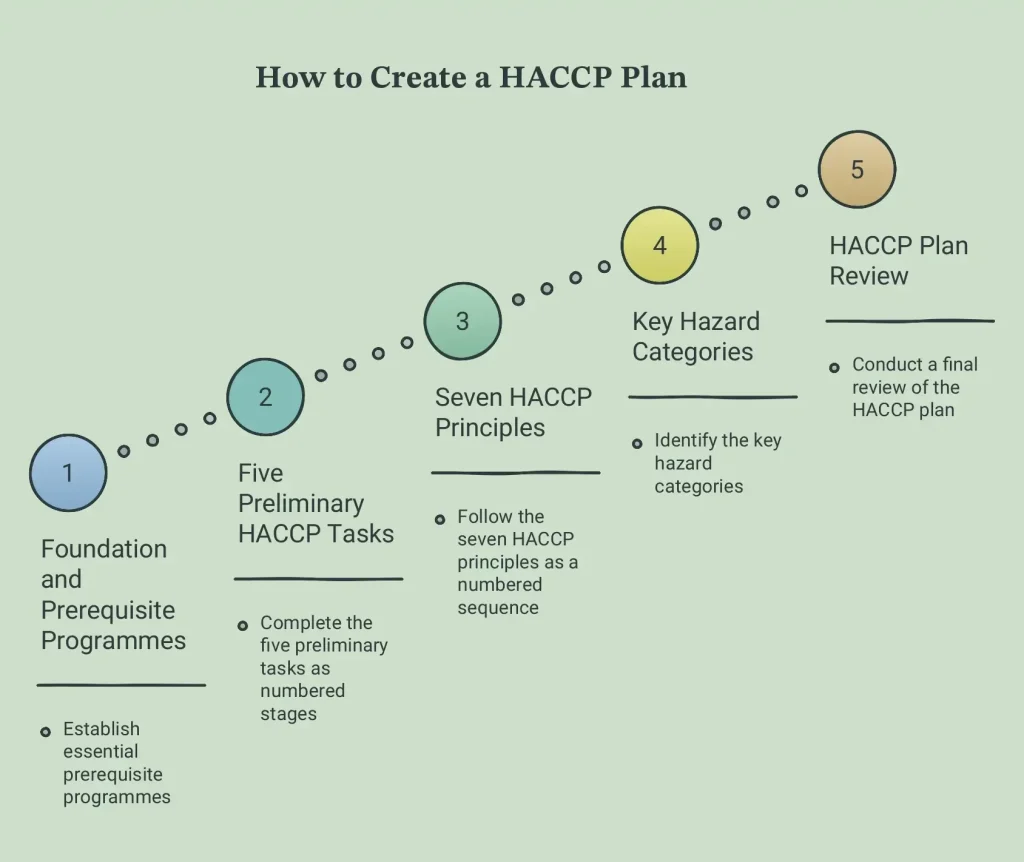
The 5 Preliminary Tasks Before Creating a HACCP Plan
Before applying the seven HACCP principles, a food business must first understand the food, the process and the potential food safety risks involved. The HACCP Plan methodology recommended by Codex begins with five essential preliminary tasks.
These preliminary tasks are:
- Assemble the HACCP team.
- Describe the product.
- Identify the intended use and consumers.
- Construct the process flow diagram.
- Confirm the flow diagram on site.
Because constructing and confirming the process flow diagram are closely connected activities, they are covered together under Step 4 below.
Before beginning these tasks, the business should confirm that its prerequisite programmes are effective. These include basic hygiene controls such as cleaning, personal hygiene, pest management, maintenance and temperature control. A HACCP Plan should strengthen food safety management, not replace essential hygiene practices.
Understanding these preliminary tasks is an important part of the HACCP plan meaning, as they provide the foundation needed to identify hazards accurately and establish effective controls.
Step 1: Assemble the HACCP Team
For anyone searching “What is the HACCP plan first step?”, the answer is to assemble a team with sufficient knowledge of the food product, processes, equipment and potential food safety hazards.
This does not necessarily require a large committee. In a small restaurant, the HACCP team may include the owner, head chef and kitchen supervisor. In a larger food business, the team may include representatives from production, food safety, quality assurance, purchasing, engineering, maintenance, cleaning and distribution.
The HACCP team should collectively understand:
- ingredients and their suppliers;
- recipes or product formulations;
- preparation and manufacturing methods;
- equipment and premises;
- storage and distribution conditions;
- likely microbiological, chemical, physical and allergen hazards;
- cleaning and cross-contamination controls; and
- how customers are expected to use the food.

Front-line employees should also be consulted, even if they are not permanent HACCP team members. Employees who work directly with food often understand practical issues that may not appear in written procedures. They may know that food is temporarily stored in a particular area during busy periods, equipment performs inconsistently or certain procedures are difficult to follow during normal operations.
At least one person should have the authority to approve changes and provide resources. If the HACCP team identifies a requirement for improved refrigeration, new packaging, additional monitoring equipment or further staff training, someone must be able to implement those improvements.
The team should also define the scope of the HACCP Plan. A clear scope ensures that all relevant activities are included and prevents important food safety risks from being overlooked.
For example:
“ This HACCP study covers chilled and frozen ingredients from approved suppliers, receipt and storage, preparation, cooking, hot holding, cooling, refrigerated storage, reheating and service within the restaurant.”
This scope would need to be expanded if the business also transports meals, produces vacuum-packed products or supplies food to another location.
The HACCP team members, their responsibilities and relevant experience should be documented. HACCP training can help individuals understand the methodology; however, completing a training course alone does not demonstrate competence in assessing every type of food process.
Where a business handles high-risk foods or uses complex processing methods, advice from a suitably qualified food safety professional may be required.
Step 2: Describe the Product
The second preliminary task is to accurately describe the food product. A detailed product description helps the HACCP team identify realistic hazards and determine suitable control measures.
For packaged products, the description may include:
- product name;
- ingredients and formulation;
- allergens;
- processing method;
- packaging type;
- storage requirements;
- shelf life;
- distribution conditions; and
- preparation instructions.
A restaurant may use a shorter description for individual dishes or groups of dishes; however, it should still include information that affects food safety.
For example, consider a restaurant preparing chicken curry. The product description may state that chilled raw chicken is supplied by an approved supplier, stored under refrigeration, prepared in a designated raw-food area, cooked in batches and either served immediately or cooled for later reheating.
This description identifies two possible process routes. Food served immediately after cooking does not involve cooling and reheating. Food retained for later service does involve these stages and therefore introduces additional hazards that require assessment.
The HACCP team should consider factors such as acidity, moisture content, packaging atmosphere, cooking method, portion size and storage temperature because these factors can influence microbial survival and growth.
Product descriptions should be reviewed whenever changes occur. For example:
- changing to larger storage containers may affect cooling times;
- extending shelf life may increase microbial risks; and
- replacing ingredients may introduce new allergens.
The product description should therefore be maintained as a controlled document within the HACCP Plan rather than treated as a one-time summary.
Step 3: Identify the Intended Use
The HACCP team must identify how the food is expected to be used and who will consume it.
Food may be:
- ready to eat;
- cooked before consumption;
- reheated by the customer; or
- used by another food business as an ingredient.
The intended use affects the level of control required.
For example, a raw product that receives a validated cooking process later in the supply chain presents different risks from a ready-to-eat product that receives no further treatment before consumption.
The intended consumer group must also be considered. Food supplied to hospitals, nurseries, care homes or other vulnerable groups may require additional controls because these consumers may be more susceptible to foodborne illness.
The HACCP team should also consider reasonably foreseeable misuse. Customers may store chilled meals for longer than recommended, fail to heat food evenly or misunderstand preparation instructions. While businesses cannot control every possible misuse, they should provide clear, accurate and realistic instructions.
An intended-use statement might state:
“The product is intended to be consumed hot by the general public immediately after service. Any food retained for later use will be rapidly cooled, refrigerated and reheated by trained restaurant staff before service.”
This statement identifies the expected consumer group and the relevant food handling processes.
Step 4: Create and Verify the Process Flow Diagram
A process flow diagram shows every stage through which food passes and provides the structure for the hazard analysis.
A basic restaurant process may appear simple:
Purchase → Delivery → Storage → Preparation → Cooking → Service
However, real operations often include additional routes, such as:
- Cooking → hot holding → service;
- Cooking → cooling → chilled storage → reheating → service; and
- Preparation → refrigerated storage → delivery to customers.
Every relevant process route must be considered within the HACCP Plan.
The flow diagram should include more than the main production stages. The HACCP team should consider:
- receipt of ingredients and packaging;
- ambient, chilled and frozen storage;
- defrosting;
- washing and preparation;
- cooking or other treatments;
- cooling;
- intermediate storage;
- suitable food reworking;
- reheating;
- hot or cold holding;
- packaging;
- transport;
- service;
- returns; and
- waste disposal.
Once the process flow diagram has been created, it must be verified on site. This is the fifth preliminary task and an essential part of ensuring that the HACCP Plan reflects actual workplace practices.
The HACCP team should walk through the premises while operations are taking place and compare the documented process with what employees actually do.
During verification, the team may identify issues such as:
- deliveries waiting outside refrigeration before checks are completed;
- cooked food passing through raw-food preparation areas;
- alternative preparation areas being used during busy periods; or
- different procedures being followed on different shifts.
Weekend staff, night workers and temporary employees should also be considered because working practices may vary between teams.
The process flow diagram should then be updated, dated and formally approved. This ensures that the correct version is used during hazard analysis and that the HACCP Plan remains accurate, practical and effective.
The 7 HACCP Principles
When considering what is the HACCP plan, the seven HACCP principles provide the foundation of the system. Although they are often referred to as the HACCP plan steps, they are more accurately described as the seven internationally recognised HACCP principles.
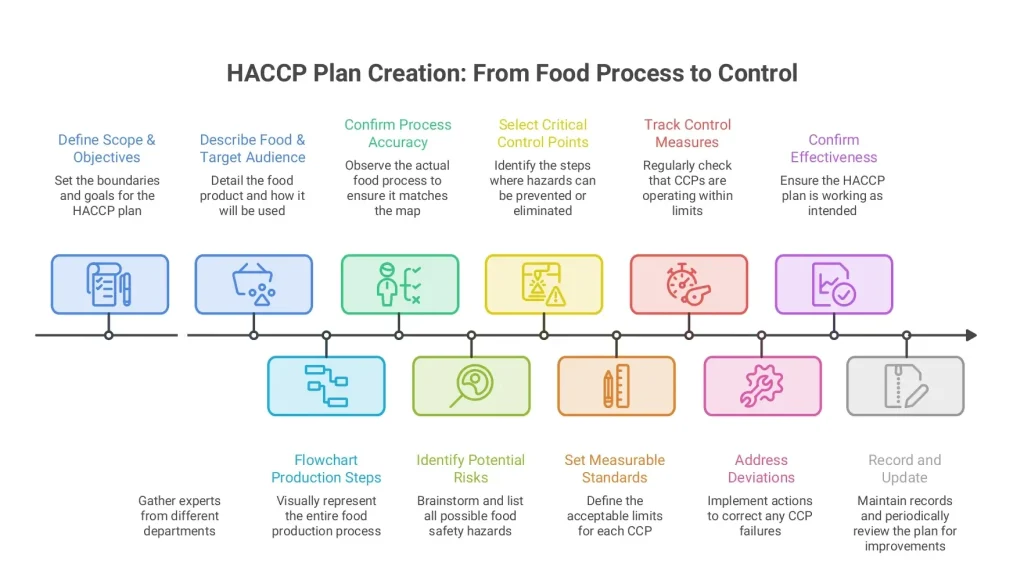
What are the 7 steps of the HACCP Plan? The HACCP plan steps in order are:
- Conduct a hazard analysis.
- Determine the Critical Control Points (CCPs).
- Establish critical limits.
- Establish monitoring procedures.
- Establish corrective actions.
- Establish verification procedures.
- Establish documentation and record-keeping.
These HACCP plan steps transform the information gathered during the preliminary tasks into a practical food safety control system.
A properly developed HACCP Plan should be specific to the individual food business. Whether it is a large manufacturing facility or a HACCP plan for restaurant operations, the principles remain the same, but the controls must reflect the actual ingredients, equipment, processes and customers involved.
A generic HACCP plan template can be useful as a starting point, but it should never be used without adaptation. A copied plan may fail to identify important hazards that are unique to a particular business. An effective HACCP system must demonstrate how hazards are identified, controlled, monitored and reviewed in real working conditions.
The following principles explain the correct HACCP plan format and how each stage contributes to maintaining effective food safety management.
Principle 1: Conduct a Hazard Analysis
The first principle requires the HACCP team to examine every stage shown on the verified process flow diagram and identify hazards that could reasonably occur.
For those searching “HACCP plan first step”, the answer is to conduct a detailed hazard analysis. This stage is critical because effective control is only possible when the business understands what hazards exist, where they may occur and how serious the consequences could be.
The three main hazard categories commonly recognised in UK food safety guidance are:
- microbiological hazards;
- chemical hazards; and
- physical hazards.
Allergens may be included within chemical hazards in some classifications; however, many food businesses assess allergens separately because poor allergen management can have severe consequences for consumers.
Microbiological Hazards
Microbiological hazards include harmful bacteria, viruses, parasites, moulds and toxins produced by microorganisms.
Examples include:
- harmful bacteria surviving because food has not been cooked adequately;
- bacterial growth caused by slow cooling;
- contamination of ready-to-eat food from raw ingredients; and
- incorrect temperature control during storage.
Chemical Hazards
Chemical hazards may include:
- cleaning chemicals;
- pesticides;
- excessive additives;
- naturally occurring toxins;
- contamination from unsuitable equipment; and
- unsafe packaging materials.
Allergens are also a significant food safety concern. A product may become unsafe for an allergic consumer if an allergen is not declared correctly or if cross-contact occurs during preparation, storage or service.
Physical Hazards
Physical hazards are unwanted objects that may cause injury to consumers.
Examples include:
- glass;
- metal fragments;
- stones;
- hard plastic;
- jewellery; and
- parts from damaged equipment.
Hazard descriptions should be clear and specific. A description such as “foreign object” provides limited information. A statement such as “metal fragment from a damaged mixer blade” identifies the likely source and helps determine the appropriate control measure.
The HACCP team must then decide which hazards are significant. This decision requires consideration of both the likelihood of occurrence and the severity of the potential outcome.
A hazard with serious consequences may require control even if it occurs rarely. Similarly, a frequently occurring hazard may require attention even if the consequences are usually less severe.
The assessment should consider:
- ingredients and suppliers;
- equipment and premises;
- processing conditions;
- intended consumer groups;
- previous incidents;
- customer complaints; and
- available scientific and technical information.
For each significant hazard, the team should identify appropriate control measures. Examples include:
- purchasing from approved suppliers;
- checking deliveries;
- refrigerated storage;
- separating raw and ready-to-eat food;
- validated cooking processes;
- allergen controls;
- sieving;
- metal detection;
- cleaning and disinfection; and
- accurate packaging or menu information.
Some hazards may be controlled through prerequisite programmes, while others must proceed to the Critical Control Point assessment stage.
The HACCP team should document the reasons behind its decisions. This supports transparency, improves future HACCP plan review activities and provides evidence that hazards have been properly considered.
Principle 2: Determine Critical Control Points
A Critical Control Point (CCP) is a stage where control is essential to prevent, eliminate or reduce a significant food safety hazard to an acceptable level.
A common HACCP plan example is the cooking of raw poultry. If the cooking process does not adequately control harmful microorganisms and no later treatment step exists, the food may remain unsafe.
However, not every important food safety activity should be classified as a CCP. Cleaning, handwashing, staff training and pest control are essential controls, but they are normally managed through prerequisite programmes rather than CCP procedures.
A decision tree can help the HACCP team determine whether a process stage is a CCP. Questions may include:
- Is there a significant hazard at this stage?
- Is a suitable control measure available?
- Is this stage specifically designed to eliminate or reduce the hazard?
- Could contamination occur or increase to an unacceptable level?
- Will a later stage adequately control the hazard?
A decision tree supports professional judgement but does not replace technical knowledge. A checklist-based approach may produce incorrect results if the original hazard analysis is incomplete.
The HACCP team should avoid creating too many CCPs. If every stage is treated as critical, employees may struggle to focus on the controls where failure creates the greatest risk.
However, reducing paperwork should never be the reason for excluding a genuine CCP.
If a significant hazard cannot be controlled effectively at an existing stage, the business may need to modify the process. This could involve:
- changing equipment;
- altering ingredients;
- introducing an additional treatment step; or
- revising working methods.
The final CCP decisions should be clearly documented within the HACCP Plan so they can be monitored, verified and reviewed over time.
Principle 3: Establish Critical Limits
A critical limit defines the boundary between acceptable and unacceptable control at a Critical Control Point (CCP).
Within a HACCP Plan, every CCP must have a clearly defined limit that allows employees to determine whether the process remains safe. A critical limit should normally be measurable or clearly observable.
Depending on the process, a critical limit may relate to:
- temperature;
- time;
- acidity or pH;
- water activity;
- concentration;
- pressure;
- moisture content; or
- another measurable food safety characteristic.
Instructions such as “cook properly”, “cool quickly” or “keep chilled” are not sufficient for a formal CCP control. Employees need clear criteria that explain exactly what result is acceptable and what action must be taken if the limit is not achieved.
Critical limits must have a reliable technical basis. The HACCP team may use:
- legislation;
- official food safety guidance;
- recognised industry standards;
- scientific evidence; or
- a properly conducted validation study.
A critical limit should never be copied from an unrelated HACCP plan template without checking that it applies to the specific food, equipment, portion size and process being controlled.
For example, a cooking method validated for a small portion may not provide the same level of control when used for a larger batch. Similarly, a cooling procedure that works with shallow containers may not be effective if food is placed into deep containers where heat removal is slower.
Many businesses establish an operational target that is more cautious than the formal critical limit. This gives employees an opportunity to correct the process before a CCP failure occurs.
The HACCP Plan should document the reason for each critical limit so that decisions can be explained during audits, inspections or future HACCP plan review activities.
Principle 4: Establish Monitoring Procedures
Monitoring is the planned checking of a CCP to confirm that it remains within the established critical limits.
A monitoring procedure must clearly explain:
- what is being checked;
- how it will be checked;
- how often it will be checked;
- who is responsible; and
- where the results will be recorded.
For example, a cooking CCP may require a trained employee to use a suitable and accurate probe thermometer to check the internal temperature of the thickest part of a food item before it is released for service.
The frequency of monitoring must be appropriate for the risk. A weekly temperature check cannot effectively control a cooking process that takes place several times every day.
Some food businesses use continuous monitoring equipment, such as automated temperature systems. However, employees may still need to review the information, confirm that equipment is operating correctly and take action if unusual results occur.
Monitoring records should be completed at the time the check is carried out. Entering results later from memory reduces reliability and weakens the evidence that the HACCP system was operating correctly.
The equipment used for monitoring must also be managed properly. A damaged, incorrectly calibrated or unsuitable thermometer can create inaccurate results and give employees false confidence.
Responsibilities should be assigned to specific roles rather than using general descriptions such as “staff”. For example, the HACCP Plan may identify the duty chef, production supervisor or quality technician as responsible for completing checks.
Employees must understand both the critical limit and the required response. Recording a failed result without preventing unsafe food from being released does not provide effective control.
Principle 5: Establish Corrective Actions
Corrective actions describe what must happen when monitoring shows that a CCP has failed.
A suitable corrective-action procedure must address two important questions:
- What should happen to the affected food?
- What action is required to restore control and prevent the problem from happening again?
For example, if monitoring shows that a batch of chicken has not reached the required cooking limit, the corrective action may allow further cooking and additional checking if food safety can still be confirmed.
However, if the required control cannot be achieved or the safety of the food cannot be demonstrated, the affected food should be isolated and disposed of according to the business procedure.
The business must also investigate the cause of the failure. Possible causes may include:
- overloaded equipment;
- incorrect settings;
- inaccurate monitoring equipment;
- unsuitable procedures; or
- insufficient staff training.
The corrective-action procedure should identify who has authority to decide whether food can be:
- reprocessed;
- released;
- returned to production; or
- discarded.
Corrective-action records should include:
- date and time;
- failed result;
- affected product or batch;
- immediate action taken;
- final product decision;
- suspected cause;
- preventive action; and
- responsible person.
Repeated CCP failures require particular attention. They may indicate that equipment is unsuitable, procedures are ineffective, employees require additional training or the control limit needs to be reviewed.
Correcting individual failures without investigating the underlying cause does not create a reliable HACCP system.
Principle 6: Establish Verification Procedures
Verification determines whether the HACCP Plan is being followed correctly and whether the overall system continues to control food safety hazards effectively.
Verification is different from monitoring.
Monitoring checks whether a CCP is under control during normal operations. Verification examines whether the HACCP system as a whole is working as intended.
Verification activities may include:
- reviewing monitoring records;
- checking corrective-action reports;
- observing employees performing procedures;
- confirming written procedures match actual practice;
- calibrating monitoring equipment;
- auditing prerequisite programmes;
- reviewing customer complaints and incidents;
- assessing supplier performance; and
- arranging suitable product or environmental testing.
Validation is closely related but has a different purpose.
Validation provides evidence that a control measure and its critical limit are capable of controlling the identified hazard. Verification confirms that the validated control continues to be applied correctly.
For example, a business may validate a cooking process using scientific evidence. A supervisor may then verify the system by reviewing cooking records, observing employees using thermometers correctly and confirming that monitoring equipment remains accurate.
Verification activities should be completed by competent individuals at suitable intervals. Where possible, the person carrying out verification should be independent from the person who completed the original monitoring.
Testing may support verification, but it should not replace effective process control. A satisfactory laboratory result from one sample does not prove that every batch has been produced safely.
Regular verification also supports effective HACCP plan review by identifying areas where procedures may need improvement.
Principle 7: Establish Documentation and Record-Keeping
Records provide evidence of what the business planned, what employees monitored and how problems were managed when controls failed.
A complete HACCP Plan may include:
- scope of the HACCP study;
- HACCP team details;
- product descriptions;
- intended-use statements;
- verified process flow diagrams;
- hazard-analysis records;
- CCP decisions;
- critical limits and supporting evidence;
- monitoring records;
- corrective-action reports;
- verification reports;
- calibration records;
- staff training information; and
- HACCP review history.
Records may be maintained electronically or on paper. Both systems can be suitable if records are accurate, accessible, protected from inappropriate changes and retained for the required period.
A useful monitoring record normally identifies:
- date;
- time;
- product or batch;
- measured result;
- employee responsible; and
- action taken if a failure occurred.
The HACCP plan format should be practical for employees to use. Excessively complicated paperwork may result in incomplete records, repeated entries or employees avoiding the system altogether.
However, reducing paperwork should never remove important evidence needed to demonstrate that significant food safety hazards were controlled.
Supervisors should actively review records rather than simply store them. Patterns such as repeated results close to critical limits, frequent corrective actions or identical repeated entries may indicate deeper problems requiring investigation.
The purpose of a HACCP plan review is not simply to update documents. It is to confirm that the controls described in the plan still reflect what happens in practice.
A strong HACCP system combines accurate documentation, trained employees, effective monitoring and regular improvement. This approach helps businesses demonstrate due diligence, maintain legal compliance and protect consumers from food safety risks.
HACCP Plan Example
The following simplified HACCP plan example demonstrates part of a restaurant process involving cooked chicken. It shows the typical structure of a HACCP Plan, but it does not provide universal critical limits. Every food business must establish controls and limits that are suitable for its own ingredients, equipment, processes and customers.
A HACCP Plan must always be based on a proper hazard analysis. The HACCP plan steps in order begin with understanding the process and identifying hazards before deciding which stages require Critical Control Point (CCP) control.
| Process stage | Significant hazard and control | CCP decision | Monitoring | Corrective action |
| Receiving raw chicken | Contamination or microbial growth controlled through approved suppliers and delivery checks | Usually managed through prerequisite procedures | Check packaging condition, dates and delivery temperature where applicable | Reject unsuitable deliveries and record the reason |
| Refrigerated storage | Growth of harmful microorganisms controlled through suitable storage conditions and stock rotation | Classification depends on the completed hazard analysis | Check storage temperatures at defined intervals | Move food to suitable storage, assess exposure and discard if safety cannot be confirmed |
| Preparation | Cross-contamination controlled through separation, handwashing and cleaned equipment | Normally managed through prerequisite procedures | Supervisor observations and hygiene checks | Stop work, clean and disinfect, replace contaminated equipment and assess affected food |
| Cooking | Survival of harmful microorganisms | Commonly identified as a CCP | Check each batch against a validated cooking limit | Continue cooking and retest where safe; otherwise isolate and discard |
| Hot holding | Microbial growth caused by inadequate temperature control | May be a CCP depending on the process | Check holding conditions at established intervals | Restore control, assess time and temperature exposure and discard if safety cannot be demonstrated |
| Cooling and chilled storage | Growth or toxin production caused by slow cooling or unsuitable storage | May require CCP control depending on the operation | Check the defined cooling procedure and storage conditions | Adjust cooling methods, investigate the cause and discard food if control cannot be demonstrated |
| Reheating | Survival or growth of harmful microorganisms | CCP status depends on the complete process | Check each batch against the validated reheating procedure | Continue reheating and retest where safe; otherwise isolate or discard |
A complete HACCP Plan would also consider:
- allergen management;
- cleaning and sanitation;
- equipment controls;
- staff hygiene;
- supplier approval;
- service procedures;
- transport;
- verification activities; and
- record-keeping.
This HACCP plan example demonstrates why hazard analysis must take place before CCP decisions are made. A stage such as refrigeration or hot holding may be managed differently depending on the food type, storage duration, later processing steps and intended consumer group.
A HACCP plan for restaurant operations cannot simply copy controls from another business. The kitchen layout, menu, preparation methods and staffing arrangements must all be considered.
HACCP Plan Template
A practical HACCP plan template should begin with document-control information. This helps ensure that the HACCP system is properly managed, reviewed and updated.
The document should include:
- business and site name;
- products or processes covered;
- scope of the HACCP study;
- HACCP team members;
- document owner;
- version number;
- approval date; and
- next scheduled review date.
The main hazard-analysis section should follow a clear HACCP plan format. A typical table may include:
- process step;
- potential hazard and source;
- likelihood and severity assessment;
- whether the hazard is significant;
- existing control measures;
- CCP decision and justification;
- critical limit;
- monitoring method, frequency and responsibility;
- corrective action;
- verification activity; and
- record used.
A separate change log should also be maintained. It should record:
- what was changed;
- why the change was required;
- who approved the amendment; and
- when employees were informed.
Supporting documents may include:
- cleaning schedules;
- supplier specifications;
- allergen matrices;
- maintenance records;
- equipment instructions;
- calibration procedures;
- training records; and
- validation evidence.
A HACCP plan template improves consistency, but it cannot make technical decisions automatically. The HACCP team remains responsible for identifying hazards, selecting appropriate controls and confirming that the finished HACCP Plan accurately reflects the real operation.
A useful HACCP plan format should be detailed enough to demonstrate control but practical enough for employees to use during normal working conditions.
HACCP Plan for Restaurants
A HACCP plan for restaurant operations should reflect the actual menu, kitchen layout, food preparation methods and different routes that food follows before reaching customers.
A dish that is prepared and served immediately has a different risk profile from a dish that is cooked, cooled, stored and reheated. Additional activities such as buffets, takeaway services, home delivery, off-site catering, vacuum packing and sous-vide preparation may introduce further hazards that must be assessed.
Restaurants should begin by grouping menu items that follow similar processes. For example, several cooked-to-order meat dishes may share one process route, while chilled ready-to-eat desserts may require a separate assessment.
However, grouping products should not hide important differences. A food containing raw egg, an allergen-rich sauce or a specialised cooling process may require separate consideration within the HACCP Plan.
Cross-contamination is one of the most significant concerns in restaurant environments. Raw ingredients, ready-to-eat foods, utensils, hands, surfaces and equipment can all contribute to contamination if controls are ineffective.
A suitable HACCP system should work alongside strong prerequisite programmes covering:
- kitchen layout;
- cleaning and disinfection;
- personal hygiene;
- handwashing;
- separation of raw and ready-to-eat foods; and
- equipment management.
Allergen management must also be integrated into daily operations. Recipe changes, alternative suppliers, replacement ingredients, garnishes, sauces and daily specials can affect allergen information.
Employees should never assume that a substitute ingredient has the same allergen profile as the original product. All changes should be checked and recorded through the business’s allergen management process.
Temperature-controlled stages such as:
- cooking;
- cooling;
- refrigeration;
- reheating; and
- hot holding
should be carefully assessed. Businesses should use controls supported by appropriate guidance, validation evidence or technical justification rather than copying limits from an unrelated HACCP plan template.
The system must also remain practical during busy service periods. Monitoring forms should be easily accessible, suitable equipment should be available and responsibilities should be clearly assigned.
A small catering business may not require the same level of documentation as a large food manufacturer. However, every food business must maintain an effective HACCP-based system that demonstrates how food safety risks are identified and controlled.
Across the UK, businesses can use recognised HACCP-based resources designed for smaller operations. For example:
- businesses in England and Wales may use the Food Standards Agency’s Safer Food, Better Business materials where appropriate;
- businesses in Northern Ireland may use Safe Catering resources; and
- catering businesses in Scotland may use Food Standards Scotland’s CookSafe guidance.
These resources are designed to make HACCP-based food safety management more practical for smaller businesses. However, completing a downloaded document alone does not create an effective HACCP Plan.
The materials must be completed specifically for the individual business, considering its menu, equipment, staff practices and food safety risks.
Where a business is unsure whether a simplified HACCP approach is suitable, it should seek advice from the relevant local authority food safety team. Larger, specialised or higher-risk operations may require a more detailed HACCP study.
Developing HACCP Knowledge Through Jobsland
Food businesses and employees often use HACCP training to improve their understanding of food safety responsibilities and develop the knowledge required to support effective HACCP implementation.
Jobsland currently lists online HACCP and food safety courses supplied by third-party e-learning providers.
One available option is the HACCP Training Masterclass. The course listing describes features including online study, access to learning materials, assessments, tutor support and certificate options. Its curriculum covers key HACCP topics, including:
- HACCP fundamentals;
- hazard analysis;
- Critical Control Points;
- monitoring;
- verification;
- documentation; and
- practical case studies.
The course information also states that no formal qualification is awarded. Although some training descriptions may use terms such as “recognised certification”, learners should confirm whether a course leads to a regulated qualification or simply provides a certificate of completion.
Before enrolling on any HACCP course, learners should check:
- who provides the training;
- who issues the certificate;
- whether an awarding organisation is involved;
- whether the qualification appears on an official register;
- how knowledge is assessed; and
- whether the course meets employer or industry requirements.
A non-regulated online HACCP course may still be valuable for improving awareness, refreshing knowledge or preparing employees for food safety responsibilities.
However, completion of an online course should not automatically be considered evidence that someone can independently validate complex HACCP systems or manage high-risk food processes without practical experience.
Effective HACCP knowledge comes from combining training with:
- workplace experience;
- supervision;
- understanding of specific food processes; and
- practical application of food safety controls.
Reviewing and Updating Your HACCP Plan
A HACCP plan review is essential because food businesses, ingredients, suppliers, equipment and working practices can change over time.
A HACCP Plan should be reviewed at planned intervals and whenever a change could affect food safety.
Common review triggers include:
- introducing a new product or recipe;
- changing ingredients or suppliers;
- using different packaging;
- extending shelf life;
- installing new equipment;
- changing kitchen or production layouts;
- altering batch sizes;
- introducing delivery or off-site catering;
- receiving repeated customer complaints;
- experiencing a food safety incident;
- identifying repeated monitoring failures; or
- receiving new legal, scientific or official guidance.
A proper HACCP plan review involves more than simply reading the document. The HACCP team should verify that the written procedures still match actual working practices.
The review should include:
- walking through the process again;
- observing employees;
- checking monitoring records;
- reviewing corrective actions;
- confirming that the process flow diagram remains accurate; and
- assessing whether controls remain effective.
The team should consider whether:
- hazards are still correctly identified;
- existing controls remain suitable;
- monitoring procedures are practical;
- corrective actions have prevented recurrence; and
- employees understand their responsibilities.
Repeated failures should receive particular attention. They may indicate that the process is not capable of consistently meeting the required standard.
For example, frequent cooking failures may result from:
- oversized batches;
- unsuitable equipment;
- inaccurate monitoring tools;
- unclear procedures; or
- insufficient staff training.
Repeatedly correcting individual batches may protect specific products, but it does not address the underlying cause.
The outcome of every formal review should be documented, including reviews where no changes are required.
Where amendments are necessary, the business should:
- update the document version;
- remove outdated copies;
- revise monitoring forms;
- update supporting procedures; and
- inform affected employees.
Additional staff training may also be required. A revised HACCP Plan cannot be effective if employees carrying out the work do not understand the updated procedures.
A well-maintained HACCP Plan is a living food safety system. Regular review, accurate records and practical implementation help businesses demonstrate due diligence, maintain compliance and protect customers from food safety risks.
Conclusion
Creating an effective HACCP Plan requires a clear understanding of the food, the processes involved and the people responsible for maintaining food safety controls.
The process begins with effective prerequisite programmes and the five preliminary HACCP tasks. The business then applies the HACCP plan steps in order by following the seven principles: identifying significant hazards, determining genuine Critical Control Points (CCPs), establishing justified critical limits, and defining monitoring, corrective action, verification and record-keeping procedures.
A successful HACCP system should be specific, practical and proportionate to the operation. Whether it is a HACCP plan for restaurant operations or a larger food production environment, the plan should describe what employees actually do rather than an ideal process that only exists on paper.
A HACCP Plan is not simply a document created for inspections. It is a working food safety system designed to help employees identify risks early, maintain effective controls and prevent unsafe food from reaching customers.
The plan must also remain current. Changes to ingredients, suppliers, equipment, menus, packaging, customer groups or production methods can introduce new hazards or affect existing controls. A regular HACCP plan review is therefore an essential part of maintaining an effective food safety management system.
The purpose of HACCP is not only compliance. It is to create reliable daily practices that protect consumers, support employees and demonstrate that food safety risks are being actively managed.
Frequently Asked Questions
1. What is the HACCP plan used for?
A HACCP Plan is used to identify significant food safety hazards and establish controls to prevent, eliminate or reduce those hazards to an acceptable level.
It also explains how controls are monitored, what actions are taken when problems occur and how the system is verified to ensure it remains effective.
2. What are the 7 steps of the HACCP plan?
The HACCP plan steps in order are based on the seven HACCP principles:
- Conduct a hazard analysis.
- Determine Critical Control Points (CCPs).
- Establish critical limits.
- Establish monitoring procedures.
- Establish corrective actions.
- Establish verification procedures.
- Establish documentation and record-keeping procedures.
These HACCP plan steps provide the framework for developing a structured food safety management system.
3. What is the first step in creating a HACCP Plan?
The HACCP plan first step depends on whether you are referring to the preliminary tasks or the seven HACCP principles.
The first preliminary task is to assemble a competent HACCP team and define the scope of the study.
The first formal HACCP principle is conducting a hazard analysis, where the team identifies and evaluates potential food safety hazards.
4. Is a HACCP Plan legally required in the UK?
Food businesses in the UK are required to implement food safety procedures based on HACCP principles. The level of documentation and complexity should be appropriate to the size, nature and risks of the operation.
A small business may use a simplified HACCP-based system, while a larger or higher-risk operation may require a more detailed HACCP study.
5. Can a small restaurant use a HACCP template?
Yes. A small restaurant may use a suitable official HACCP-based pack or HACCP plan template as a starting point.
However, the template must be adapted to the actual business, including its menu, ingredients, equipment, kitchen layout, staff practices and food safety risks.
A blank template alone does not create an effective HACCP system.
6. Can I copy another business’s HACCP Plan?
A HACCP Plan from another business may provide useful guidance, but it should not be copied without a proper assessment.
Different businesses may have different hazards due to variations in:
- ingredients;
- suppliers;
- equipment;
- preparation methods;
- customer groups; and
- storage conditions.
A reliable HACCP Plan must reflect the specific operation where it is used.
7. Is every food safety control a Critical Control Point?
No. Not every food safety activity is a CCP.
Many essential controls, such as cleaning, personal hygiene, pest management and staff training, are normally managed through prerequisite programmes.
A CCP is a specific stage where control is essential to prevent, eliminate or reduce a significant food safety hazard.
8. How many CCPs should a HACCP Plan have?
There is no standard number of CCPs required.
The correct number depends on the outcome of the hazard analysis and the complexity of the food process. A small food business may have only a few CCPs, while a complex manufacturing process may require several.
The aim is not to create as many CCPs as possible, but to identify the points where control is genuinely critical.
9. How often should HACCP records be completed?
Monitoring records should be completed at the frequency specified within the HACCP Plan.
The frequency must be sufficient to identify a loss of control before unsafe food is released. Records should be completed at the time checks are performed rather than recreated later from memory.
10. How often should a HACCP Plan be reviewed?
A HACCP plan review should take place at planned intervals and whenever changes may affect food safety.
Common review triggers include:
- new products or recipes;
- ingredient or supplier changes;
- new equipment;
- packaging changes;
- changes to premises or layout;
- altered production methods;
- customer complaints;
- food safety incidents; and
- repeated monitoring failures.
A regular review ensures that the HACCP Plan remains accurate, practical and aligned with current workplace practices.