
The 7 Principles of HACCP provide the foundation for a proactive food-safety management system designed to prevent problems before they occur.
Quick Overview
If you are looking for a clear explanation of the 7 Principles of HACCP, the main focus is not simply creating a HACCP document, but building a practical food-safety system that identifies risks, controls hazards and prevents unsafe food from reaching consumers.
Whether you are learning HACCP for catering, food production, hospitality or food service, this guide covers:
✅ How to arrange the 7 principles of haccp in process order
✅ What each HACCP principle means and how it is applied in real workplaces
✅ How hazard analysis, CCPs and critical limits help control food-safety risks
✅ Practical examples of monitoring, corrective actions, verification and record-keeping
✅ Why the 7 Principles of HACCP are important for maintaining safe food preparation and service
Food safety should not depend on discovering an issue after food has already been prepared, packaged, delivered or served. A responsible food business identifies potential risks in advance and introduces effective controls to prevent unsafe food from reaching consumers.
HACCP, which stands for Hazard Analysis and Critical Control Point, is a structured and internationally recognised approach to managing food-safety risks. It helps food businesses identify potential hazards, determine where control is essential and confirm that safety measures remain effective throughout food production and service.
The HACCP system can be applied across the entire food chain. In catering environments, it can help manage processes such as cooking, cooling, storage and reheating. Food manufacturers may use HACCP principles to control processes including pasteurisation, allergen management, foreign-body detection and packaging safety.
Other businesses, including care homes, schools, hotels, takeaways, bakeries and mobile caterers, can develop HACCP-based procedures that reflect their specific operations, equipment and customer needs.
The 7 principles of HACCP form the core of this system and are designed to be followed in a logical sequence:
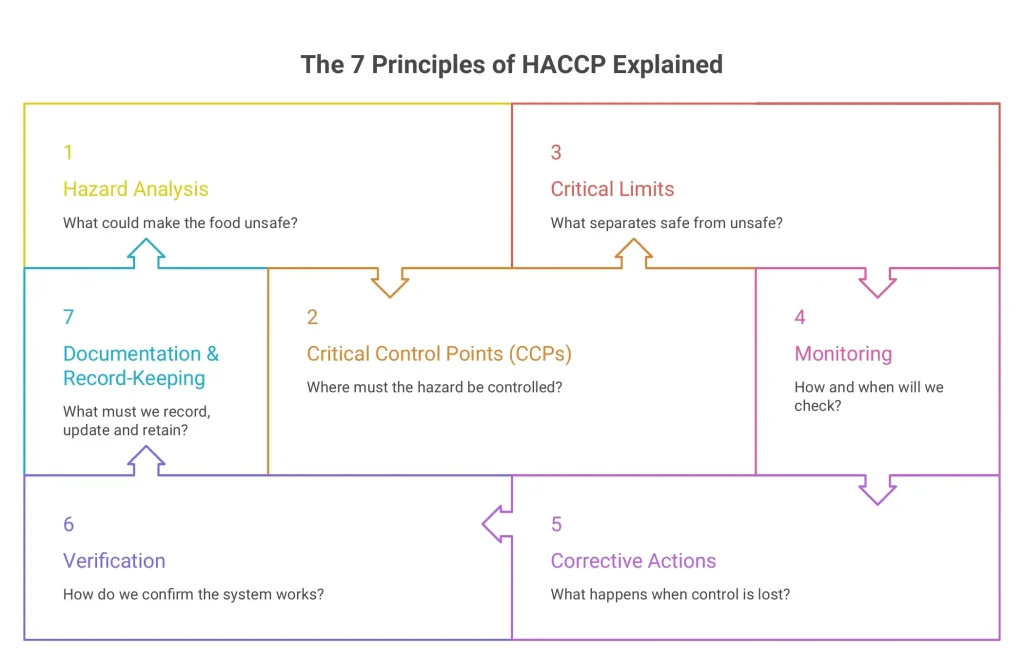
- Conduct a hazard analysis.
- Determine Critical Control Points (CCPs).
- Establish critical limits.
- Establish monitoring procedures.
- Establish corrective actions.
- Establish verification procedures.
- Establish documentation and record-keeping procedures.
Understanding the names of the HACCP principles is only the first step. Effective food-safety management requires food handlers, supervisors and managers to understand how each principle applies to their ingredients, preparation methods, equipment, processes and the people they serve.
A well-designed HACCP plan reflects practical experience from daily food operations. It considers realistic risks such as bacterial growth, cross-contamination, incorrect cooking temperatures, allergen controls and equipment failures. By identifying these risks early and applying appropriate controls, businesses can create safer working practices and maintain consistent food-safety standards.
This guide explains the 7 Principles of HACCP with realistic examples from catering, manufacturing and food-service environments. It also demonstrates how each principle works together to create a practical, reliable and evidence-based food-safety management system that supports consumer protection and regulatory compliance.
The 7 Principles of HACCP Explained with Examples
Before a business formally applies the 7 Principles of HACCP, it must first develop a clear understanding of its operations, products and food-safety risks.
The business should identify the food covered by the HACCP plan, how it is prepared, how it is stored and who is likely to consume it. Particular attention may be required when serving vulnerable groups, such as older people, hospital patients or young children, as these consumers can be at greater risk of serious consequences from foodborne illness.
A HACCP team should also map the complete food process, from the arrival of ingredients through to the point where food leaves the business or is served to customers. This process is usually documented using a process-flow diagram, which provides a clear overview of each stage where food-safety risks may need to be controlled.
A simple process flow might include:
Receiving ingredients → Storage → Preparation → Cooking → Cooling → Chilled storage → Reheating → Service
The process-flow diagram must represent what actually happens in the workplace. If food is frozen, transported, portioned, prepared at another location or reheated before service, these stages should be included in the HACCP plan.
Before developing a HACCP system, businesses should already have effective basic food-hygiene controls in place. These supporting measures are often known as prerequisite programmes (PRPs). They include cleaning and sanitation, pest control, supplier approval, personal hygiene, allergen management, waste disposal, equipment maintenance and the separation of raw and ready-to-eat foods.
The 7 principles of haccp are not designed to replace these essential hygiene practices. Instead, they build upon them to create a structured approach to preventing food-safety failures. For example, controlling cooking temperatures alone will not protect consumers if cooked food is later placed on a contaminated surface used for raw meat.
When considering how to arrange the 7 Principles of HACCP in a logical process order, the following structure provides a practical summary:
| Principle | Main purpose | Simple workplace question |
| Hazard analysis | Identify significant food-safety hazards | What could make the food unsafe? |
| Critical Control Points (CCPs) | Identify stages where control is essential | Where must the hazard be controlled? |
| Critical limits | Define acceptable safety boundaries | What result separates safe from unsafe? |
| Monitoring | Confirm that controls are working | How and when will we check? |
| Corrective action | Respond when control is lost | What will we do if the check fails? |
| Verification | Confirm that the HACCP system is effective | How will we test and review the plan? |
| Documentation and record-keeping | Maintain evidence and demonstrate control | What must we record, update and retain? |
Each HACCP principle relies on decisions made during earlier stages. A business cannot establish meaningful critical limits unless it has first identified the hazard and determined where that hazard must be controlled.
In practice, an effective HACCP system requires more than completing paperwork. Food businesses must regularly review their procedures, train staff correctly and ensure that controls continue to work during everyday operations. By applying the 7 Principles of HACCP systematically, businesses can create a reliable food-safety management system that protects consumers and supports compliance with food-safety requirements.
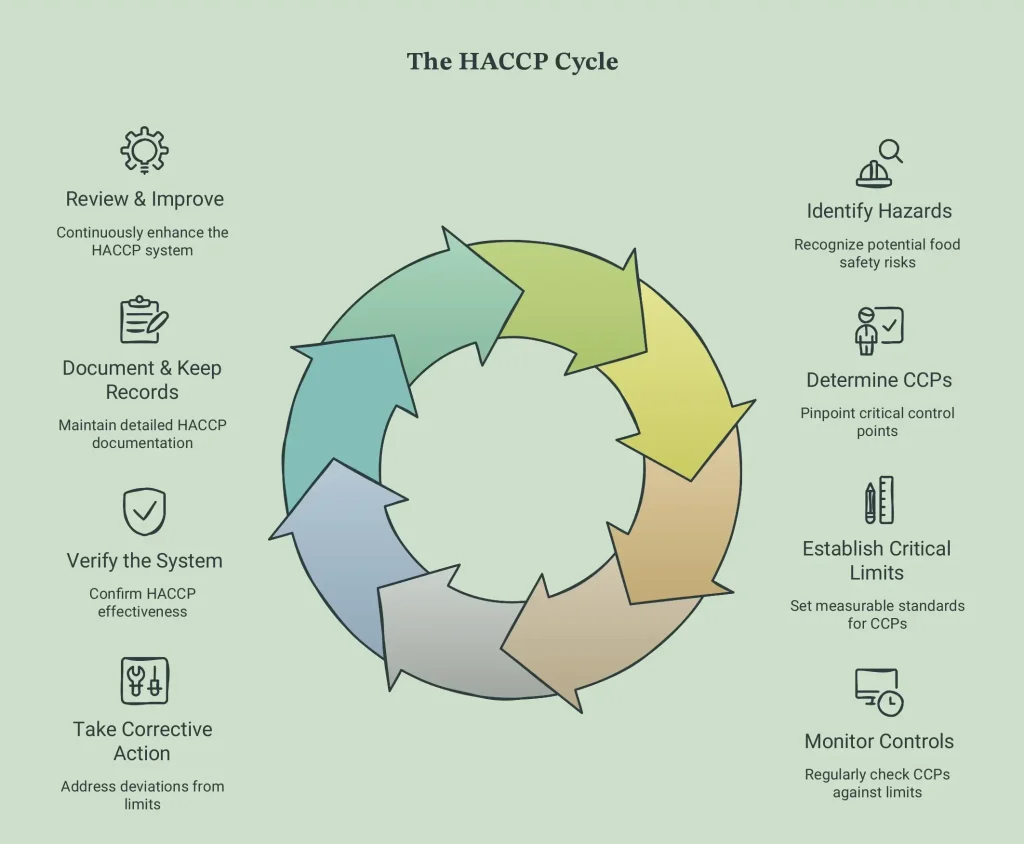
1. Conduct a Hazard Analysis
The first principle in the 7 Principles of HACCP is to examine each stage of the food process and identify hazards that could cause harm to consumers.
A hazard is anything with the potential to make food unsafe. When businesses explain the 7 principles of haccp, hazard analysis is the starting point because it helps identify what could go wrong before controls are introduced. HACCP commonly considers biological, chemical and physical hazards. Allergen hazards also require careful attention and may be assessed separately or considered within chemical hazards, depending on the HACCP approach used by the business.
Biological hazards
Biological hazards include harmful bacteria, viruses, parasites, yeasts and moulds.
Examples include Salmonella in raw poultry, harmful strains of E. coli in inadequately cooked minced beef, Listeria monocytogenes in certain chilled ready-to-eat products and norovirus transferred through poor personal hygiene.
Biological hazards may survive when food is inadequately cooked. They can also multiply if food is stored at unsuitable temperatures or spread through cross-contamination between raw and ready-to-eat foods.
Chemical hazards
Chemical hazards may arise from cleaning products, pest-control chemicals, pesticides, machine lubricants, excessive use of additives or unsuitable packaging materials.
For example, a bottle of cleaning chemical stored above an open food-preparation area could leak and contaminate food. Similarly, a sanitising product used at the incorrect concentration could leave harmful residues on equipment or ingredients.
Physical hazards
Physical hazards are foreign objects that may enter food and cause injury to consumers.
Examples include broken glass, metal fragments, stones, wood, hard plastic, packaging materials, jewellery or damaged machinery parts.
A physical hazard may enter food with raw ingredients or be introduced during preparation. For example, a damaged mixer attachment could release metal fragments into a food product during production.
Allergen hazards
Food allergens require particular attention because even a small amount of an allergen can trigger a serious reaction in a sensitive person.

Allergen risks may arise from incorrect recipes, unsuitable ingredient substitutions, shared utensils, unclear labelling or poor communication between kitchen and service staff.
For example, a dish advertised as nut-free could become unsafe if it is prepared using equipment that has not been properly cleaned after handling nuts. An allergen risk may also occur when a supplier changes an ingredient without the business updating its allergen information.
Assessing the significance of hazards
The purpose of hazard analysis is not simply to create the longest possible list of hazards. A HACCP team must evaluate which hazards are reasonably likely to occur and consider the severity of the potential consequences.
For example, consider a restaurant preparing chicken tikka. The process may include receiving raw chicken, refrigerated storage, marinating, skewering, cooking, hot holding and service.
The HACCP team may identify several hazards:
- Raw chicken may contain harmful bacteria.
- Poor refrigeration may allow bacteria to multiply during storage.
- Raw chicken juices may contaminate salads, sauces or ready-to-eat foods during preparation.
- Insufficient cooking may allow harmful organisms to survive.
- Incorrect hot holding temperatures may allow bacterial growth before service.
The team then identifies suitable control measures. Supplier approval and delivery checks help control risks at receipt. Refrigeration controls bacterial growth during storage. Separate equipment and effective cleaning procedures reduce cross-contamination. Adequate cooking destroys harmful organisms, while controlled hot holding limits further growth before food is served.
A strong HACCP system must reflect the actual workplace. A small restaurant using pre-prepared ingredients may have different hazards from a large manufacturing facility receiving whole raw carcasses. Using a generic HACCP plan without adapting it to the business may result in missed hazards related to specific equipment, recipes, processes or customer groups.
Hazard analysis should also be reviewed whenever operations change. A new supplier, delivery method, recipe, allergen, piece of equipment or packaging process may introduce risks that were not previously considered.
2. Determine Critical Control Points (CCPs)
The second stage in the 7 principles of haccp is determining where control is essential.
Once significant hazards have been identified, the business must decide where control measures are necessary to prevent, eliminate or reduce those hazards to an acceptable level.
A Critical Control Point (CCP) is a stage where a specific control measure can be applied and is essential for managing a significant food-safety hazard.
Not every control activity is a CCP. Many important activities are managed through prerequisite programmes (PRPs) or standard operating procedures.
Cleaning, staff hygiene and pest control are essential food-safety practices, but they may be managed as general hygiene controls. Cooking raw poultry, however, is often identified as a CCP because the cooking process must destroy harmful bacteria before the food reaches consumers.
How a business identifies a CCP
A HACCP team may use a structured decision-making process, such as a decision tree, to determine whether a stage is a CCP. The team considers questions including:
- Is there a significant hazard at this stage?
- Is a control measure available?
- Is this stage specifically designed to remove or reduce the hazard?
- Could the hazard increase to an unacceptable level?
- Will a later stage control the hazard effectively?
For example, consider a business producing chilled cooked chicken.
Raw chicken may contain harmful bacteria, and cooking is intended to reduce these organisms to a safe level. If cooking fails, later chilled storage will not remove the bacteria. Therefore, cooking is likely to be identified as a Critical Control Point.
Cooling may also be considered a CCP if slow cooling allows dangerous bacterial growth. The final decision depends on the product, process, equipment, customer requirements and existing control measures.
Examples of Critical Control Points
Possible CCPs include:
- Heat treatment or pasteurisation
- Cooking raw meat, poultry or fish
- Rapid cooling of cooked food
- Reheating previously cooked food
- Controlling acidity in preserved products
- Metal detection on a production line
- A validated freezing treatment for a specific parasite hazard
- Controlled application of a food-safety chemical treatment
The same process stage will not automatically be a CCP in every business. HACCP plans must be specific to the operation.
For example, refrigerated storage may be a formal CCP in one business but managed through prerequisite temperature controls in another. The difference depends on the type of food, the process design and whether a loss of temperature control would create a significant hazard that cannot be controlled later.
Avoiding too many CCPs
Some businesses classify every check as critical because they believe this creates a stronger HACCP system. However, too many CCPs can make the system difficult to manage effectively.
Staff may become overwhelmed with unnecessary checks, while genuinely critical stages may receive no additional attention compared with minor quality checks.
A quality issue is not always a food-safety issue. For example, a cake baked for too short a time may have poor colour or texture, but this does not automatically mean the baking stage is a CCP. The HACCP team must distinguish between food-safety hazards and commercial quality concerns.
When people ask “what are 3 of the 7 principles of haccp?”, conducting a hazard analysis, determining Critical Control Points and establishing critical limits are three correct examples. However, an effective HACCP system requires all seven principles to work together. Monitoring, corrective actions, verification and documentation are equally important for maintaining food safety and demonstrating that controls remain effective..
3. Establish Critical Limits
The third stage of the 7 Principles of HACCP is establishing critical limits for each Critical Control Point (CCP). When businesses explain the 7 principles of haccp, critical limits are an essential part of understanding how food-safety controls are measured and maintained.
After identifying a CCP, the business must establish a critical limit. A critical limit is the boundary that separates acceptable control from unacceptable control. It tells staff when a process is operating safely and when it has moved outside the approved condition.
Within the 7 Principles of HACCP, critical limits must be clear, measurable and suitable for the specific food process. A limit should normally be measurable or clearly observable and may relate to:
- Time
- Temperature
- Acidity or pH
- Water activity
- Chemical concentration
- Moisture
- Pressure
- Weight
- Detector sensitivity
A vague instruction such as “cook properly” is not an effective critical limit. Different employees may interpret “properly” differently, and visual appearance alone may not confirm that harmful microorganisms have been adequately controlled.
A stronger HACCP instruction would specify an approved core temperature and time combination, the exact position where the reading should be taken and the equipment required for accurate measurement.
The basis for critical limits
The 7 Principles of HACCP require critical limits to be based on reliable evidence rather than assumptions. Critical limits should not be selected through guesswork. They should be supported by legislation, government guidance, scientific evidence, recognised industry guidance, equipment specifications or validated process studies.
Different combinations of time and temperature may achieve an equivalent food-safety outcome. A business must select and validate a method that is appropriate for its product, equipment and operating conditions.
For example, the thickness, composition and starting temperature of food can affect the heating process. A method suitable for a thin chicken fillet may not provide the same safety assurance for a large rolled joint.
A cooking example
To explain the 7 principles of haccp in practice, consider a pub kitchen preparing handmade beef burgers.
The hazard analysis identifies harmful bacteria in raw minced beef. Cooking is selected as a CCP because this stage is responsible for reducing the hazard to a safe level.
As part of the 7 Principles of HACCP, the business establishes an approved minimum core temperature and time combination. Staff are trained to check the thickest burger in each batch using a clean and disinfected probe thermometer.
If the result meets or exceeds the critical limit, the batch may proceed to service. If the critical limit is not achieved, the corrective-action procedure must begin.
A chilling example
A sandwich manufacturer may identify chilled storage as an important control measure for limiting bacterial growth in ready-to-eat fillings.
The HACCP plan establishes a maximum acceptable storage temperature. Refrigeration units are monitored, and an alert may be triggered if temperatures approach or exceed the defined limit.
When looking at the 7 principles of haccp explained with examples, chilled storage demonstrates how businesses use measurable limits to maintain control and protect consumers.
The business may also establish an operational target below the critical limit. This gives staff time to investigate and correct problems before food safety is affected.
Operational limits and critical limits
An operational limit is an early-warning point. It is normally set more cautiously than the critical limit.
For example, a business may aim to keep a process comfortably within its safety boundary. If the operational target is missed, staff investigate and adjust the process. If the critical limit is exceeded, the food must be managed under the corrective-action procedure.
Understanding the difference between operational limits and critical limits is important when considering what are the 7 principles of haccp and explain each, because it shows how HACCP systems prevent failures rather than simply reacting after problems occur.
4. Establish Monitoring Procedures
The fourth stage of the 7 Principles of HACCP is establishing effective monitoring procedures. Monitoring provides evidence that Critical Control Points remain within their critical limits and that food-safety controls continue to work.
Within the 7 Principles of HACCP, monitoring is the planned observation or measurement of a CCP. Its purpose is to identify whether control has been maintained and to detect developing problems early enough for staff to respond before unsafe food reaches consumers.
A complete monitoring procedure should answer four questions:
- What will be monitored?
- How will the check be carried out?
- When or how frequently will it be performed?
- Who is responsible?
Monitoring a cooking CCP
In a catering kitchen, a trained employee may check the core temperature of cooked chicken using a suitable probe thermometer.
A properly designed HACCP procedure should explain which pieces are tested, where the probe should be inserted, how the probe is cleaned and disinfected, how frequently checks are completed and where results are recorded.
Employees should understand that monitoring is not simply a paperwork task. The measurement determines whether food can safely continue towards service.
Monitoring chilled storage
A business may monitor refrigeration through unit displays, independent thermometers, food-temperature checks or automated monitoring systems.
An automatic alarm can provide useful support, but it does not replace human review. Staff must know who receives alerts, what action is required and how problems are managed outside normal working hours.
A refrigerator display may show air temperature rather than the actual temperature of food. Therefore, the monitoring method must match the hazard being controlled and the business’s HACCP procedure.
Monitoring frequency
The 7 Principles of HACCP require monitoring frequency to be appropriate for the level of risk.
If a batch process takes place several times each day, each batch may require a check. A continuous production line may use automated monitoring with scheduled confirmation checks. A small café may complete checks at specific times supported by observations throughout the day.
The frequency should be justified by the process and potential hazard. Checking only once at the end of the week would not provide effective control for a cooking CCP operating every day.
People and equipment
The employee responsible for monitoring must be trained, understand the procedure and have authority to act when problems occur.
Measuring equipment must also be suitable and reliable. Thermometers should be maintained, cleaned and checked for accuracy according to the business’s verification system.
A faulty probe can create the appearance of control while food is actually unsafe. For this reason, calibration and accuracy checks are important parts of effective HACCP management.
Reliable monitoring records
Records should be completed when the observation is made. Staff should not complete temperature records from memory or enter expected figures without carrying out the required checks.
Unrealistically perfect records may indicate weak monitoring practices. Managers should review records regularly to confirm that checks are genuine and procedures are being followed.
Monitoring should also be practical enough to complete during normal operations. A complicated system that creates unnecessary workload may encourage shortcuts and weaken the 7 Principles of HACCP implementation.
5. Establish Corrective Actions
The fifth stage of the 7 Principles of HACCP is establishing corrective actions. These procedures define what must happen when monitoring shows that a critical limit has not been achieved.
When businesses explain the 7 principles of haccp, corrective actions are a key element because they provide a planned response when food-safety controls fail.
Corrective actions should be prepared before a problem occurs. Staff should not be expected to create a response while production is continuing or customers are waiting.
A suitable corrective action should answer two questions:
- What will happen to the affected food?
- What action will restore control and prevent the problem from happening again?
Example: an undercooked batch
Suppose a hotel kitchen checks a tray of cooked chicken and finds that the established critical limit has not been achieved.
The corrective-action procedure may allow the chicken to be returned to cooking and checked again, but only where the process has been validated and food safety can still be assured.
If the food cannot be safely brought back under control, it must be isolated and disposed of rather than served.
The supervisor should investigate the cause. Possible reasons may include an overloaded oven, larger portions than expected, an incorrect cooking programme or equipment failure.
Example: refrigeration failure
A café discovers that a refrigerator containing cooked meat, dairy products and prepared sandwiches has operated above its critical limit.
The response should involve more than simply adjusting the thermostat. Staff may need to transfer food to suitable refrigeration, identify affected products and assess how long food was exposed to unsuitable conditions.
A responsible person must decide whether the food can safely be retained. The refrigerator should be inspected, repaired and the incident documented.
Example: metal detector rejection
In a manufacturing operation, a metal detector rejects a packaged product.
The rejected item should be isolated. The detector should be checked using approved test pieces, and products produced since the last satisfactory test may need to be held while the investigation takes place.
Returning the rejected product to production without investigation would undermine the effectiveness of the HACCP system.
Authority and responsibility
A strong 7 Principles of HACCP system clearly defines who has authority to take corrective action.
Employees must be able to stop a process, isolate food or contact a supervisor without concern about delaying service. If responsibility is unclear, unsafe food may continue through the operation while staff wait for a decision.
Preventing repeat failures
Corrective actions should restore immediate control, but repeated failures indicate a deeper issue.
For example, repeatedly transferring food from an unreliable refrigerator is not an effective long-term solution. The business may need to replace equipment, improve maintenance procedures, change storage practices or provide additional staff training.
Corrective-action records support continuous improvement because they reveal patterns and help businesses strengthen their HACCP controls over time. This practical approach is central to the 7 principles of haccp explained with examples and demonstrates how food businesses maintain safe operations.
6. Establish Verification Procedures
The sixth stage of the 7 Principles of HACCP is establishing verification procedures. Verification confirms that the HACCP system is working as intended and that food-safety controls remain effective over time.
Understanding why the 7 principles of haccp are important requires recognising that monitoring alone is not enough. Monitoring checks whether a particular Critical Control Point (CCP) is under control during daily operations, while verification takes a wider view by assessing whether the HACCP plan remains suitable, procedures are being followed and controls continue to work effectively.
Verification activities
Within the 7 Principles of HACCP, verification activities may include:
- Reviewing monitoring records
- Examining corrective-action reports
- Observing staff carrying out checks
- Checking the accuracy of thermometers and other measuring equipment
- Conducting internal audits
- Reviewing customer complaints
- Examining test or sampling results
- Comparing actual processes with the process-flow diagram
- Reviewing supplier performance
- Checking staff knowledge and understanding
- Reassessing the HACCP plan after significant changes
For example, a manager may review cooking records each week and compare them with production volumes. If records are regularly missing during busy periods, the business may need to provide additional supervision, improve staff training or simplify the recording process.
Validation and verification
Validation and verification are closely related but have different purposes.
Validation provides evidence that a control measure is capable of managing a specific hazard. It asks whether the selected process should work when it is applied correctly.
Verification confirms that the validated process is being followed and continues to work effectively in real operations.
For example, a food manufacturer may validate that a specific heat-treatment process can reduce a target microorganism to an acceptable level. The business then verifies that equipment reaches the required conditions, monitoring records are accurate and employees follow the approved procedure.
When learning what are 3 of the 7 principles of haccp, verification is one of the principles that demonstrates why HACCP is not a one-time document but an ongoing food-safety management system.
When a HACCP plan should be reviewed
A scheduled review may take place annually or according to company policy. However, the 7 Principles of HACCP require businesses to review their HACCP system whenever significant changes could introduce new risks.
Changes may include:
- A new product or recipe
- A new allergen
- A different supplier
- New packaging materials
- New preparation equipment
- Changes to storage or delivery methods
- A longer shelf life
- Altered portion sizes
- A serious customer complaint
- A food-safety incident
- Repeated monitoring failures
- New scientific or legal information
For example, if a restaurant begins vacuum-packing cooked food to extend shelf life, this creates different storage conditions compared with normal refrigeration. A new hazard assessment may be required because the existing HACCP plan cannot simply be assumed to cover the change.
Independent thinking during verification
Effective verification should challenge the HACCP system rather than simply confirm that paperwork has been completed.
If every temperature record shows exactly the same result, the reviewer should investigate whether readings are being copied rather than genuinely measured. If corrective actions are rarely recorded despite repeated equipment problems, staff may not understand when a deviation has occurred.
A strong 7 Principles of HACCP approach uses verification to identify weaknesses honestly and improve food-safety performance.
7. Establish Documentation and Record-Keeping
The final stage of the 7 Principles of HACCP is establishing appropriate documentation and record-keeping procedures.
When considering why the 7 principles of haccp are important, documentation plays a key role because it provides evidence that food-safety procedures have been planned, implemented and maintained.
Documentation explains how the HACCP system should operate. Records demonstrate what actually happened during daily activities.
HACCP documents
The documented HACCP system may include:
- The scope of the plan
- Product descriptions
- Intended use and consumer groups
- Process-flow diagrams
- Hazard-analysis decisions
- Identified CCPs
- Critical limits
- Monitoring procedures
- Corrective actions
- Verification arrangements
- Staff responsibilities
- Review procedures
These documents provide employees with clear instructions and help ensure that food-safety controls are applied consistently.
HACCP records
Operational records may include:
- Delivery checks
- Refrigeration temperature readings
- Cooking and reheating temperatures
- Cooling records
- Metal-detector checks
- Corrective-action reports
- Equipment maintenance records
- Thermometer accuracy checks
- Supplier information
- Training records
- Internal audit reports
- HACCP review notes
Records provide evidence that procedures were followed correctly. They may also be required during inspections, audits, customer complaints, product withdrawals or food-safety investigations.
Creating useful records
Effective documentation is a key part of the 7 Principles of HACCP because records must provide useful evidence rather than simply create paperwork.
Records should be:
- Legible
- Dated
- Attributable to the person completing them
- Completed at the correct time
- Stored securely for an appropriate period
Digital records may be used if they are reliable, accessible and protected against inappropriate alteration or loss.
The level of documentation should reflect the size and complexity of the business. A large factory producing multiple high-risk chilled products will require a more detailed HACCP system than a small café with a limited menu.
However, smaller businesses still need effective hazard controls. The size of the operation does not remove the responsibility to protect consumers.
Avoiding paperwork for its own sake
A record should always have a clear purpose.
If employees complete forms that are never reviewed or used to improve processes, the business gains little protection. Excessive paperwork may also encourage staff to create inaccurate records or view food safety as only an administrative task.
Effective documentation should be detailed enough to demonstrate control while remaining practical for everyday use.
The final principle of the 7 Principles of HACCP also supports continuous improvement. Records can reveal important patterns, such as repeated supplier issues, refrigeration failures, or recipes that frequently miss cooking limits.
This information allows the business to return to the beginning of the HACCP process, reassess hazards and strengthen controls. This ongoing review cycle explains what are 3 of the 7 principles of haccp and why all seven principles must work together to create an effective food-safety management system.
Real-World Application: HACCP in Action
The 7 Principles of HACCP are designed to work together as a practical food-safety management system. To understand how businesses apply HACCP in real situations, it is useful to see how the principles operate within an everyday food preparation and service process.
Consider a catering company preparing chicken pasta salad for a conference.
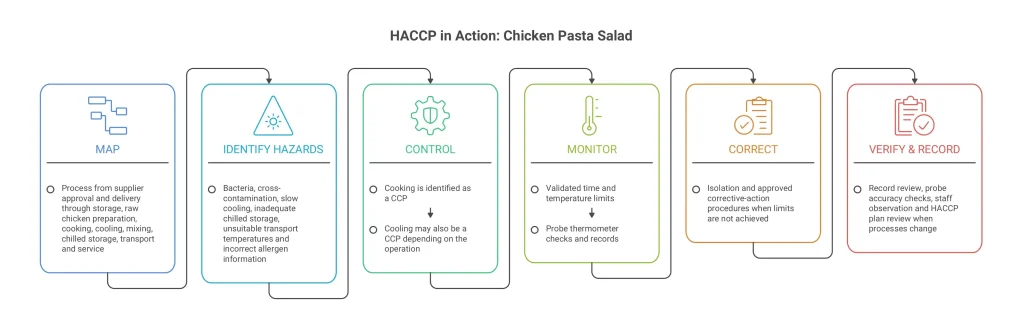
The dish contains cooked chicken, pasta, mayonnaise, vegetables and herbs. It will be prepared in advance, cooled, refrigerated, transported and displayed at the venue.
This example helps demonstrate what are the seven principles of haccp in food preparation and service because each stage requires businesses to identify hazards, introduce controls, monitor results and take action when necessary.
Mapping the process
To arrange the 7 principles of haccp in process order, the business first creates a clear understanding of the complete food journey.
The business maps the following stages:
Supplier approval → Delivery → Chilled and dry storage → Raw chicken preparation → Cooking → Cooling → Preparation of other ingredients → Mixing → Chilled storage → Transport → Display and service
The flow diagram is checked in the kitchen to confirm that it reflects actual working practices and that no important stage has been overlooked.
A HACCP plan must represent what happens in reality. If the process changes, the 7 Principles of HACCP require the business to review whether new hazards or controls need to be considered.
Conducting the hazard analysis
The first stage of the 7 Principles of HACCP involves identifying hazards that could affect food safety.
The HACCP team identifies harmful bacteria in raw chicken as a biological hazard. It also identifies the risk of cross-contamination between raw chicken and ready-to-eat vegetables.
Further hazards may include:
- Bacterial growth caused by slow cooling
- Contamination during mixing
- Inadequate chilled storage
- Unsuitable transport temperatures
- Incorrect allergen information for ingredients used in mayonnaise or pasta products
This hazard analysis shows why the 7 Principles of HACCP begin with prevention. Businesses must understand what could go wrong before deciding how hazards will be controlled.
Selecting controls and CCPs
After identifying hazards, the business determines where control is essential.
Supplier approval and delivery checks help control incoming ingredients. Separate raw-food equipment, effective handwashing and cleaning procedures help reduce cross-contamination.
Cooking is identified as a Critical Control Point (CCP) because it must reduce harmful bacteria in the chicken to a safe level.
Cooling may also be selected as a CCP because cooked chicken must pass through temperature ranges that allow bacterial growth without remaining there for an unsafe period.
Chilled storage and transport are evaluated according to the business’s specific process. Depending on the operation, these stages may be managed as CCPs or controlled through established prerequisite temperature procedures.
Understanding the relationship between hazards, CCPs and controls is essential when explaining what are the seven principles of haccp in food preparation and service, because every decision must be based on the actual risks of the operation.
Establishing limits and monitoring
The business establishes validated time and temperature limits for cooking and cooling.
A trained cook uses a clean and disinfected probe thermometer to check representative pieces from each cooking batch. Cooling times and temperatures are recorded using the method specified in the HACCP plan.
Refrigeration is checked before the completed dish is stored. Transport vehicles or insulated containers are prepared and checked before loading.
Within the 7 Principles of HACCP, monitoring provides evidence that controls remain effective and allows staff to identify problems before unsafe food reaches consumers.
Correcting failures
A key part of the 7 Principles of HACCP is having planned corrective actions when controls fail.
If the chicken does not reach the cooking limit, it is cooked further and rechecked where the approved procedure allows.
If cooling exceeds the permitted limit, the batch is isolated. A supervisor assesses whether the food can be safely recovered or whether it must be disposed of.
If refrigeration fails before transport, the food is moved to suitable storage and the exposure time is assessed. The faulty equipment is reported and investigated.
Verification and records
Verification confirms that the HACCP system continues to work effectively.
The catering manager reviews records after each event. Probe accuracy is checked, and staff are observed carrying out required procedures.
If the company begins producing larger quantities, changes transport containers or extends display times, the HACCP plan must be reviewed.
This demonstrates why the 7 Principles of HACCP must operate together. Identifying cooking as a CCP provides limited protection without an appropriate critical limit. A critical limit provides little protection without monitoring. Monitoring cannot protect consumers unless staff take corrective action when results show a loss of control.
Why These Principles Matter in the UK Food Industry
Understanding why the 7 principles of haccp are important helps explain why HACCP remains a fundamental approach to food-safety management across the UK.
The importance of HACCP can be understood through four main ideas:
Prevention
The 7 Principles of HACCP focus on preventing unsafe food rather than relying only on testing the final product.
Final product testing has limitations. A sample may not represent the entire batch, and results may only become available after food has already been distributed. Preventive controls operate during preparation and production, where risks can be controlled more effectively.
Consistency
A documented HACCP system creates clear expectations for employees.
Without defined limits and responsibilities, one chef may judge food safety by appearance while another uses a thermometer. One supervisor may reject a delivery while another accepts the same condition.
The 7 Principles of HACCP reduce this inconsistency by creating agreed procedures, measurable standards and clear decision points.
Accountability
Records created through the 7 Principles of HACCP show what checks were completed, who carried them out and what actions followed.
This evidence supports internal management and may be reviewed during inspections, audits or investigations. It also helps businesses demonstrate how food was handled if a complaint or food-safety concern occurs.
Continuous improvement
Monitoring, corrective-action and verification records provide valuable information.
A business can identify repeated equipment failures, unsuitable procedures, supplier issues and training gaps. The HACCP plan can then be improved before the same problem develops into a more serious food-safety incident.
HACCP-Based Systems Across the UK
The 7 Principles of HACCP provide the foundation for food-safety management systems used throughout the UK. Food businesses must operate suitable food-safety arrangements, although practical guidance differs between nations.
Small businesses in England and Wales may use Safer Food, Better Business. Catering businesses in Scotland can use CookSafe, while Northern Irish businesses may use Safe Catering.
These resources help businesses apply HACCP principles through practical procedures, diaries, house rules and records. Larger or more complex operations may require a fully customised HACCP plan supported by technical expertise.
Management responsibility
The success of the 7 Principles of HACCP depends on effective management involvement.
HACCP cannot succeed through paperwork alone. Managers must provide suitable premises, maintained equipment, adequate staffing, appropriate training and sufficient time for employees to complete safety checks correctly.
Staff must also feel able to report problems honestly. A workplace culture that rewards speed while ignoring unsafe results can weaken even a technically accurate HACCP system.
Strong leadership ensures that the 7 Principles of HACCP become part of everyday food preparation and service rather than simply a document created for compliance.
Fast-Track Option
People working in hospitality, catering, food production or retail may need to understand HACCP without attending an extended classroom programme.
An online course can provide a fast-track introduction to the 7 Principles of HACCP, including hazard analysis, Critical Control Points (CCPs), critical limits, monitoring, corrective actions, verification and record-keeping.
Understanding HACCP training also helps learners see how to arrange the 7 principles of haccp in process order, from identifying hazards through to maintaining records that demonstrate effective control.
This type of training can be useful for:
- New food-business owners
- Chefs and kitchen staff
- Catering supervisors
- Production employees
- Hospitality managers
- Quality-assurance assistants
- Warehouse and distribution staff
- People seeking employment in the food industry
The depth of training should match the employee’s responsibilities.
A person following an established cooking check may only need practical instruction on the workplace procedure, equipment and recording requirements. A manager responsible for creating, reviewing or maintaining a HACCP plan requires broader knowledge and may need more detailed training or specialist support.
A short online course should not be presented as proof that someone can independently design a complex HACCP system for every type of food operation. The 7 Principles of HACCP must always be adapted to the specific products, processes, equipment and customer groups of each business.
Learners should also examine course terminology carefully. A course described as “Level 3” is not automatically an Ofqual-regulated Level 3 qualification. Where formal regulated status is claimed, the provider should clearly identify the awarding organisation and qualification number.
Learn HACCP Online with CPD-IQ Accredited Courses
Jobsland operates as a course marketplace and currently lists a range of HACCP and food-safety programmes from different learning providers.
One current listing, the HACCP Training Masterclass, describes six hours of online study, lifetime access, tutor support, included assessment and PDF and hard-copy certificates. The course covers HACCP fundamentals, hazard analysis, CCPs, risk control, monitoring, verification and practical case studies.
The course description states that it does not provide a formal qualification. Learners should therefore understand the certificate according to the information provided and should not present it as a regulated award or professional licence.
Jobsland also lists longer HACCP and food-safety bundles from third-party providers. For example, some refresher packages combine food hygiene, hospitality, food safety and HACCP learning, with certificates issued for completed course components. These listings also state when a programme does not provide a formal qualification.
CPD-IQ accredited courses can be useful for recording continuing professional development, refreshing existing knowledge and demonstrating completion of structured learning. However, CPD accreditation and regulated qualification status are different forms of recognition.
When selecting HACCP training related to the 7 Principles of HACCP, learners should check:
- The name of the learning provider
- The exact course syllabus
- Stated study hours
- Assessment method
- Tutor support available
- CPD status
- Certificate wording
- Whether the certificate is included
- Whether a regulated awarding organisation is named
- Whether the course meets employer requirements
Course details, availability and prices can change, so learners should review the current information at the time of enrolment.
Online training should also be followed by workplace-specific instruction. A generic course cannot identify which probe thermometer should be used in a particular kitchen, where records are stored, who is responsible for checks or who has authority to dispose of a failed batch.
Used correctly, an online HACCP course can provide a valuable foundation. It may help beginners understand what are the seven principles of haccp in food preparation and service, prepare employees for additional responsibility or highlight areas where more advanced training is required.
Conclusion: Turning Knowledge into Compliance
The 7 Principles of HACCP transform food safety from a collection of general intentions into a structured control process.
To understand what are the seven principles of haccp in food preparation and service, businesses must recognise how each principle supports the next stage of the system.
Hazard analysis identifies what could make food unsafe. Critical Control Points show where control is essential. Critical limits define the boundary between acceptable and unacceptable conditions.
Monitoring confirms whether those limits are being achieved. Corrective actions protect consumers when control is lost. Verification confirms whether the HACCP system remains effective, and documentation provides evidence of what the business has done.
The 7 Principles of HACCP must always be applied together. Removing one element creates a weakness in the system.
A critical limit without monitoring is only a written standard. Monitoring without corrective action identifies a failure but does not resolve the problem. Records without verification may preserve inaccurate information rather than demonstrate genuine control.
For food businesses, the real objective is not simply completing a HACCP document. The goal is to create a practical system that employees understand and follow during everyday operations.
Training provides essential knowledge, but effective compliance depends on practical application, responsible management, competent staff and regular review.
A successful HACCP system changes as products, processes, equipment and risks change. By applying the 7 Principles of HACCP consistently and reviewing them regularly, food businesses can maintain safer practices and protect consumers.
FAQs
1. What is HACCP, and why is it important?
HACCP stands for Hazard Analysis and Critical Control Point. It is a preventive food-safety management system used to identify significant hazards and control them at important stages of food production, preparation, storage and service.
The 7 Principles of HACCP provide the structure businesses use to identify risks, establish controls and maintain safe practices.
HACCP is important because unsafe food cannot always be identified through appearance, smell or final product testing. The system focuses on preventing hazards before food reaches the consumer rather than relying only on detecting problems afterwards.
2. Is HACCP a legal requirement in the UK?
UK food businesses are generally required to implement and maintain food-safety management procedures based on HACCP principles.
The exact approach should be suitable for the size, complexity and risk level of the business. A small café may use simplified official guidance, while a food manufacturer may require detailed product-specific HACCP plans, technical validation and extensive records.
Applying the 7 Principles of HACCP allows businesses to create food-safety systems that match their actual processes rather than using a generic approach.
3. Who should complete HACCP training?
HACCP training is relevant for food-business owners, chefs, kitchen managers, production supervisors, quality personnel, auditors and anyone responsible for maintaining food-safety procedures.
Food handlers who are not responsible for designing the HACCP system still require appropriate training and supervision. They need to understand the controls, monitoring procedures and corrective actions connected to their own tasks.
Understanding the 7 Principles of HACCP helps employees recognise why specific checks are required and how their actions contribute to food safety.
4. What are the seven principles of HACCP?
The 7 Principles of HACCP are:
- Conducting a hazard analysis
- Determining Critical Control Points (CCPs)
- Establishing critical limits
- Establishing monitoring procedures
- Establishing corrective actions
- Establishing verification procedures
- Establishing documentation and record-keeping procedures
For readers searching “what are the 7 principles of HACCP and explain each”, the key point is that these principles form a connected food-safety system. They are not separate rules but stages that work together to identify hazards, control risks and demonstrate effective management.
5. How long does a Level 3 Food Hygiene or HACCP course take?
The duration varies depending on the course provider, content and assessment requirements.
A short online programme may take several hours, while a broader training package or assessed qualification may require several days or weeks.
Learners should compare the actual syllabus, learning hours and assessment requirements rather than relying only on the phrase “Level 3”. A course title alone does not confirm whether a qualification is formally regulated.
6. What qualification will I receive after completing the course?
The outcome depends on the type of course and provider.
A learner may receive:
- A provider-issued completion certificate
- A CPD-accredited certificate
- A regulated qualification
These outcomes are different and should not be confused.
Before enrolling, learners should check the awarding organisation, qualification details, assessment method and certificate wording. If a course states “No Formal Qualifications”, the certificate should not be presented as a regulated qualification.
A clear understanding of certification is an important part of choosing suitable HACCP training alongside learning the 7 Principles of HACCP.
7. What careers can I pursue after HACCP training?
HACCP knowledge is useful across many food-related sectors, including restaurants, catering businesses, hotels, food factories, warehouses, care homes, schools, supermarkets and food-distribution operations.
It may support progression towards roles such as:
- Kitchen supervisor
- Catering manager
- Production team leader
- Quality-assurance assistant
- Food-safety coordinator
- Hygiene supervisor
Training alone does not guarantee a specific position. Employers also consider practical experience, technical competence and knowledge of the particular food operation.
Knowledge of the 7 Principles of HACCP can strengthen an employee’s understanding of how professional food-safety systems operate.
8. Can I study HACCP training online?
Yes. Online HACCP courses are widely available and can provide flexible learning on hazards, risk controls, CCPs, monitoring procedures and record-keeping.
However, online learning should be supported by workplace-specific instruction. Employees must understand the exact critical limits, monitoring methods and corrective actions used by their employer.
The 7 Principles of HACCP must always be applied to the actual workplace because hazards and controls vary between different food businesses.
9. How often should I renew my HACCP training?
There is no single universal renewal period that applies to every HACCP course.
Employers should review staff competence regularly and provide refresher training when responsibilities, equipment, recipes or procedures change.
Additional training may also be required after:
- A food-safety incident
- An inspection concern
- Repeated monitoring failures
- A long absence from food-related work
- Significant changes to the HACCP system
Some employers, customers or certification schemes may set their own refresher requirements.
What are 3 of the 7 principles of HACCP?
Three of the 7 Principles of HACCP are:
- Conducting a hazard analysis
- Identifying Critical Control Points (CCPs)
- Establishing critical limits
These are the first three stages of the system, but they do not create a complete HACCP programme on their own.
Monitoring, corrective action, verification and documentation must also be implemented to ensure that hazards remain under control.
What are the seven principles of HACCP in food preparation and service?
The 7 Principles of HACCP in food preparation and service involve identifying hazards within kitchen or service operations, deciding where control is essential, establishing measurable safety limits and checking that those limits are achieved.
Businesses must also have procedures for responding when controls fail, reviewing whether the system remains effective and maintaining appropriate records.
This approach helps restaurants, caterers and other food businesses create consistent procedures that protect consumers.
Why are the 7 principles of HACCP important?
The 7 Principles of HACCP are important because they help businesses prevent foodborne illness, establish consistent working practices and demonstrate how food-safety risks are controlled.
They also help managers identify recurring problems and improve operations through monitoring results, corrective-action records and verification activities.
A successful HACCP system is not simply a document. It is a practical process that requires trained employees, effective management and regular review to remain effective.